

Choosing an arch window covering starts with two questions: does it fit the curve, and do you need it to open? Those answers matter more than fabric color or voice control, particularly when the window sits above a doorway or out of easy reach.
A fitted shade can preserve the outline, while curtains can cover the entire opening. Neither approach suits every room. Before ordering, consider where unwanted light enters, how much of the glass you want exposed, and how you will operate and maintain the treatment.
Quick takeaway: The right arch window covering depends on shape, privacy, and whether the curved section needs to open. Compare fitted shades, custom shutters, and curtains above the arch. For high windows, consider specialty motorization, then verify mounting clearance, charging access, and the exact smart-home connection requirements.
Which Arch Window Covering Suits Your Window?
Cellular and pleated arch shades
Cellular shades use a honeycomb structure, while pleated shades have folded fabric without the same enclosed cells. Start by checking the actual operating design: an attractive fitted treatment may stay permanently across the glass.
Hunter Douglas notes that many cellular arch options are stationary. An adjustable design therefore needs explicit confirmation; a product-family photograph is insufficient evidence. Arched-window treatment guide
For an arch window covering in a living room, decide whether softened daylight throughout the day is enough or whether you want an unobstructed view at times. Ask to see the fully open and fully closed positions before choosing fabric.
Custom arched shutters
Shutters offer a more architectural appearance. Depending on the design, louvers can adjust incoming light, but louver movement and opening the entire shutter panel are different functions.
Confirm both. If the window opens inward, ask whether the shutter frame or panels will interfere with it. Include handles and any existing screens in that discussion.
Curtains mounted above the arch
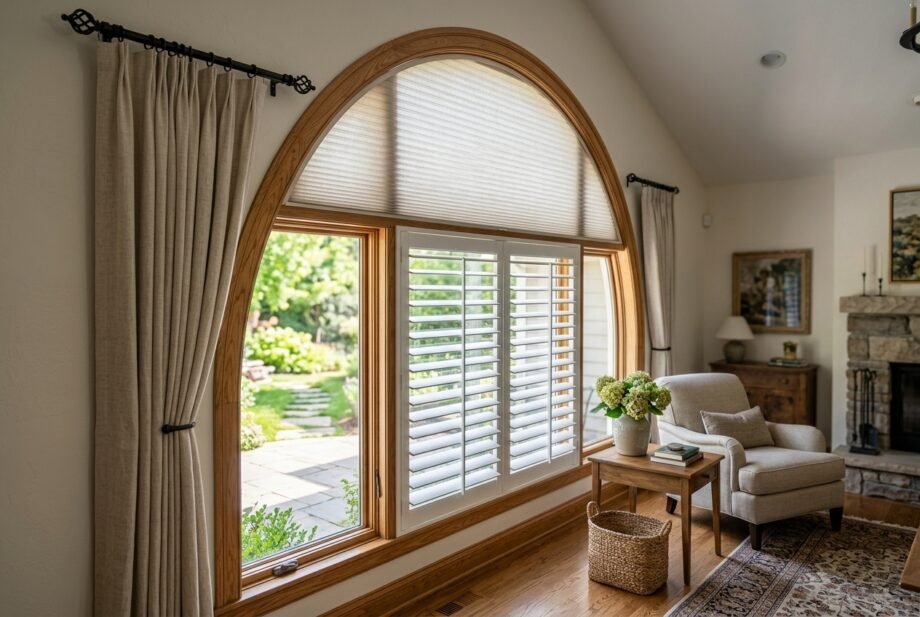
Curtains on a straight rod above the curve can cover the whole window. This approach needs room for secure mounting and somewhere for the open curtains to gather.
Consider how much glass the gathered fabric will obscure. For a narrow wall between windows, the available space may determine the result more than the curtain style.
A fixed arch with a separate lower shade
On a window with a rectangular lower section, separate treatments let you operate the lower shade independently. The upper section still needs its own light-control decision.
This arch window covering arrangement deserves particular attention in bedrooms: closing the lower shade does not address sunlight entering through an uncovered arch.
| Option | Typical operation | Main appeal | Verify before buying |
| Cellular arch shade | Fixed or operable, by model | Fitted fabric treatment | Actual movement and parked fabric |
| Pleated arch shade | Often stationary | Simple coverage | Shape limits and attachment |
| Custom shutters | Design-dependent louvers and panels | Architectural appearance | Panel clearance and light adjustment |
| Curtains above arch | Fabric draws sideways | Whole-opening coverage | Rod height and gathering space |
| Specialty motorized shade | Motor-driven movement | Easier daily access | Shape, power, and controls |
Choose the Right Light Control and Privacy
Light-filtering versus blackout fabric
Choose your arch window covering around the room’s hardest lighting problem. Is it morning sun above the bed, glare on a monitor, or a direct view from neighboring windows?
Request samples and assess them against the glass. Check privacy after dark with the room lights on; daytime appearance alone does not tell you enough about visibility from outside.
For a workspace, filtering harsh light may be preferable to darkening the entire room. For a bedroom, judge the complete installed treatment rather than relying on the fabric’s label.
Fabric opacity versus perimeter light gaps
Blackout fabric addresses light passing through the material. Ask separately about light around the perimeter, mounting hardware, and any junction between upper and lower treatments.
Before ordering an arch window covering for sleep, request details of expected gaps and compatible ways to reduce them. Avoid improvised strips that obstruct a moving shade.
If heat is the main concern, ask for relevant product performance information. Do not assume the darkest fabric offers the best thermal performance or that a particular electricity saving is guaranteed.
How to Measure for an Arch Window Covering
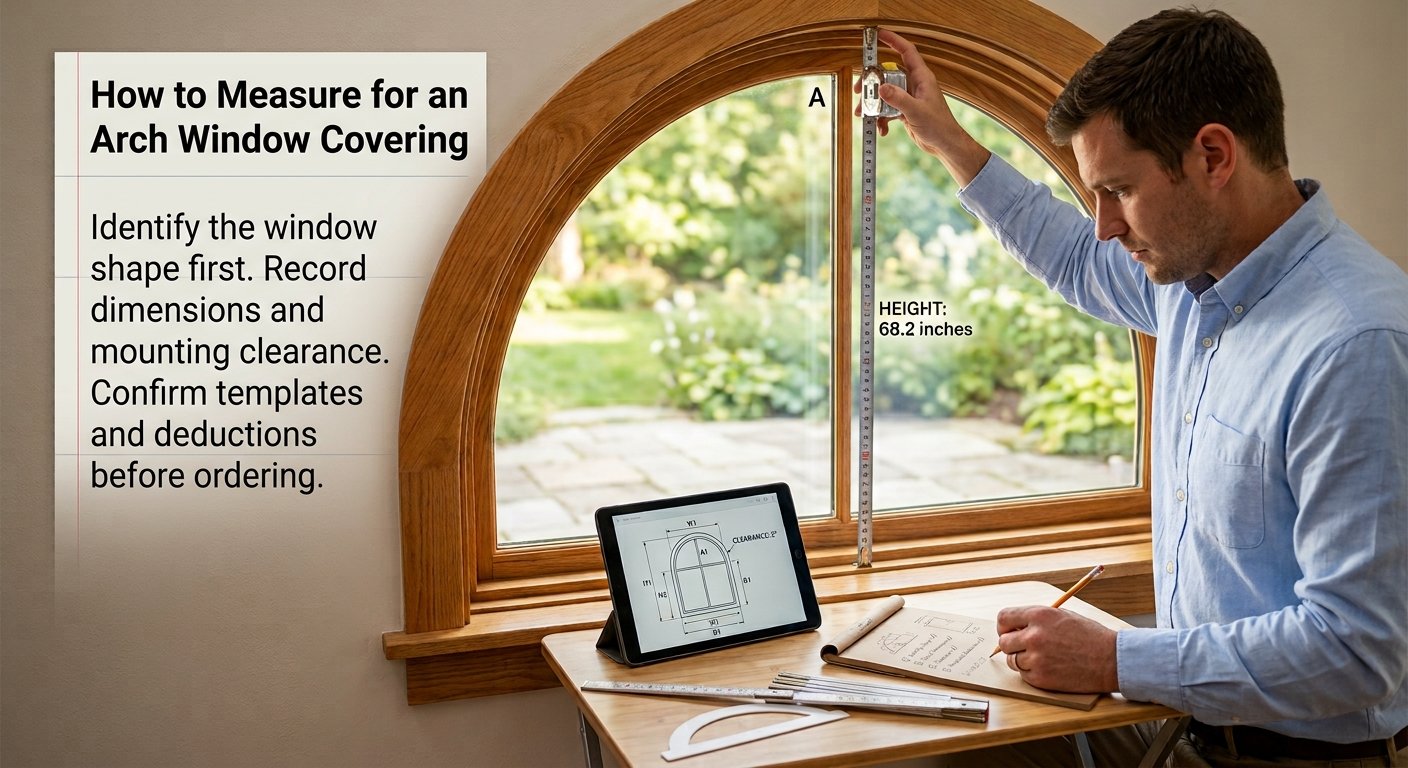
Identify the window shape first
A semicircular opening has a curved section whose height is half its base width. A shallow eyebrow arch or a tall window with an arched top requires a different description.
Bali’s specialty-shape guide distinguishes perfect arches from non-perfect arches and requires templates for certain shapes. Use the current guide for the product you intend to order. Bali specialty-shape measuring guide
Photograph the whole opening and its surrounding trim. A close-up of the curve alone may hide obstructions or a missing mounting surface.
Record dimensions and mounting clearance
For an arch window covering, prepare the measurements the supplier requests:
- Width at the specified reference point.
- Arch height and total opening height, where applicable.
- Usable mounting depth.
- Clearance around handles, screens, trim, and hinges.
- Available space for rails, brackets, and gathered fabric.
Label each window separately, even if two openings look identical. Measure the actual mounting location rather than assuming the visible glass dimensions are the order dimensions.
Confirm templates and deductions before ordering
Do not subtract an arbitrary allowance. Ask whether the supplier makes fitting deductions and whether it needs opening dimensions or finished treatment dimensions.
An arch window covering made to incorrect measurements can be difficult to return. Before payment, confirm the approved shape, mounting method, dimensions, and terms covering measurement errors. For a high or irregular opening, professional measurement may prevent an expensive remake.
Can an Arch Window Covering Be Motorized?
Confirm what the motor actually moves
Yes, specialty motorized designs exist. Graywind lists custom motorized arch cellular shades with a Zigbee motor, compatible Alexa connectivity, and Google Home support through a hub. Confirm the configuration before purchase. Motorized arch shade specifications
Ask whether the arch itself moves, whether only a lower rectangular shade moves, and where the fabric rests when open. A motorized arch window covering should be evaluated through its complete travel, not just a photograph of the closed position.
Alexa and Google Home
Check the exact motor and bridge combination. “Works with Alexa” does not establish that your existing speaker provides the necessary connection. Ask about open/close commands, percentage positioning, and routines separately.
Apple Home, Matter, Zigbee, and Z-Wave
These labels describe different parts of a setup. Use this checklist when assessing an arch window covering:
| Platform or standard | What to confirm |
| Apple Home / HomeKit | Explicit support for the selected product or supported bridge |
| Matter | Certification and the connection method of the exact configuration |
| Zigbee | A compatible hub and support for the shade’s functions |
| Z-Wave | A Z-Wave motor/controller, compatible hub, and correct regional version |
Matter is an IP-based interoperability standard; a Zigbee label alone does not establish Matter compatibility. Connectivity Standards Alliance
For a Thread-based Matter accessory, check Apple’s current Thread requirements. For Z-Wave, verify the region before importing equipment. Apple Thread setup guidance, Z-Wave regional information
Remote control, offline operation, and accounts
Ask which functions depend on the internet: handheld control, schedules, voice commands, and remote app access may behave differently. Check account requirements and household access permissions too. Do not assume undocumented offline behavior.
Installation and Everyday Setup
Plan access before mounting the treatment. If reaching the battery requires awkward ladder placement, resolve that before the brackets are fixed.
- Check the delivery. Match the dimensions, motor, fabric, brackets, and accessories to the approved order. Locate the instructions for that configuration.
- Prepare the power arrangement. Charge the battery if instructed. Confirm cable routing, socket access, and clearance for a charging connector.
- Mount the hardware. Follow the specified bracket positions and use fixings appropriate to the mounting surface. Keep cables clear of moving parts.
- Test physical operation. Watch a complete opening and closing cycle. Stop if fabric catches, the rail twists, or the motor strains.
- Test the supplied controller. Confirm direction and stopping positions. Set travel limits only if the instructions require it.
- Connect smart controls. Pair the correct hub or bridge, assign a clear room name, and check supported commands.
- Create one routine. Start with evening privacy, then check it over several days before adding more conditions.
For example, schedule the arch window covering to close before the room becomes visible from outside. Adjust the timing seasonally, or use a supported sunset trigger.
Keep a usable physical controller accessible to other household members. If the installation involves mains wiring, have a qualified electrician handle it; do not adapt a USB or battery motor to mains power.
Troubleshooting Common Problems
Diagnose problems in layers: power, physical movement, supplied controls, smart connection, then automation. This makes it easier to identify where a command stops working.
| Symptom | First checks | Next action |
| No movement | Battery, power connection, visible obstruction | Try the documented local control; contact support if unresponsive |
| Remote works, app fails | Hub power, network status, correct account | Review the specific integration and pairing instructions |
| Uneven or incomplete movement | Obstructions, clearance, mounting alignment | Use documented adjustments; avoid forcing the fabric |
| Light enters at edges | Ordered size, installed position, expected gaps | Ask about approved coverage improvements |
| Frequent charging | Usage, complete charging, panel exposure if fitted | Compare with the product’s charging guidance |
Do not begin with a factory reset. It may remove pairing or settings while leaving a physical obstruction unresolved. Record the model, symptom, and controller behavior first.
If an arch window covering responds manually but misses a schedule, check time zone, routine conditions, and competing automations. Test a simple timed command before rebuilding the routine.
Solar charging also needs realistic expectations. Graywind describes its optional panel as supplemental and explicitly says manual USB charging may still be necessary. Preserve charging access even if you add a panel. Charging and adjustment guidance
Frequently Asked Questions
What is the best covering for an arched window?
The best arch window covering meets your shape, movement, and light-control requirements. Compare fitted shades if preserving the curve matters, shutters if you prefer an architectural treatment, and curtains if you want whole-opening coverage. For a high window that needs frequent adjustment, investigate specialty motorization. Confirm the open position and maintenance access before deciding; neither appearance nor an automation logo tells you how the treatment will work in your room.
How do you cover an arched window for blackout?
Choose opaque material and evaluate the entire opening, including the curved top and the junction with any lower shade. Ask about perimeter gaps before ordering. Where mounting space permits, a properly sized curtain treatment above the arch may provide an additional layer. Request samples and installation details rather than assuming a “blackout” label guarantees complete darkness. Also consider other windows and doors that admit light into the room.
Can arched window shades open and close?
Some can; others remain fixed. A stationary arch window covering stays across the glass, while an operable model has a mechanism designed to move its fabric or components. Ask the seller to demonstrate both endpoints and explain any remaining obstruction. Also distinguish adjustable shutter louvers from opening an entire shutter panel. If your window opens for ventilation, confirm that the treatment permits the access and movement you need.
How do you measure an arched window for a shade?
Identify the shape, then follow the chosen product’s measuring guide. Record the requested width, height, depth, and obstruction clearances, and supply a template if required. Do not assume an eyebrow arch follows semicircular dimensions or that two neighboring windows match. Confirm whether measurements describe the opening or finished shade. Keep the supplier’s written approval with your order, especially for irregular shapes or installations where correction would be difficult.
Can you motorize an arched window shade?
Yes, but select a mechanism designed for the specific geometry. A motorized arch window covering is not automatically compatible with a retrofit motor intended for a conventional roller shade. Confirm the moving section, supported dimensions, power arrangement, and operating controls. Then verify any app or voice integration for the exact configuration. Ask about access for charging, replacement parts, and what operation remains available if the internet connection is lost.
Final Verdict and Long-Term Care
Choose an arch window covering in this order: correct fit, required movement, light control, then automation. A smart motor is useful only when the underlying treatment suits the opening and your daily needs.
Before ordering, obtain written confirmation of dimensions, mounting clearance, controls, and the open position. Keep those details with the model number and installation guide.
Dust according to the fabric-care instructions, watch for developing snags, and maintain charging access. Recheck schedules as daylight changes. If movement becomes uneven or noisy, stop and investigate before repeated operation turns a minor obstruction into damage.
Disclaimer: Fit, controls, and installation requirements vary by product. Follow the selected manufacturer’s instructions and confirm compatibility before ordering. Use qualified help for mains wiring and any installation that cannot be reached safely.