

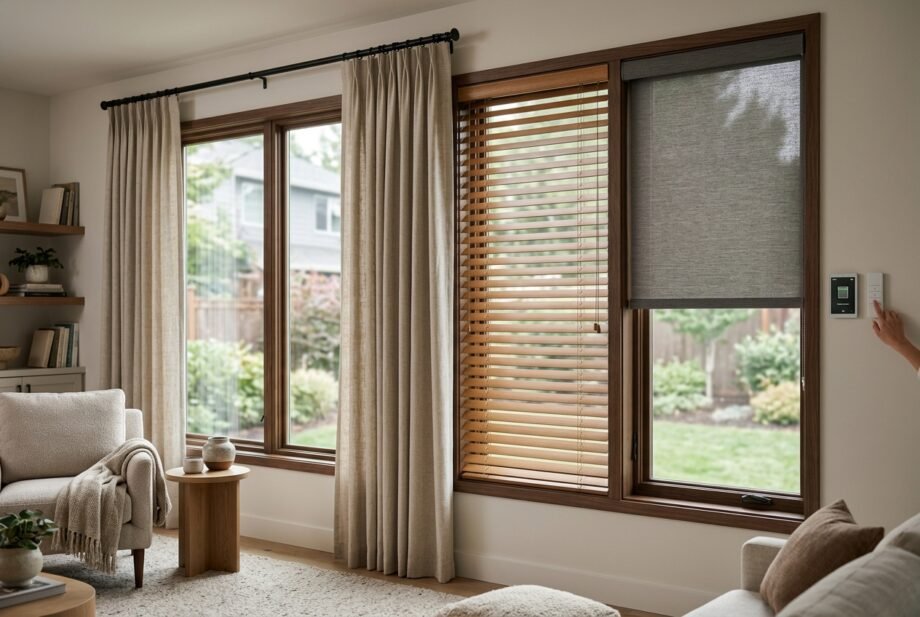
The best window covering ideas solve the problem you notice every day: a bedroom that gets bright too early, a living room exposed to neighbors, or sunlight washing out your monitor. The right choice should also suit the room’s proportions and feel comfortable to use.
Start with privacy, light, and fit. Then decide whether motorization makes daily life easier enough to justify its cost.
Quick Takeaways
Choose window covering ideas around each room’s privacy, daylight, and installation needs. Layer curtains for flexible coverage, consider cellular shades for insulation, and assess blackout options for bedrooms. Add smart controls where schedules or difficult access help, checking power, compatibility, and offline operation before buying.
Window Covering Ideas for Different Rooms
1. Layer Sheer Curtains With Opaque Drapes
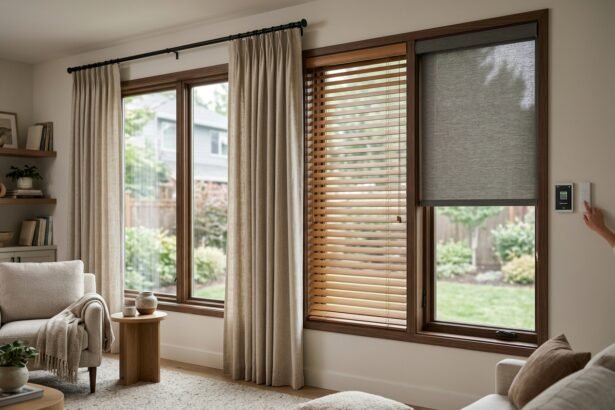
For living rooms, combining sheer panels with opaque drapes offers two useful settings: softened daylight and fuller coverage after dark. Warm white sheers with textured oatmeal curtains create a quiet backdrop; deeper drapes can echo a rug or accent chair.
These window covering ideas work best when both layers move independently. Allow enough rod or track width for the curtains to stack beside the glass. Sheers alone should not be relied on for nighttime privacy.
Automating the heavier layer can be useful for large windows, while the sheers remain manually operated.
2. Choose Blackout Roller Shades for Bedrooms
A blackout roller shade keeps the window visually simple and can disappear behind a decorative curtain when raised. Choose a fabric color that blends with the wall if you want the covering to recede.
For bedroom window covering ideas, distinguish blackout fabric from a blackout installation. Light can still enter around the edges. Manufacturer-approved side channels, adequate outside-mount overlap, or an additional curtain may improve coverage.
A scheduled morning opening can be convenient, but consider a partner’s sleeping hours before linking every bedroom shade to one routine.
3. Use Cellular Shades for Insulation-Focused Rooms
Cellular shades contain honeycomb-shaped pockets that trap air. They deserve consideration when a window area feels uncomfortable in hot or cold weather, with fabric choices that prioritize filtered light or darkness.
Among window covering ideas, this option offers a useful connection between appearance and thermal comfort. However, results depend on the product, installation, climate, and operation. PNNL’s window-attachment guidance explains why different coverings perform differently.
Motorization can help maintain a useful schedule, but the motor itself does not provide insulation. Avoid assuming that an automated shade will deliver a particular reduction in energy bills.
4. Add Roman Shades for a Softer, Tailored Look
Roman shades bring fabric into a room without floor-length curtains. A small pattern can add interest to a dining area, while a plain woven fabric suits a quieter bedroom.
Account for the folds when the shade is raised: they occupy space near the top of the window and can reduce exposed glass. Check the product’s stacked height before ordering for a short window.
If comparing window covering ideas for a kitchen, consider distance from cooking splashes and the fabric’s cleaning instructions. A beautiful material becomes frustrating if its upkeep does not match the room.
5. Try Top-Down Bottom-Up Shades for Street-Facing Windows
These shades let you cover the lower portion of a window while admitting light above it. That arrangement can help in a ground-floor room facing a sidewalk.
Test the actual sightlines. Someone in a taller neighboring building may still see through the uncovered upper glass. Privacy depends on viewing angles as well as shade position.
If these window covering ideas appeal to you, confirm the exact operating configuration before buying. A motorized version does not necessarily offer independent smart control of both edges.
6. Use Solar Shades to Manage Home-Office Glare
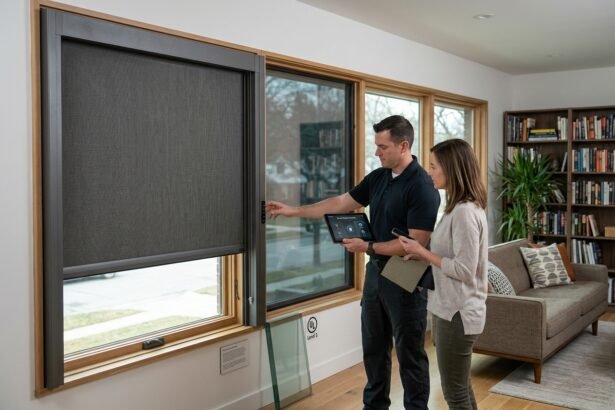
Solar shades use screening fabric to reduce direct glare while retaining some outward visibility. They can suit a desk near a bright window where keeping a connection to the outdoors matters.
Compare samples at the time of day you normally work. Fabric color and openness affect the result; the openness percentage describes the fabric’s open area, not a universal UV-protection rating.
Treat these as daytime window covering ideas unless the specific product provides the privacy you need after dark. Interior lighting can make occupants visible through screening fabric, so another layer may be necessary.
7. Consider Moisture-Suitable Faux-Wood Blinds
Faux-wood blinds offer adjustable slats and a structured appearance that can work in kitchens and bathrooms. Choose a model explicitly suitable for the room’s humidity and cleaning conditions.
Check clearance around taps, handles, and inward-opening windows. Deep slats can interfere with fixtures even when the overall blind width fits.
For automation, establish what actually moves. Some retrofit devices tilt compatible slats without raising the blind. That may be enough for daily privacy adjustments, but it will not provide an unobstructed view on command.
8. Frame the Window With Interior Shutters
Interior shutters give windows a more architectural presence. White panels can blend with trim, while a wood finish adds warmth where the material suits the environment.
These window covering ideas need an access check: open the proposed panels mentally against nearby furniture, taps, and walls. Louvers adjust light, but opening the whole panel requires clearance.
Shutters are a more permanent commitment than a curtain change. Prioritize alignment, material suitability, and comfortable manual operation; automation need not be part of every window decision.
9. Use Sliding Panels or Curtains for Patio Doors
Large doors need coverings that accommodate people moving through them. Sliding panels provide broad, clean sections, while curtains offer softer styling and flexible fabric choices.
Check how much space the covering occupies when open and whether it stacks on the convenient side. A treatment that repeatedly blocks the handle will become irritating.
For motorized tracks, verify the rated curtain weight and track arrangement. Keep the doorway usable and understand the manufacturer’s manual-operation procedure before relying on a powered system.
10. Choose No-Drill Coverings for Suitable Rental Windows
Tension-mounted shades or manufacturer-designed no-drill brackets can help where permanent fixings are restricted. Suitability depends on the frame, mounting surface, covering weight, and operating forces.
Evaluate these window covering ideas against the actual installation instructions and your tenancy requirements. “No drill” does not guarantee that a fitting cannot mark a surface or loosen in use.
Avoid adding a motor to a lightweight temporary assembly unless the manufacturer approves the combination. Secure mounting matters more than adding app control.
Check Privacy, Fit, and Budget Before You Buy
Before ordering, narrow your window covering ideas to two options and compare fabric samples in the actual room. Check them in daylight and after dark with the interior lights on.
- Measure each window separately. Follow the supplier’s instructions for recess measurements and deductions; do not subtract allowances twice.
- Check mounting depth. An inside mount needs room for the headrail, brackets, and moving parts. An outside mount needs sufficient coverage and fixing space.
- Inspect obstructions. Include handles, opening sashes, radiators, furniture, and curtain stacks.
- Calculate the complete cost. Include installation, tracks, motors, bridges, controls, and charging accessories.
- Prioritize child safety. Choose cordless coverings wherever young children may be present. Motorization alone does not establish that every accessible cord hazard has been removed. CPSC cordless guidance
For tall windows, decide how you will reach the charging connection before purchase.
Compare the Main Window Covering Options
Use this comparison to shortlist window covering ideas. Fabric and installation still determine the finished result.
| Type | Best use | Main limitation | Smart-upgrade check |
| Layered curtains | Flexible daylight and evening privacy | Requires stacking space | Track and curtain weight |
| Blackout roller | Bedroom darkness | Edge gaps | Tube fit or integrated motor |
| Cellular shade | Insulation-focused rooms | Fabric and fit affect performance | Available motor configuration |
| Solar shade | Glare with outward visibility | Nighttime privacy | Fabric choice plus motor support |
| Faux-wood blind | Adjustable slat privacy | Cleaning individual slats | Tilt-only versus lift control |
| Shutters | Fitted architectural finish | Panel-opening clearance | Usually assess manual use first |
Window Covering Ideas With Smart Controls
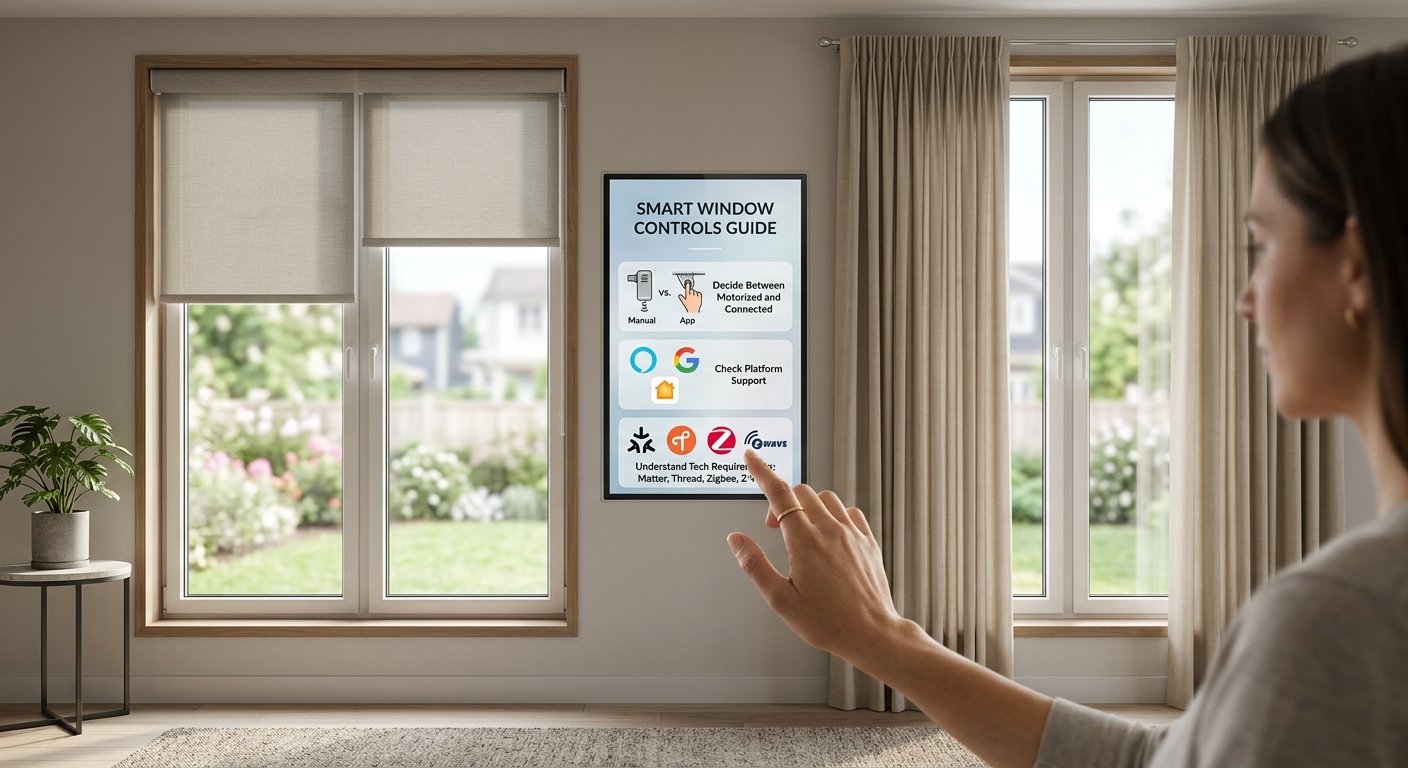
Decide Between Motorized and Connected Controls
A motorized covering may operate from a handheld remote without joining your smart home. Connected models can add schedules, scenes, and app access, depending on their hardware and integration.
The strongest smart window covering ideas solve a repeated inconvenience: reaching a high window, closing several shades each evening, or reducing predictable afternoon glare. Also check motor noise, charging access, and physical controls.
Check Alexa, Google Home, and Apple Home Support
Verify the exact motor version, required bridge, and supported ecosystem. A product family may offer different versions for different systems. Apple Home support through Matter and native HomeKit support are distinct integration routes.
Basic opening and closing does not guarantee access to every advanced feature. Confirm percentage positioning, slat tilt, schedules, and grouping separately. Check account requirements and whether remote access or voice functions depend on cloud services.
Understand Matter, Thread, Zigbee, and Z-Wave Requirements
Matter is an interoperability standard; Thread and Wi-Fi are networking technologies it can use. A Thread border router connects a Thread network to the home network. Zigbee and Z-Wave products need compatible control hardware for ecosystem integration; a suitable bridge can expose supported devices to Matter. CSA’s bridging explanation
Requirements remain product-specific. Eve’s Matter-enabled roller upgrade kit, for example, specifies a Matter controller and Thread border router. Its documented on-device schedules can run without internet access, while other automation types may depend on a hub or cloud service. Eve Motionblinds specifications
Ask where your chosen schedule runs. “Local control” does not mean every function survives a power outage, and a depleted motor battery still prevents movement.
Install and Configure a Smart Covering Step by Step
Turn your chosen window covering ideas into a working installation in this order:
- Confirm fit. Check dimensions, mounting clearance, brackets, and any retrofit motor’s tube and load requirements.
- Prepare power and controls. Charge batteries or confirm the specified power supply. Set up required control hardware before pairing.
- Mount securely. Use fixings suitable for the surface and product. Keep fabric and moving parts clear of obstructions.
- Set travel limits. Follow the manufacturer’s calibration procedure and check full opening and closing without binding.
- Pair and name the covering. Use a clear room-based name and confirm movement from the app.
- Create one schedule. Start with evening closure. Check timezone, selected days, and any competing routines.
- Test fallback operation. Check physical controls and test an internet disconnection while leaving the local network powered. Record which functions remain available.
Electrical caution: Have a qualified electrician handle mains wiring. Power must be isolated and verified dead before electrical work; a software “off” command is not isolation. Never force a stalled motor or pull the fabric unless the instructions permit it.
Troubleshoot Common Installation and Automation Problems
Start by checking whether the problem is mechanical, electrical, or related to control. If the covering moves normally from its physical control, investigate connectivity before disturbing the mounting.
| Symptom | First check | Next action |
| Stops early or closes unevenly | Obstruction, alignment, battery charge | Clear the path; recalibrate according to instructions |
| Physical control works, app fails | Hub power and network connection | Restore connectivity; follow model-specific pairing guidance |
| Schedule does not run | Timezone, selected days, disabled routine | Check where it runs and remove conflicting automations |
| Light enters around blackout shade | Edge gaps and mounting overlap | Assess suitable side channels or a second layer |
| Frequent charging | Movement frequency and mechanical resistance | Check installation and manufacturer battery guidance |
Avoid repeatedly commanding a struggling motor. Stop if it binds, overheats, or makes unusual noises, and contact the supplier. Save a factory reset for the manufacturer’s troubleshooting sequence: it can erase settings without resolving poor alignment or an unavailable hub.
Frequently Asked Questions
What Window Coverings Provide Privacy While Letting in Light?
Light-filtering shades and top-down bottom-up designs can balance daylight with coverage. The best window covering ideas depend on sightlines and fabric opacity. Check nighttime visibility with indoor lights on before trusting a sample’s daytime appearance.
What Can I Use to Cover Windows Instead of Curtains?
Consider roller, Roman, cellular, or Venetian coverings, plus interior shutters. Privacy film is another option for suitable glass, but it does not provide adjustable coverage. Check glass compatibility and how much outward visibility you would lose.
What Is the Difference Between Blackout and Room-Darkening Coverings?
Blackout generally describes a material designed to block light through the fabric; room-darkening products reduce it. Neither label alone guarantees a completely dark room. Gaps, seams, mounting, and surrounding light sources affect the result.
Can Existing Blinds Be Converted Into Smart Blinds?
Sometimes. Roller motors, curtain drivers, and tilt devices serve different mechanisms. Check dimensions, load limits, mounting, and supported movement. A compatible wireless protocol cannot compensate for a motor that does not physically fit.
Do Smart Blinds Work Without Wi-Fi or Internet?
Some use Thread, Zigbee, Z-Wave, or a dedicated remote instead of Wi-Fi. During an internet outage, physical controls or local schedules may still work. Cloud functions can fail, and continued operation requires adequate power and any necessary local hardware.
Final Verdict and Long-Term Care
The most useful window covering ideas make the room easier to live in: comfortable daylight, dependable privacy, and controls everyone can use. Choose the fabric and fit first, then automate where it removes a daily inconvenience.
Clean according to the material’s care instructions, keep tracks clear, and periodically inspect accessible brackets. Maintain battery charge and review schedules as routines and daylight change. Keep installation details, pairing information, and the manual somewhere accessible so future maintenance is straightforward.
Disclaimer: Compatibility and features vary; check current manufacturer specifications.
Follow installation instructions and use a qualified electrician for mains wiring.
Choose cordless coverings wherever young children may be present.