


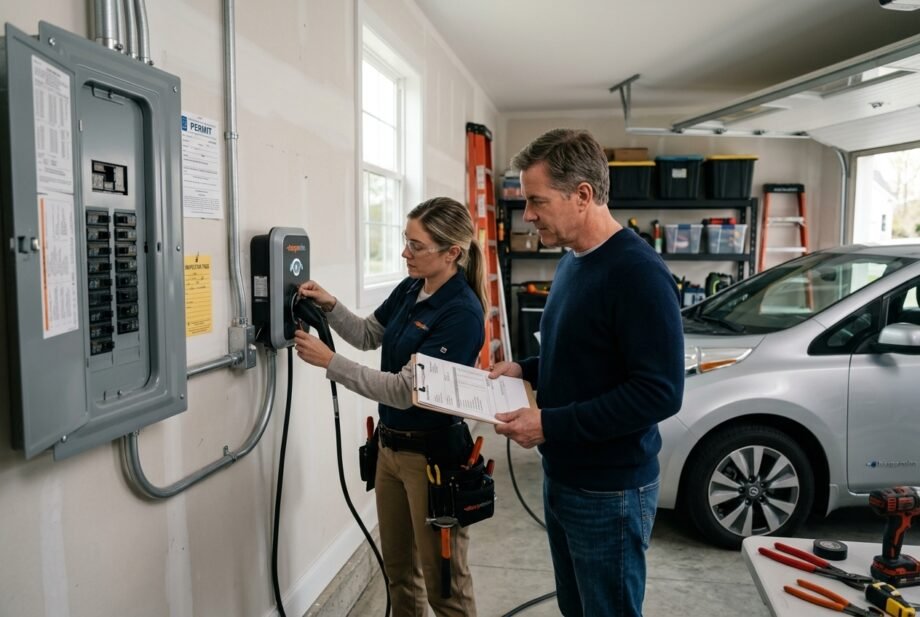
Quick answer: What is the cost of installing a home EV charger? For US budgeting, allow roughly $1,100–$3,800 for a Level 2 charger and installation, before major electrical upgrades. This combines approximately $300–$800 for equipment with $800–$3,000 for installation. Permits, trenching, or electrical service work can increase the total.
US pricing and incentive information checked September 24, 2026.
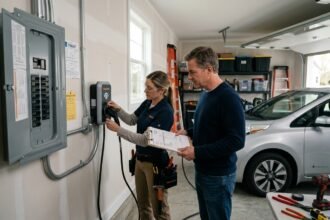
The charger on the garage wall is only one part of the purchase. Getting electricity safely from your panel to the parking space can cost considerably more than the equipment itself.
The range above is a planning allowance built from separate equipment and installation estimates, not a measured national average or a local quote. A short installation beside an accessible panel may cost less; a detached garage or service upgrade can push the project well beyond it.
Before choosing equipment, establish what your home needs and what each electrician includes.
Home EV Charger Installation Cost Breakdown
A useful estimate separates the charging station from the work needed to power it. EnergySage currently reports installation at $800–$3,000 before equipment, illustrating why an advertised installation price should not automatically become your complete budget.
| Budget item | Planning allowance or treatment | What to confirm |
| Level 2 charging equipment | Approximately $300–$800 for the equipment allowance used here | Exact model, vehicle connector, and included accessories |
| Electrical installation | Approximately $800–$3,000 | Labor, materials, wiring route, mounting, and testing |
| Equipment plus installation | Approximately $1,100–$3,800 | A combined allowance before major additional work |
| Permits and inspections | Confirm locally; inclusion varies | Whether charges are already in the installation price |
| Panel or service upgrade | Separate quote; potentially several thousand dollars | Exactly which equipment and utility work are required |
| Trenching and surface repairs | Separate site-specific quote | Excavation, backfilling, and restoration |
| Load-management equipment | Additional hardware and installation where needed | Compatibility and complete installed price |
Do not add every row together. The combined allowance already includes equipment and electrical installation, and some installers include permits within their package.
For example, Qmerit’s explanation of installation inclusions says customers generally supply their own charging equipment. Required permit charges are added to the final estimate, while its electrical installation includes labor and materials.
Here is a simple illustrative calculation, not a customer quote: a $500 charger plus $1,200 of electrical work and a separately charged $150 permit produces a $1,850 project. If that same permit is already included in the $1,200 quote, the total is $1,700.
Ask whether sales tax, delivery, and installation accessories are included too. Small omissions are easier to resolve before approving the work than after equipment arrives.
What Makes an EV Charger Installation More Expensive?
Distance and access to the parking space
The relevant distance is the proposed wiring route, not a straight line across the floor plan. A charger near the panel may need a short, accessible run. Reaching the opposite side of the house can involve finished walls, an attic, or exterior conduit.
A detached garage adds another question: is its existing electrical supply suitable, or does the project require a new feeder and excavation? Ask who restores disturbed paving, landscaping, or interior surfaces.
Position also affects daily convenience. A cheaper mounting location is a poor choice if the charging cable cannot reach the vehicle’s port without stretching or crossing a walkway. Check the car’s parking orientation before the installer fixes the location.
Electrical capacity and the scope of upgrades
An empty breaker position does not prove the house has enough capacity for another substantial load. Equally, a 100-amp service does not automatically mean Level 2 charging is impossible.
Have an electrician assess existing demand and the proposed charging load. Ask the quote to distinguish a replacement panel, an added subpanel, and an electrical service upgrade. A subpanel can provide distribution space, but does not increase the capacity of the incoming service by itself.
Local conditions and project boundaries
Labor rates, access restrictions, permitting, and utility involvement vary. An attached garage with an accessible panel is a different project from a parking pad across a paved yard.
If an upgrade is proposed, request the reason in writing. “More breaker spaces needed” and “insufficient supply capacity” describe different problems and may call for different solutions.
Do You Need a Panel Upgrade—or Could Load Management Help?
Start with the charging rate you need, rather than the largest number printed on the charger. A suitably configured lower-output installation may replenish your daily driving without demanding the highest available capacity.
There are three approaches worth discussing with the electrician:
- Fixed charging output: The installer configures an appropriate maximum for the circuit and assessed household capacity.
- Dynamic load management: Compatible equipment monitors household demand and adjusts charging within the system’s limits.
- Electrical upgrades: Additional work provides the capacity or distribution arrangement the project requires.
Tesla’s power-management documentation distinguishes fixed limits from dynamic control. Its dynamic option requires an approved power meter purchased and installed separately.
That makes the useful comparison the complete installed price of load management against the complete upgrade price. Ask what happens when household demand rises, whether charging slows or pauses, and how the proposed equipment handles loss of its monitoring connection.
Load management does not repair damaged wiring or unsuitable equipment. It also does not guarantee that every home can avoid an upgrade.
Mention planned purchases such as a second EV or heat pump during the assessment. Paying for work twice can erase an apparent saving from considering only today’s charger.
Hardwired vs. Plug-In EV Chargers: Which Installation Makes Sense?
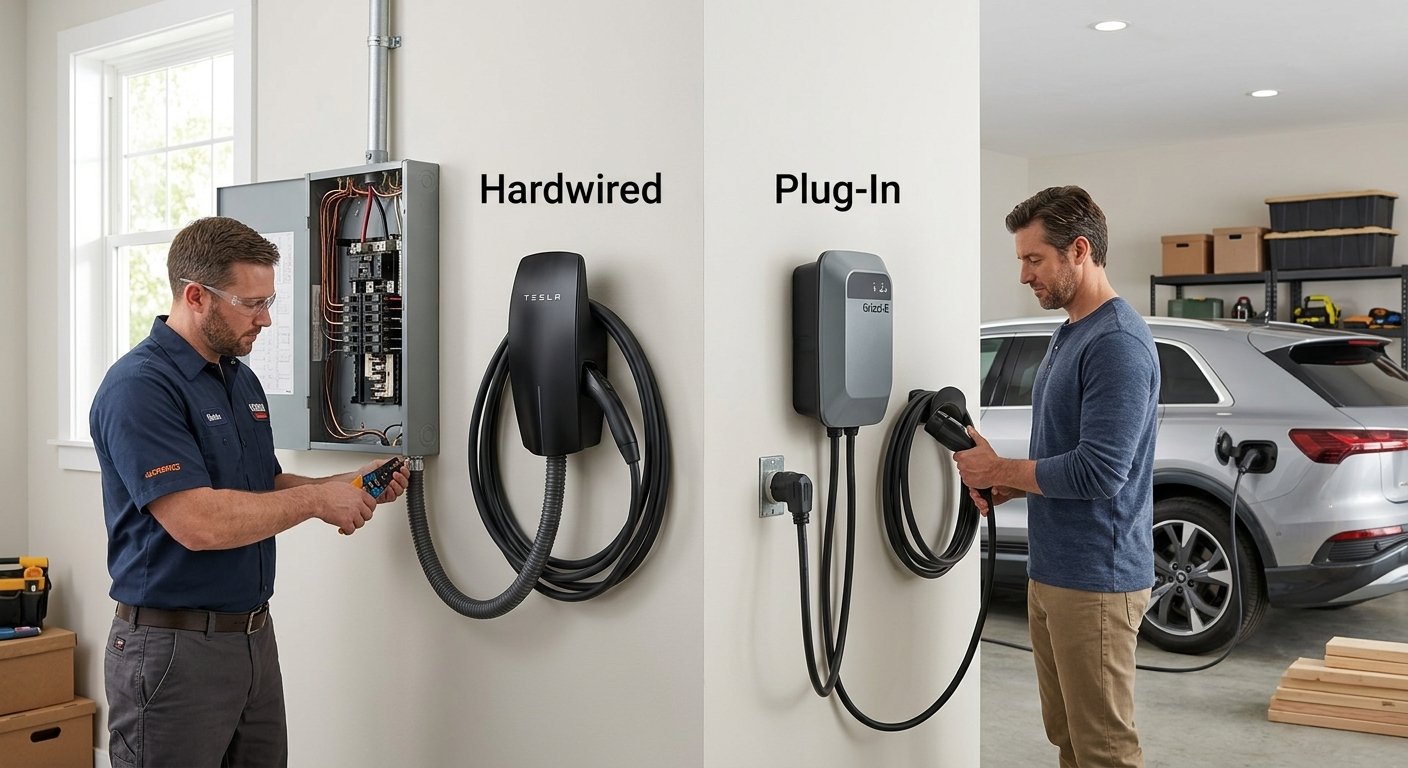
A plug-in charger connects to a compatible receptacle, such as a NEMA 14-50. A hardwired unit connects directly to the electrical circuit. Both require an installation suited to the equipment and location.
| Decision point | Plug-in installation | Hardwired installation |
| Existing infrastructure | A suitable existing circuit and receptacle may reduce new work | Requires a suitable direct electrical connection |
| Moving the equipment | Easier to remove and take with you | Disconnection and reconnection require electrical work |
| Charging output | Limited by the receptacle, circuit, and charger | May support higher output where the installation permits |
| Outdoor use | Verify the exact product and installation requirements | Often a practical option with appropriately rated equipment |
| Cost comparison | Include receptacle and required protection | Include direct connection and any circuit changes |
A new receptacle is not automatically cheaper than hardwiring. Compare both options at the same charging output.
ChargePoint notes that certain GFCI arrangements can cause nuisance tripping with Home Flex and recommends considering hardwiring where applicable. The solution must still satisfy local requirements; required protection should never be bypassed to stop a trip.
How Much Charging Speed Do You Actually Need?
Level 1 uses a suitable 120-volt supply; residential Level 2 typically uses 240 volts. Level 1 may cover modest daily driving when enough overnight charging time is available. Check whether compatible charging equipment actually comes with your vehicle.
For a simple planning example, assume you drive 40 miles daily and the vehicle uses 0.30 kWh per mile. That represents 12 kWh of battery energy to replace. At 240 volts and 16 amps, supply power is about 3.8 kW: the idealized calculation is a little over three hours, with charging losses and vehicle conditions extending the actual time.
The point is to size charging around your routine. A long commute, a less efficient vehicle, or a short overnight window changes the calculation.
Breaker rating and charging current also differ. ChargePoint specifies 32-amp charging on a 40-amp circuit or 40-amp charging on a 50-amp circuit for its applicable plug-in Home Flex installations.
The vehicle’s onboard AC charger imposes another limit. Buying a higher-output station cannot make the car accept more AC power than it supports. Have the electrician establish the permitted settings; changing an app setting does not upgrade the wiring.
Is a Smart EV Charger Worth the Extra Cost?
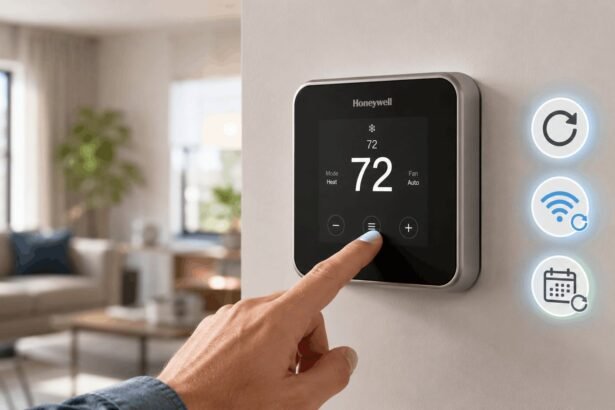
Connected features are worth evaluating individually: scheduling, energy records, remote control, and utility-program participation. Decide which you will use before paying a premium.
Check whether your vehicle already provides the scheduling function you need. Also verify connector compatibility—J1772 or NACS/J3400 as applicable—and any approved adapter requirements before ordering.
A phone app does not establish compatibility with every home platform. If you use Apple’s ecosystem, our explanation of Apple Home compatibility and hub requirements provides useful background; verify the charger’s specific integration separately.
Offline behavior is model-specific. ChargePoint documents continued charging and stored-schedule operation without Wi-Fi for the Home Flex models covered by its settings guidance. Remote functions and records may depend on connectivity.
Ask about required accounts, subscriptions, and support before buying. Check signal strength at the intended mounting point, especially in a detached garage.
How to Compare Electrician Quotes and Reduce Installation Costs
Request two or three quotes using the same proposed location, equipment, and charging output. Otherwise, the lowest bid may simply describe less work.
- Specify the equipment and vehicle. Provide the charger model, connector, cable length, and intended output. If equipment is undecided, ask for a clearly stated allowance.
- Agree on the mounting point. Confirm cable reach with the car parked normally, then discuss practical wiring routes.
- Request a capacity assessment. Ask what supports any proposed electrical upgrade and whether another suitable charging output changes the design.
- Confirm the full scope. Identify wiring, protection, permits, inspections, repairs, equipment supply, and load-management hardware.
- Clarify completion and support. Establish who handles inspection follow-up, tests operation, records the installed settings, and covers workmanship issues.
| Before accepting the quote | Confirmed? |
| Charger included or separately priced | Yes / No |
| Charging output and wiring route specified | Yes / No |
| Required permits and inspection responsibilities clear | Yes / No |
| Additional work and exclusions itemized | Yes / No |
| Commissioning and workmanship coverage explained | Yes / No |
The most useful savings often come from an accessible location and an appropriate charging rate. Avoid reducing the specification of required protection or substituting unapproved accessories.
Also separate time on site from the full project schedule. Equipment delivery, permits, utility coordination, and inspections may determine when the charger is ready, even when physical installation is straightforward. Request a realistic completion window before relying on home charging for a new vehicle.
Rebates and Electricity Costs: What Changes Your Budget?
Calculate the project price before incentives, then subtract only benefits whose eligibility you have confirmed.
Under the IRS instructions for the alternative fuel refueling property credit, equipment placed in service after June 30, 2026, does not qualify for the federal Section 30C credit. Eligible earlier installations are a separate tax-filing question.
Check your state’s and utility’s current programs before purchasing. Confirm approved models, application deadlines, any preapproval requirement, and whether enrollment in a charging program is necessary.
For running costs, multiply electricity drawn from the supply by your applicable rate. An illustrative 300 kWh monthly at $0.15/kWh costs $45, before any additional tariff charges. Use supply-side consumption so charging losses are not accidentally omitted.
Compare the whole electricity plan before switching tariffs. A lower overnight EV rate may come with different daytime prices affecting the rest of the house.
Frequently Asked Questions
How much does it cost to install a Level 2 EV charger at home?
For initial US budgeting, allow roughly $1,100–$3,800 for equipment and electrical installation using the allowances above. Treat major upgrades, excavation, and other excluded work separately. This is a planning range rather than a guaranteed price; an electrician’s assessment establishes what your property needs.
Does an EV charger installation quote include the charger?
Not necessarily. Some quotes cover electrical labor and materials while requiring you to buy the charging station. Others bundle equipment and installation. Ask for the equipment model and price, then confirm whether permits, inspections, delivery, and additional work are included before comparing the total with another offer.
Do I need to upgrade my electrical panel for an EV charger?
That depends on the electrical assessment, proposed charging output, equipment condition, and available load-management options. Neither an empty breaker slot nor the panel’s amp rating settles the question alone. Ask why an upgrade is required and whether a suitable lower-output or managed installation could meet your needs.
Is hardwiring cheaper than installing a 240-volt outlet?
Either can be cheaper, depending on existing infrastructure and the equipment requirements. A verified suitable receptacle may reduce new work. Starting from scratch, hardwiring avoids installing a receptacle and may simplify the chosen design. Compare equivalent charging output, required protection, and the same mounting location to judge the quotes fairly.
Are home EV charger rebates or tax credits still available?
State or utility assistance may be available, depending on your address and program conditions. The federal Section 30C credit does not apply to equipment placed in service after June 30, 2026. Check eligibility before buying, and keep written approvals, invoices, model details, and installation records for any program you use.
Final Takeaway: Budget for Your Home’s Actual Requirements
What is the cost of installing a home EV charger? Start with the equipment-plus-installation allowance, then establish whether your home needs additional work. A useful quote explains the charging output, wiring route, capacity assessment, and exclusions.
Choose a setup that replenishes your normal driving within the time you have available. Spend extra where it solves a demonstrated need: difficult access, suitable load management, or necessary electrical improvements. An itemized quote gives you a much stronger buying decision than a low advertised starting price.
Disclaimer: Cost allowances are estimates, not electrical designs. Use a qualified electrician for circuit installation, panel work, protection selection, and commissioning under local requirements and manufacturer instructions. Homeowner app settings must remain within the limits established for the installed equipment.