


Quick answer: The main residential smoke detector types use photoelectric or ionization sensing; dual-sensor alarms combine both. Battery-powered, hardwired, interconnected, and smart describe additional features. Compare sensing technology first, then check certification, power, compatible interconnection, and local requirements before choosing an alarm for your home.
Two alarms can look almost identical while having different sensors, power supplies, and communication features. A photoelectric alarm, for example, might also be hardwired, wirelessly interconnected, and connected to an app. Those labels answer different questions.
Understanding smoke detector types helps you read beyond the packaging. You need to know what detects the smoke, what powers the warning, and whether other alarms or your phone receive the alert.
This guide focuses on residential alarms and uses U.S. safety guidance where standards are discussed. Requirements elsewhere can differ, so check the rules and approved products for your location.
Smoke Detector Types by Sensing Technology
Photoelectric smoke alarms
A typical photoelectric alarm contains a light source and a light sensor inside a chamber. Smoke particles scatter light toward the sensor, and the alarm activates when the detection criteria are met.
Photoelectric sensing generally responds sooner to the larger particles associated with smoldering fires. However, it also detects smoke from flaming fires. Calling it a detector for “slow fires only” misrepresents how it works.
The practical question is how a particular alarm performs, including its sensing design and certification. A sensor label cannot tell you its response time in every fire.
Ionization smoke alarms
An ionization alarm uses a small radioactive source to ionize air inside its sensing chamber. Smoke entering the chamber reduces the electrical current, allowing the device to recognize a smoke condition.
This technology generally responds sooner to certain flaming-fire smoke conditions. It can also detect smoldering fires, although its response can differ from photoelectric sensing. The explanation of how smoke detectors work describes both mechanisms and their response tendencies.
Do not open or modify the sensing chamber. Routine maintenance should follow the product manual; internal sensor repair is not a household troubleshooting task.
Dual-sensor smoke alarms
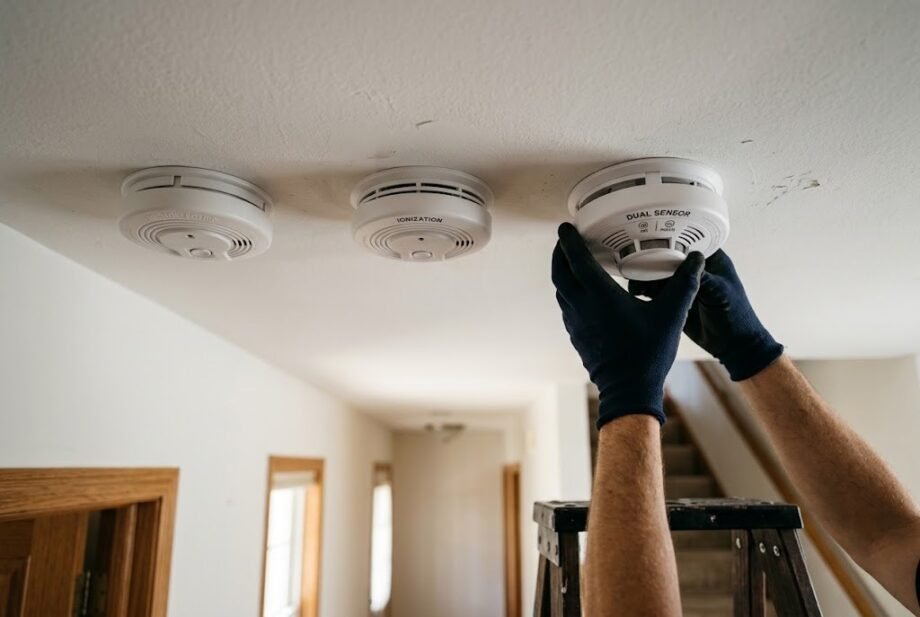
A traditional dual-sensor smoke alarm combines photoelectric and ionization sensing in one housing. Check the specifications for both terms, because manufacturers also sell combination products that detect smoke and carbon monoxide.
The U.S. Fire Administration recommends having both photoelectric and ionization alarms, or dual-sensor alarms, in homes and sleeping locations. Local requirements may specify particular alarm types or arrangements.
Dual-sensor smoke detector types are one way to provide both technologies, but sensor count alone does not establish that a product outperforms every newer design. Certification and the manufacturer’s documented capabilities also deserve attention.
Where multi-criteria detection fits
Some alarms evaluate multiple inputs, such as smoke measurements together with heat or carbon monoxide readings, to decide whether to issue a fire warning. This is called multi-criteria detection.
Do not assume “multi-criteria,” “dual sensor,” and “smoke/CO combination” mean the same thing. An input used in a fire-detection algorithm does not, by itself, establish that the product is certified to provide a separate CO warning.
Smoke Detector Types Compared at a Glance
| Sensing design | Detection method | General response considerations | What to verify |
| Photoelectric | Detects light scattered by smoke particles | Generally responds sooner to smoldering-fire smoke; also detects flaming fires | Certification, placement instructions, and specific sensing design |
| Ionization | Detects a change in current within an ionized chamber | Generally responds sooner to certain flaming-fire smoke; also detects smoldering fires | Local suitability, certification, and installation requirements |
| Photoelectric plus ionization | Combines both sensing technologies | Provides both sensing approaches in one alarm | That both technologies are explicitly listed |
These are response tendencies, not a ranking that applies to every product or fire. Smoke composition, alarm design, and the conditions under which smoke reaches the device all affect detection.
Modern performance requirements add useful context. Updated UL 217 smoke-alarm testing requirements include smoldering and flaming polyurethane tests and a cooking-nuisance test. An alarm’s ability to meet those requirements matters alongside its sensor name.
When comparing smoke detector types, look for documented certification to the applicable standard. A marketplace description saying “advanced detection” or “smart protection” does not establish a particular certification, sensor combination, or interconnection capability.
Battery-Powered, Hardwired, and Interconnected Alarms
Replaceable batteries and sealed batteries
Battery-powered alarms are useful where an approved battery installation suits the property. Some accept replaceable batteries; others have a sealed battery intended to last for the alarm’s rated service life.
A sealed battery reduces routine battery changes, but the alarm still needs testing. If it reports a battery fault or reaches its replacement date, follow the replacement instructions rather than trying to open the battery enclosure.
Treat “10-year battery” as a maintenance feature, not permission to ignore warning signals for a decade.
Hardwired alarms and backup power
Hardwired alarms receive power from the home’s electrical supply. Many include battery backup, but the battery type and maintenance schedule depend on the model.
Before replacing one, identify its rated voltage, connector, backup arrangement, and compatible interconnection system. Matching the shape of the mounting plate is insufficient. Do not downgrade an existing installation to battery-only power without checking applicable requirements.
Electrical safety: Use a qualified electrician for mains-powered installation or wiring changes. Never connect an alarm to an unidentified cable or assume a similar plug proves electrical compatibility.
Interconnection is a separate feature
Interconnected alarms communicate so a detected emergency can produce warnings at other compatible units. Depending on the product, communication may use wiring or a dedicated wireless connection.
Some battery-powered alarms support wireless interconnection. Conversely, the word “hardwired” does not prove that the alarms in your home are actually interconnected.
Verify the exact compatible models and test the completed arrangement using its instructions. Sharing a brand name, radio frequency, or app does not automatically establish alarm-to-alarm compatibility.
Smart smoke detector types add connected functions, such as phone notifications and status reporting. Those features should be evaluated separately from smoke detection and the audible warning inside the home.
Ask the manufacturer three specific questions:
- Will the individual alarm detect smoke and sound without internet access?
- Will compatible alarms still warn together if the router or hub is unavailable?
- What is required to deliver an alert to a phone outside the home?
What happens when Wi-Fi fails?
The answer depends on the system. Google documents that Nest Protect continues detecting smoke and CO when disconnected from Wi-Fi, and that interconnected Protect units can still sound together. Remote app features are affected by the lost connection.
That example illustrates why “offline” needs interpretation. An unavailable app does not necessarily mean the alarm has stopped protecting the room. Equally, normal operation at one alarm does not prove that every remote feature or connected unit is functioning.
Power loss is a separate question. Check what powers the alarm, any required base station, and the networking equipment needed for remote notifications.
Check ecosystem support by model
If you want Apple Home, Google Home, Alexa, or Home Assistant integration, verify the exact product and supported functions. Ask whether it exposes smoke status, trouble warnings, and battery information, and whether any additional bridge or hub is required.
Our guide to Apple Home compatibility and hub requirements explains those platform roles. A product’s app connection and its integration into a wider ecosystem are different capabilities.
Keep phone alerts supplementary to the installed warning system. A notification depends on more than the smoke sensor, including the communication service, phone settings, and whether someone notices it.
Smoke/CO Combination Alarms and Other Detector Categories
A smoke and carbon monoxide combination alarm monitors two hazards in one unit. Its smoke sensor might be photoelectric or ionization; “combination” does not establish which one is present. Check the listed sensors and certifications.
Heat alarms belong to a different category. They respond to temperature conditions rather than smoke particles. USFA identifies garages as a useful application, but heat detection should not replace required smoke-alarm coverage in living and sleeping areas.
There is also a distinction between a self-contained smoke alarm, which includes a warning sounder, and a system smoke detector that reports to compatible fire-alarm equipment. A panel detector is not automatically a substitute for a residential alarm.
Broader lists of smoke detector types may include projected-beam and aspirating detectors. These serve specialist system applications and require appropriate design and installation. For an ordinary household replacement, first establish whether you have a self-contained alarm or a detector connected to a building system.
How to Choose an Alarm for Your Home
Use this checklist before comparing prices or ordering a replacement.
- Confirm local requirements. Identify any rules governing sensing technology, power, interconnection, and installation. The residential smoke-alarm guidance recommends checking requirements with your local fire marshal.
- Record the existing equipment. Note the model, manufacture or replacement date, power source, and any connected panel. Photograph the accessible label safely; do not disturb electrical wiring to collect information.
- Check detection and certification. Confirm the smoke-sensing technology and whether CO detection is included. Verify the product’s safety listing rather than relying on marketing language.
- Confirm compatible interconnection. Use the manufacturer’s approved model list. If only one unit is being replaced, establish how it will communicate with the remaining alarms.
- Consider every occupant. Ask about suitable accessible notification equipment for anyone who cannot reliably hear the alarm. Compatible strobes, vibration devices, or other specialized equipment may be needed.
- Evaluate connected features last. Check hub requirements, remote-alert dependencies, ongoing service costs, and support arrangements before paying extra for smart functions.
If you are adding fire detection to a wider security installation, consult the system’s supported fire-device list. Our explanation of alarm sensors and system compatibility covers the wider integration question using door and window sensors; those devices have a different job from smoke alarms.
The best choice among smoke detector types is the one that meets the property’s requirements and fits the complete warning arrangement. Buying a feature-rich unit that cannot join the existing system can leave an avoidable gap in your plan.
Placement, Nuisance Alarms, and Long-Term Reliability
Put alarms where the instructions require
U.S. guidance calls for smoke alarms inside bedrooms, outside separate sleeping areas, and on every level, including the basement. Follow the model’s mounting instructions and local requirements, including guidance for sloped ceilings and nearby cooking or steam sources.
Replacing an old alarm also provides an opportunity to check coverage. A convenient existing mounting position does not establish that the whole home has enough alarms.
Handle cooking-related alarms without disabling protection
If an alarm sounds and you cannot confidently identify a harmless cause, evacuate and contact emergency services from outside. Do not spend time checking an app while an actual fire may be developing.
For a confirmed cooking nuisance, use the documented hush function and address ventilation or placement as instructed. Never remove a battery to make nuisance alarms stop.
Newer detection designs can still react to cooking aerosols. NIST research found that nuisance performance varied with cooking conditions, so “improved nuisance resistance” should not be read as “never sounds during cooking.”
Test, clean, and replace on schedule
Test at least monthly, or more often if the manufacturer requires it. Some manuals specify weekly testing. Follow the prescribed test-button procedure; do not use an open flame, burning paper, or vehicle exhaust.
Clean only as instructed. Record the replacement date and replace a failed alarm promptly. Residential smoke alarms generally require replacement ten years from manufacture, while some combination products specify a different service life.
Check the manual’s signal chart when diagnosing a non-emergency chirp. Low battery, malfunction, and end-of-life warnings may require different actions. A new battery cannot restore an expired sensor’s service life.
Frequently Asked Questions
What are the main types of smoke detectors?
The main residential sensing technologies are photoelectric and ionization. Traditional dual-sensor alarms contain both. Product descriptions also classify alarms by power supply, interconnection, CO detection, and smart features. These categories overlap, so one alarm can carry several descriptions without containing several different smoke sensors.
Which is better: photoelectric or ionization?
Their response tendencies differ: photoelectric generally responds sooner to smoldering-fire smoke, while ionization generally responds sooner to certain flaming-fire smoke. Both detect both fire patterns. Consider the specific alarm’s certification and local requirements; USFA recommends both technologies or a dual-sensor arrangement.
Is a dual-sensor alarm the same as a smoke/CO alarm?
No. A traditional dual-sensor smoke alarm combines photoelectric and ionization detection. A smoke/CO combination alarm detects smoke and carbon monoxide. Read the sensor specifications: two detected hazards do not necessarily mean two smoke-sensing technologies, and neither label alone tells you about interconnection or app support.
Are hardwired alarms better than battery-powered alarms?
Hardwired alarms use mains power and may include backup batteries and interconnection. Battery-powered models can also offer interconnection and may suit approved retrofit installations. Choose according to the property’s requirements and existing system. Do not replace required hardwired protection with battery-only units for convenience.
Do smart smoke detectors work without Wi-Fi?
Some continue local smoke detection, audible warnings, and compatible interconnection without Wi-Fi. Remote notifications can become unavailable. Check the exact model’s documentation for each function separately, and distinguish internet failure from router, hub, or electrical failure. The word “smart” does not define a universal outage behavior.
Choosing the Right Smoke Detector
Compare smoke detector types by what they sense, then check certification, power, and compatible interconnection. Make sure the installation covers the home and can warn everyone who lives there.
Smart features can add useful visibility, but judge them by their documented capabilities and dependencies. Before buying, you should be able to explain what sounds locally, which other alarms respond, and what still works during an outage. Keep the manual and replacement date accessible so maintaining that protection stays straightforward.
Disclaimer:
Follow local requirements and the manufacturer’s instructions; use a qualified electrician for mains wiring. If an alarm signals possible fire or CO danger, evacuate and call emergency services from outside.