

Commercial energy storage solutions are battery systems that help businesses cut electricity costs, survive power outages, and use more solar power. They store cheap or surplus electricity and release it when prices peak or the grid fails. For companies facing high demand charges, a well-sized system can pay for itself in just a few years.
- What Are Commercial Energy Storage Solutions?
- How Does Commercial Battery Storage Work?
- Main Types of Commercial Storage
- Key Components of a Commercial System
- Business Benefits That Actually Move the Needle
- Peak Shaving and Demand Charge Reduction
- Backup Power Without Diesel
- Solar Self-Consumption
- Time-of-Use Arbitrage
- Grid Services Revenue
- How to Size a Commercial Storage System
- What Does Commercial Storage Cost?
- Leading Commercial Storage Providers
- Is Commercial Storage Right for Your Business?
- FAQs
- What are commercial energy storage solutions?
- How much does commercial energy storage cost?
- How long do commercial battery systems last?
- What size battery does a business need?
- Can commercial storage work without solar panels?
- Are commercial battery systems safe?
- Which businesses benefit most from energy storage?
- Conclusion
If you run a factory, warehouse, office building, or retail store, your electricity bill probably punishes you for short spikes in usage. This guide explains how commercial storage works, the main system types, what they cost, and how to tell if one makes sense for your business.
What Are Commercial Energy Storage Solutions?
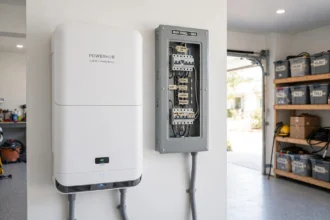
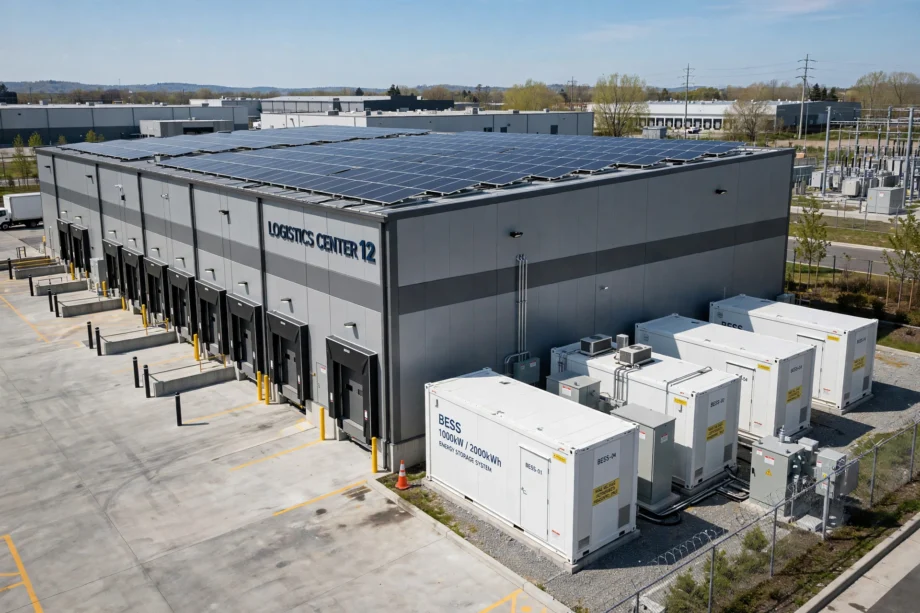
Commercial energy storage solutions, often called C&I (commercial and industrial) ESS, are large battery installations built for businesses rather than homes. They range from cabinet-sized units around 200 kWh to containerized systems holding several megawatt-hours, so there’s a size for almost every facility. Unlike home batteries, they are sized around a facility’s load profile and electricity tariff.
The core idea is simple. Businesses buy electricity at prices that change through the day, and utilities add demand charges based on peak usage. As a result, a storage system buys low, avoids peaks, and sometimes even sells services back to the grid. It is essentially an energy manager that never sleeps.
These systems have moved from pilot projects to mainstream investments. Because of falling battery prices, higher electricity rates, and utility incentive programs, commercial storage has reached positive ROI territory for many industries, from manufacturing to data centers.
How Does Commercial Battery Storage Work?
The daily cycle follows the same charge-store-discharge pattern as any battery, but the strategy is tuned for business economics. Here is how a typical weekday looks.
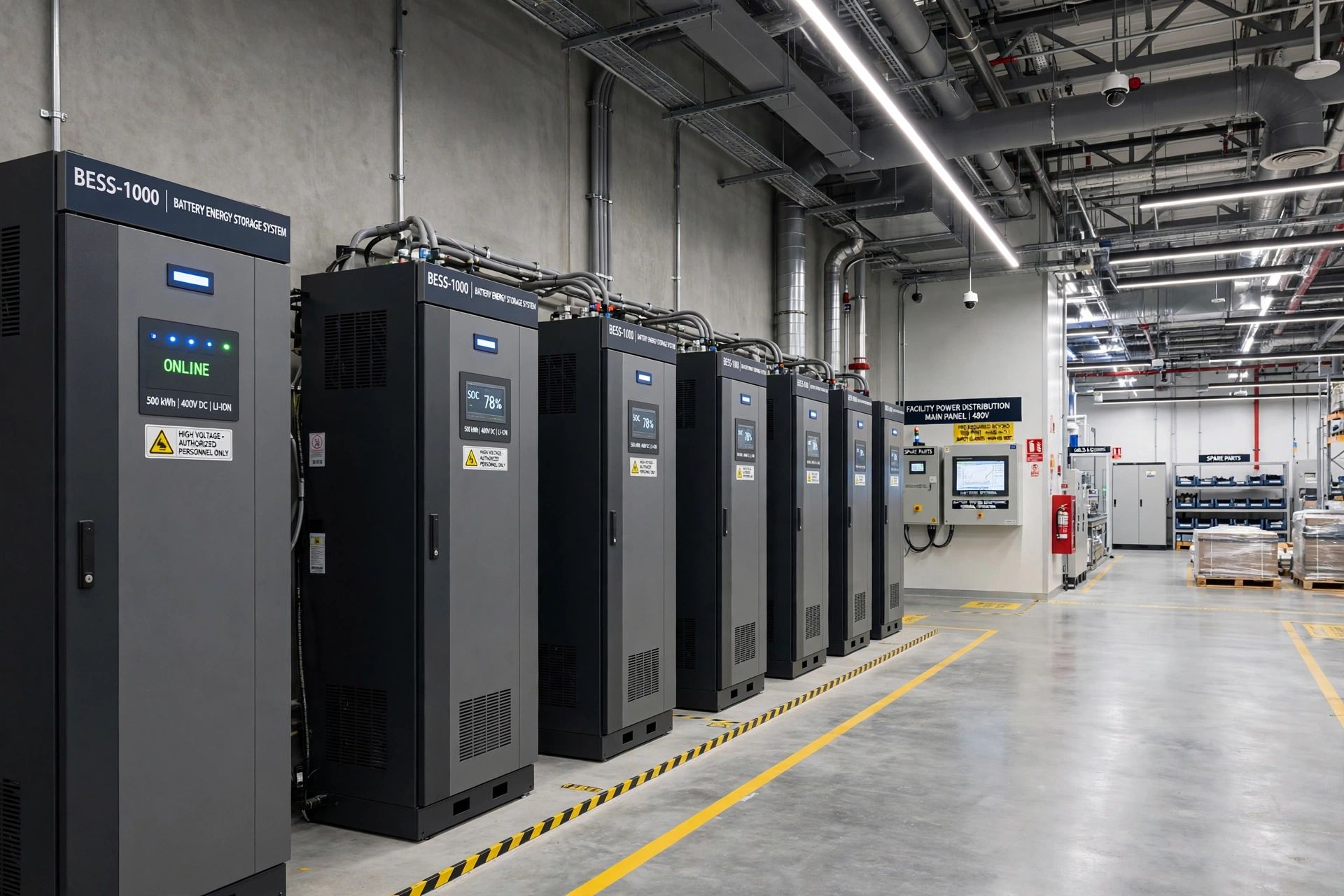
Overnight, the system charges from the grid when rates are lowest. Because most commercial tariffs drop sharply after midnight, the battery fills up cheaply while the building sleeps. The energy management software then handles this automatically, so nobody needs to watch it.
During the day, the system watches the building’s power draw in real time. When usage climbs toward an expensive peak, perhaps because the HVAC and production lines run together, the battery discharges to shave that peak. The grid therefore sees a flat, well-behaved load instead of costly spikes.
In the evening, any stored solar surplus gets used or exported at favorable rates. Then the cycle repeats. Over a year, those daily savings stack into serious money. That is also why the financial case usually starts with the electricity bill, not the technology.
Main Types of Commercial Storage
Not every business needs the same technology. The three main options each suit different jobs. Still, it helps to compare them directly.
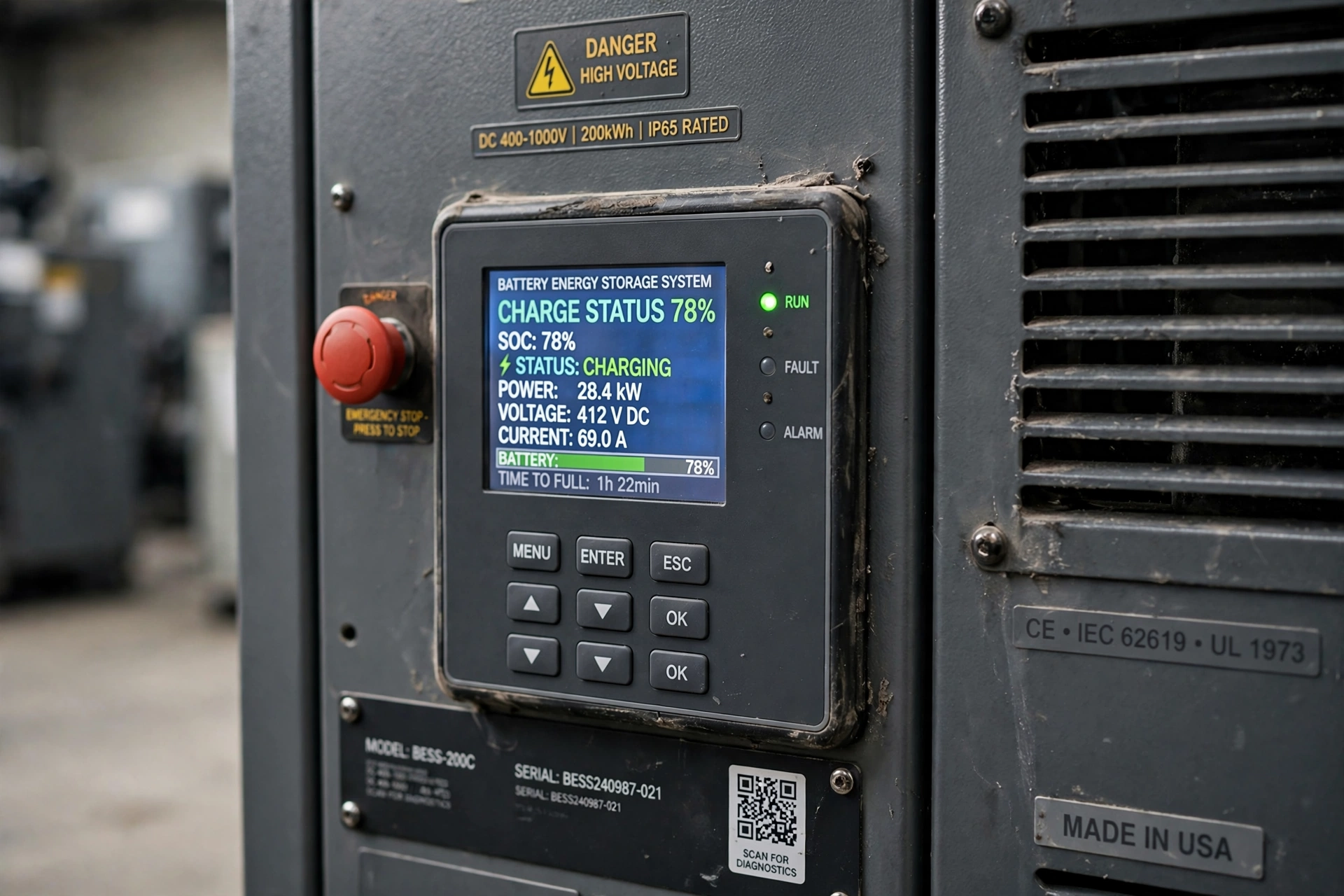
Lithium-Ion Battery Systems
Lithium-ion, specifically lithium iron phosphate (LFP), dominates commercial installations today. These systems pack the most energy into the smallest footprint, respond in milliseconds, and now last 6,000 to 10,000 cycles. They handle the classic commercial jobs, including peak shaving, backup power, and solar self-consumption.
Most containerized and cabinet systems you see quoted are LFP-based. The technology won because it balances cost, safety, and lifespan better than alternatives for daily cycling applications.
Flow Battery Systems
Flow batteries store energy in liquid electrolytes held in external tanks. Their big advantage is duration: adding more tank capacity extends storage hours without buying more power electronics. They also degrade very little over time, since the liquids don’t wear out like solid electrodes.
The tradeoff is footprint and upfront cost. Flow batteries suit businesses needing 6 to 12 hours of backup or long-duration shifting, such as facilities pairing with large solar arrays. For standard 2 to 4 hour peak shaving, however, lithium-ion usually wins on economics.
Thermal Energy Storage
Thermal storage banks heating or cooling instead of electricity. A building makes ice or chilled water overnight, then uses it for air conditioning during expensive afternoon hours. It is simple, durable, and cheap per unit of energy.
The catch is that it only serves thermal loads. If your biggest cost is HVAC, thermal storage can be brilliant. If your peaks come from machinery or EV chargers, on the other hand, you need batteries instead. Some sites install both, since they solve different problems.
Table: Commercial storage types compared
| Feature | Lithium-Ion (LFP) | Flow Battery | Thermal Storage |
|---|---|---|---|
| Typical duration | 2 to 4 hours | 6 to 12 hours | 4 to 8 hours |
| Best job | Peak shaving, backup | Long-duration shifting | HVAC load shifting |
| Footprint | Compact | Large (tanks) | Medium (tanks) |
| Cycle life | 6,000 to 10,000 | 15,000+ | 20+ years |
| Serves | All electric loads | All electric loads | Heating/cooling only |
Key Components of a Commercial System
Every commercial battery system combines the same building blocks, scaled to business needs. Understanding them also helps you read vendor quotes critically.
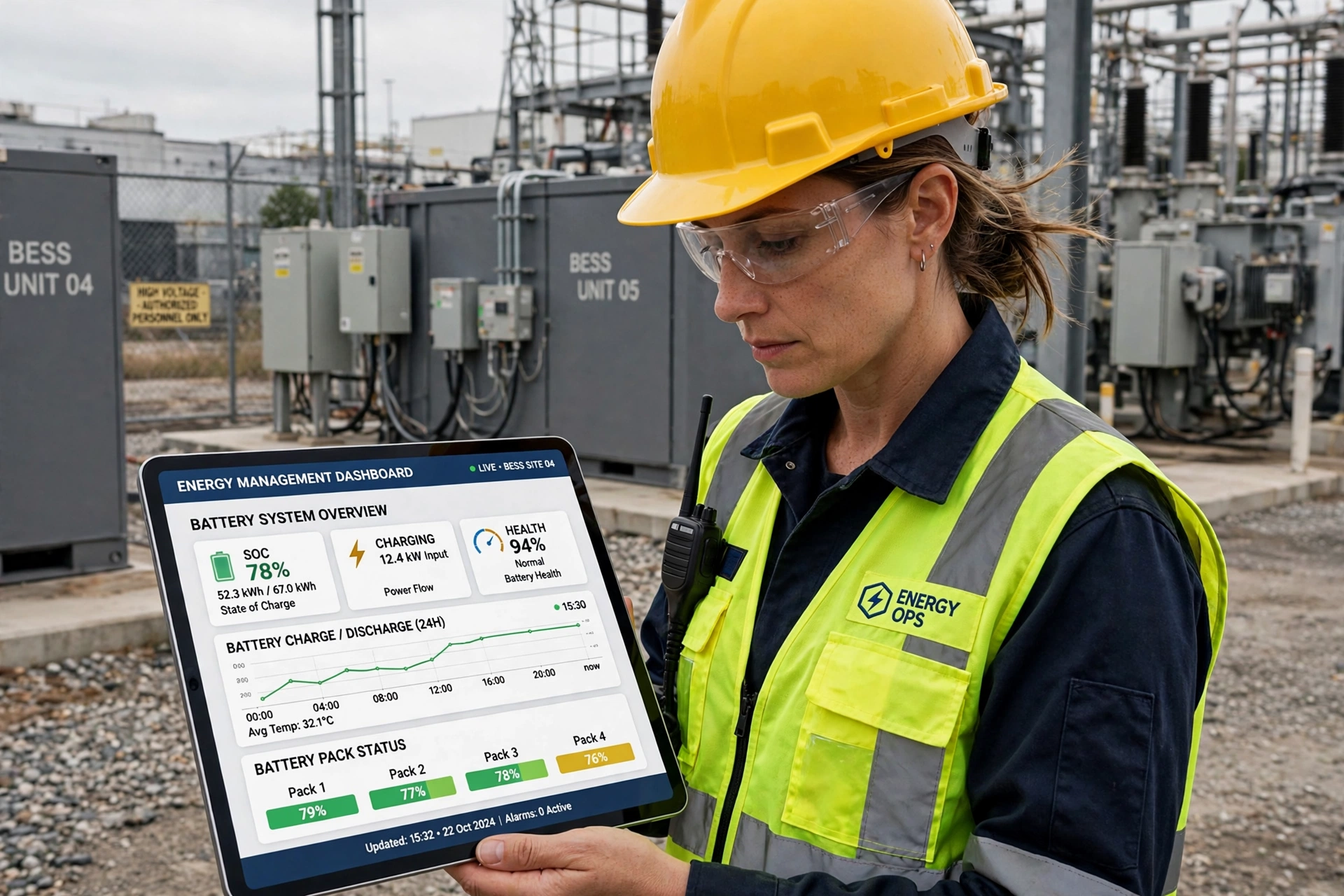
Battery modules store the energy, wired into racks like their utility-scale cousins. The battery management system (BMS) monitors every cell for voltage, temperature, and health. The power conversion system (PCS) swaps DC for AC and back, while the energy management system (EMS) decides when to charge and discharge based on tariffs and load forecasts.
Thermal management keeps cells at ideal temperature, and the whole package sits in a safety-rated enclosure with fire detection and suppression. For a deeper look at how these parts fit together, containerized designs follow the same architecture at larger scale.
Business Benefits That Actually Move the Needle
Vendors list many benefits, but a few dominate real purchase decisions. Here are the ones worth modeling for your site, starting with the biggest.
Peak Shaving and Demand Charge Reduction
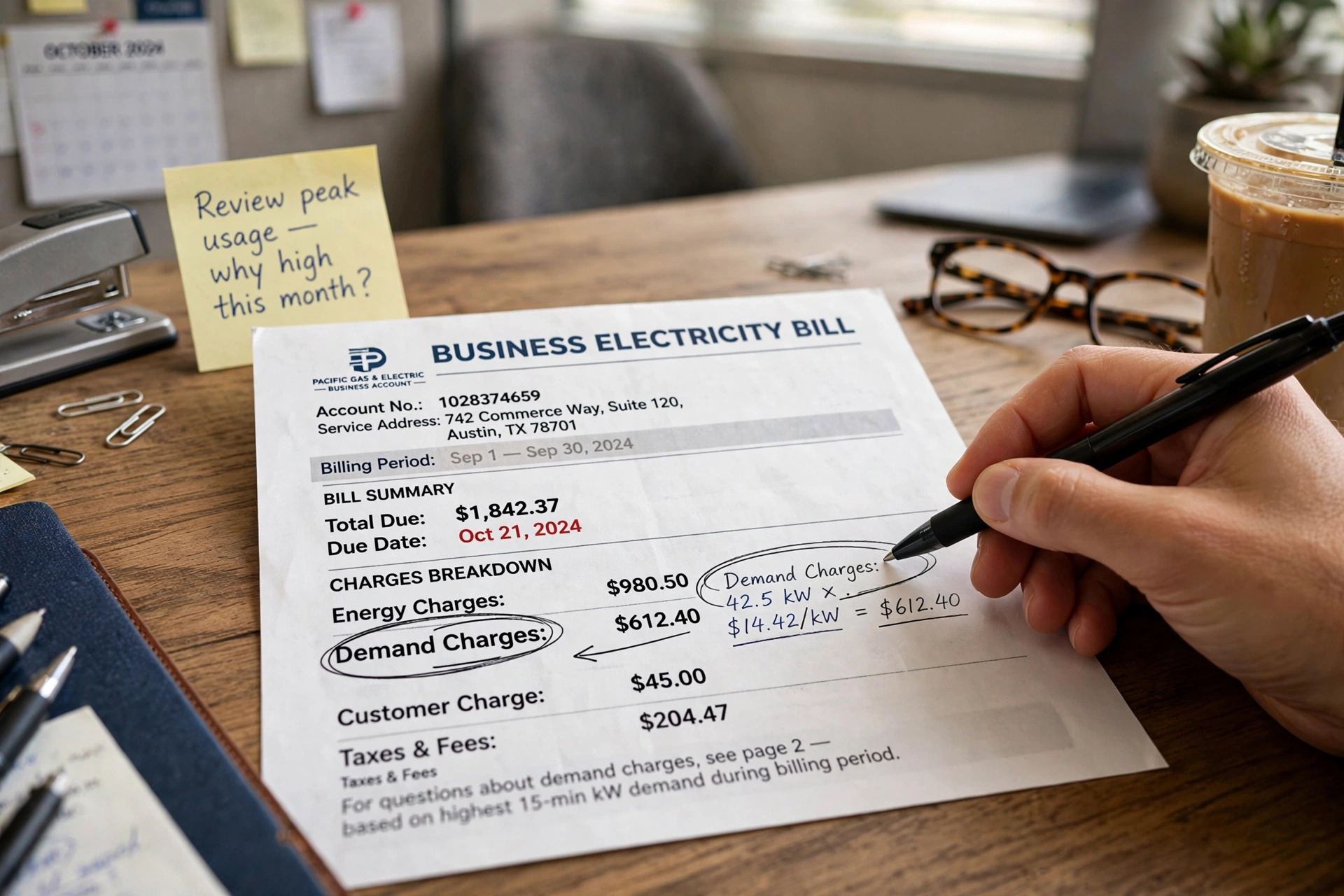
Indeed, demand charges often make up 30 to 70 percent of a commercial electricity bill. Utilities measure your highest 15-minute usage window each month and bill every kilowatt of it. One hot afternoon can therefore inflate twelve monthly bills, so the stakes are high.
For example, a battery shaves those peaks by discharging exactly when the building spikes. Consider a warehouse with a 300 kW peak and demand charges of $18 per kW each month. If the battery trims 150 kW off that peak, monthly savings hit $2,700, or $32,400 per year. Because the math is that direct, peak shaving alone often justifies the investment.
Backup Power Without Diesel
Outages cost businesses far more than the electricity itself. Specifically, spoiled inventory, idle workers, and lost sales add up fast. Batteries switch over in milliseconds, run silently, and need no fuel deliveries or noisy generators.
Unlike a generator that sits idle 99 percent of the time, a battery earns money daily through peak shaving while standing ready for outages. That dual role therefore transforms backup power from a sunk cost into a working asset.
Solar Self-Consumption
Businesses with rooftop or ground-mount solar often generate surplus power at midday when nobody needs it. Without storage, however, that surplus exports to the grid at low feed-in rates. With storage, the building uses its own solar in the expensive evening hours instead.
This matters more as net metering rules get less generous. In markets where export rates keep falling, storing your own solar becomes the obvious move, and the battery effectively raises your solar array’s value.
Time-of-Use Arbitrage
Where tariffs vary strongly by hour, the battery simply buys low and uses high. It charges overnight at off-peak rates and discharges during afternoon price spikes. The spread between those rates is pure savings. The EMS then optimizes it daily without human input.
Grid Services Revenue
In some markets, businesses earn extra income by letting utilities dispatch their battery during grid stress events. Demand response programs and frequency services pay for availability plus performance. These payments stack on top of bill savings. As a result, they can shorten payback by a year or more.
How to Size a Commercial Storage System
Sizing is where projects succeed or fail, so it deserves a careful walkthrough. Two numbers define every system: power (kW) and energy (kWh).
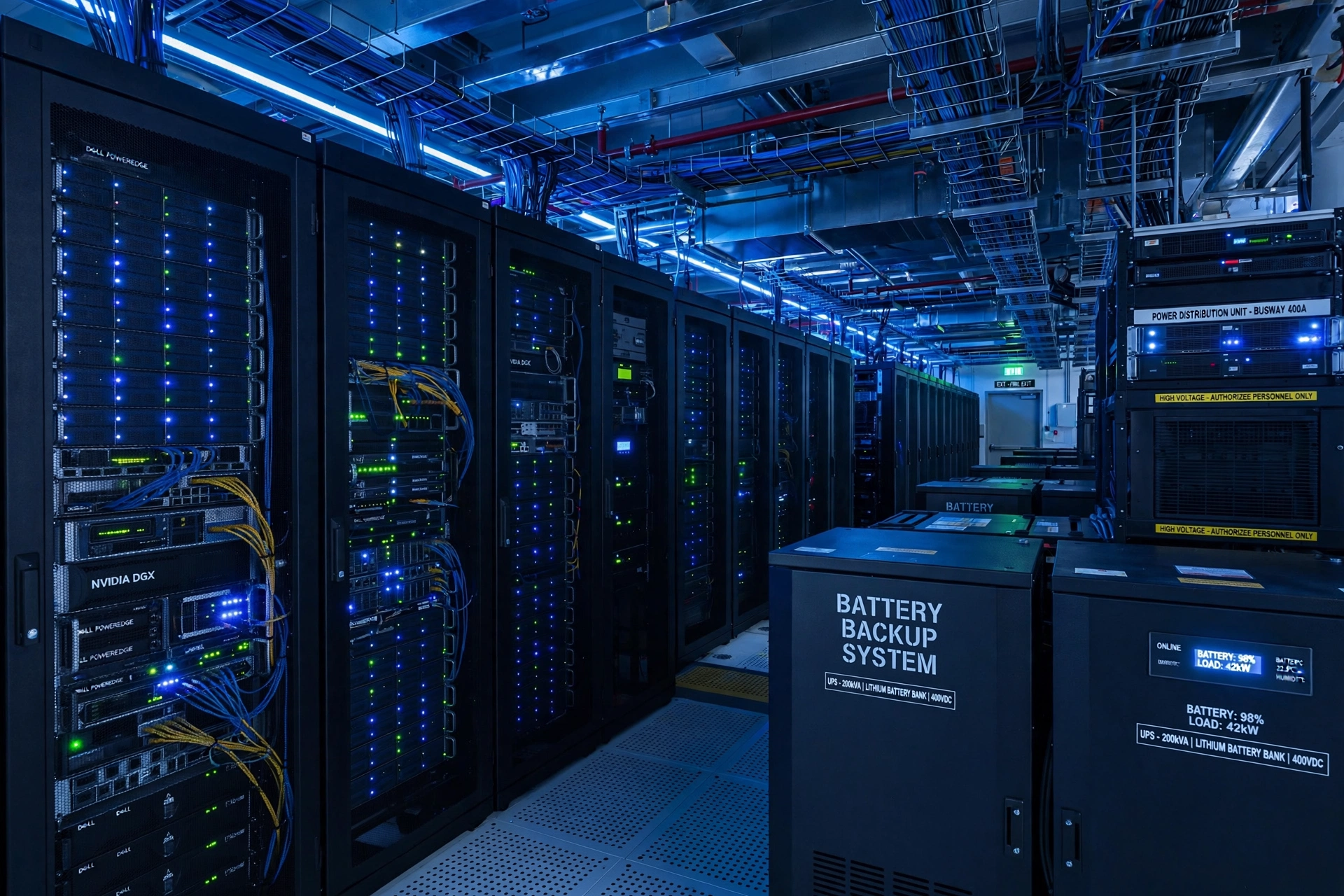
Power, measured in kilowatts, sets how much load the battery can cover at once. If your peaks hit 400 kW and you want to shave 150 kW, you need at least 150 kW of power capacity. Undersize this and the battery can’t clip the peaks that drive your bill.
Energy, measured in kilowatt-hours, sets how long that power lasts. A 150 kW system with 300 kWh of storage sustains full output for two hours. Most commercial peaks last one to three hours, so 2-hour duration covers the common case. Longer outages or solar shifting need more energy relative to power.
The practical process starts with 12 months of interval meter data, ideally in 15-minute increments. An engineer then models your load shape against tariff rates and tests virtual battery sizes to find the sweet spot. As a rule of thumb, the battery should cover your top 10 to 20 percent of peak demand, since chasing the last few kilowatts costs more than it saves.
Businesses adding EV chargers for fleets should size with charging in mind, because a row of fast chargers can double a site’s peak overnight. Planning storage and charging together avoids an expensive retrofit later.
What Does Commercial Storage Cost?
Installed costs for commercial lithium-ion systems typically fall between $300 and $600 per kWh, though larger projects beat that range. A 500 kWh cabinet system might therefore run $150,000 to $300,000 before incentives, while containerized megawatt-hour systems price lower per unit.
Incentives change the picture dramatically. The US federal investment tax credit applies to standalone storage, and many states and utilities add their own rebates or performance payments. Always compare quotes on an after-incentive basis, since two identical systems can differ wildly in net cost by location.
Payback periods commonly land between 4 and 8 years for peak-shaving projects, then the system keeps earning for another decade. Because batteries degrade slowly, year-ten savings look much like year-one savings, which makes the lifetime math attractive.
For context on how commercial energy investments compare with residential ones, our breakdown of home EV charger installation costs shows the smaller-scale side of the same trend.
Leading Commercial Storage Providers
The market has consolidated around a handful of serious manufacturers. These names appear most often in commercial quotes, and knowing them helps you benchmark proposals.
Tesla’s Megapack dominates the large end, with each unit holding about 3.9 MWh in a factory-built enclosure. Fluence, a Siemens and AES joint venture, supplies modular systems widely used by utilities and large commercial sites. BYD and CATL, both battery giants, offer containerized solutions at aggressive prices, while LG Energy Solution serves the commercial segment with its own integrated systems.
When comparing vendors, look past the brand. Ask for the cell chemistry, the warranted cycle life at your expected usage, the EMS capabilities, and the monitoring response time. Two quotes with the same headline capacity can differ enormously in lifetime value.
Is Commercial Storage Right for Your Business?
Not every site benefits, so run through this checklist before calling vendors. You are a strong candidate if several of these fit.
Your demand charges exceed $10 per kW monthly, since high demand rates make peak shaving lucrative. Your load has sharp, predictable peaks rather than a flat profile, because flat loads leave nothing to shave. You already have solar or plan to add it, which gives the battery cheap energy to store. You suffer outages that cost real money, making backup value tangible. Or your utility offers demand response payments that reward flexible load. Sites planning workplace EV charging should also factor in how chargers reshape their load profile.
If none of those apply, a battery probably won’t pay back yet. Energy efficiency upgrades or tariff switching might save more per dollar. But if two or three fit, get a proper load analysis, because the numbers often surprise on the upside.
FAQs
What are commercial energy storage solutions?
They are battery systems designed for businesses, ranging from cabinet-sized units to containerized megawatt-hour installations. They cut electricity costs through peak shaving and time-of-use arbitrage, provide backup power, and increase solar self-consumption. Most modern systems use lithium iron phosphate (LFP) chemistry.
How much does commercial energy storage cost?
Installed costs typically run $300 to $600 per kWh, so a 500 kWh system costs roughly $150,000 to $300,000 before incentives. Federal tax credits and local rebates can cut net costs substantially. Payback periods of 4 to 8 years are common for peak-shaving projects.
How long do commercial battery systems last?
LFP-based systems are typically warranted for 10 to 15 years and rated for 6,000 to 10,000 cycles. With one full cycle per day, that means 15 to 25 years of service life. Real lifespan depends on depth of discharge, temperature management, and how aggressively the system is cycled.
What size battery does a business need?
It depends on peak demand and tariff structure, but a common starting point is covering the top 10 to 20 percent of peak load for 2 hours. A site peaking at 400 kW might install 60 to 80 kW of power with 120 to 160 kWh of energy. A proper sizing study uses 12 months of interval meter data.
Can commercial storage work without solar panels?
Yes. Many systems charge from the grid overnight at cheap off-peak rates and discharge during expensive peaks, which needs no solar at all. Solar improves the economics by providing free charging energy, but time-of-use arbitrage and demand charge reduction work fine on grid power alone.
Are commercial battery systems safe?
Modern systems use stable LFP chemistry plus battery management systems, thermal management, gas detection, and fire suppression, all certified to standards like UL 9540. Incidents are rare in properly installed commercial systems. Buyers should still verify certifications and ask vendors about monitoring and maintenance practices.
Which businesses benefit most from energy storage?
Manufacturing plants, warehouses, data centers, supermarkets, hotels, and office buildings with high demand charges see the strongest returns. Sites with EV fleet charging, on-site solar, or frequent outages benefit even more. Businesses with flat load profiles and low demand charges gain the least.
Conclusion
Commercial energy storage solutions turn one of your biggest operating costs into a managed asset. By shaving peaks, shifting solar, and standing ready for outages, a well-sized battery earns its keep every single day.
Your next step is concrete: pull 12 months of electricity bills, highlight the demand charge line, and get a sizing study from two or three vendors. That one exercise tells you more than any brochure. And if your plans include fleet charging, read our guide to what an EV charger is so storage and charging get designed as one system.