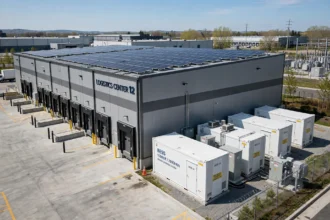


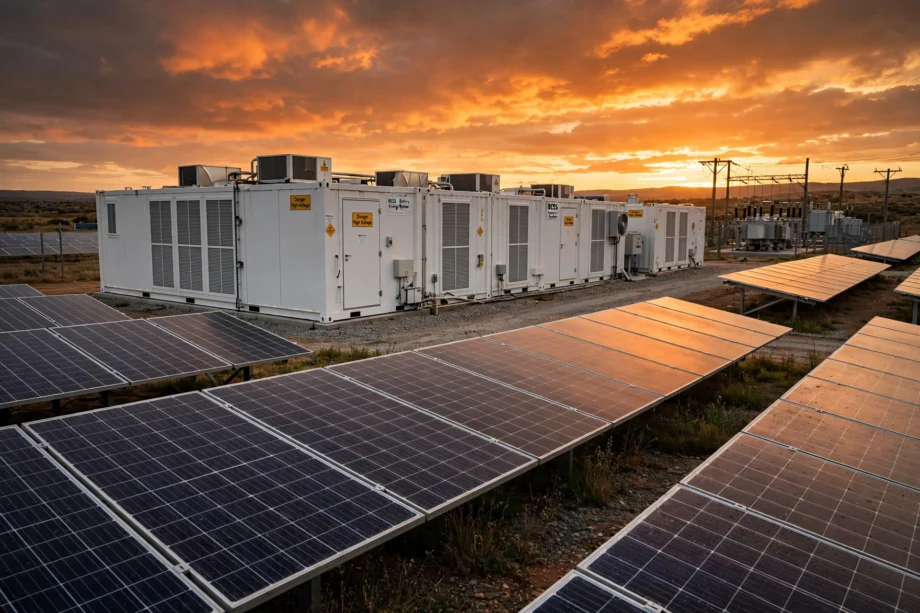
An energy storage container is a complete, large-scale battery system built inside a standard shipping container. It stores electricity from solar panels, wind turbines, or the grid, then releases it when demand is high. Think of it as a giant rechargeable battery in a steel box.
- What Is It, Exactly?
- What Is Inside an Energy Storage Container?
- Battery Modules and Racks
- Battery Management System (BMS)
- Power Conversion System (PCS)
- Energy Management System (EMS)
- Thermal Management and Fire Safety
- How Does the Charge Cycle Work?
- Where Are These Containers Used?
- Solar and Wind Farm Support
- Peak Shaving for Businesses
- Backup Power and Microgrids
- Grid Services and Frequency Regulation
- Energy Storage Container Sizes and Capacity
- How Much Does One Cost?
- How It Compares to Other Storage Types
- Is Container Storage Right for Homes?
- Safety: What About Battery Fires?
- FAQs
- What is it in simple terms?
- How long do these systems last?
- How much energy can a 20-foot unit hold?
- Are these containers safe?
- What is the difference between a BESS and a containerized system?
- Can one container power a house?
- Do they work with solar panels?
- Conclusion
You have probably seen rows of plain-looking containers next to solar farms. They aren’t storage sheds. Each one holds thousands of battery cells, cooling equipment, and smart controls. This guide explains what is inside, how the charge cycle works, and what they cost.
What Is It, Exactly?
An energy storage container is also called a containerized BESS. It packs every part of a grid-scale battery into one transportable unit. The steel box, usually 20 or 40 feet long, also arrives pre-built from the factory. Crews then set it on a concrete pad, connect the cables, and it starts working within weeks.
This plug-and-play design is the whole point. A custom-built battery facility can take years of engineering and construction. A containerized system skips most of that. And because the design is modular, adding capacity later is as simple as placing another container beside the first.
Most new containers use lithium iron phosphate (LFP) battery chemistry. LFP won the market because it handles heat better, survives more charge cycles, and costs less than older lithium chemistries. A typical 20-foot unit holds around 2 to 5 megawatt-hours (MWh). For perspective, 2.5 MWh can run roughly 80 average homes for a full day, since a typical home uses about 30 kWh daily.
What Is Inside an Energy Storage Container?
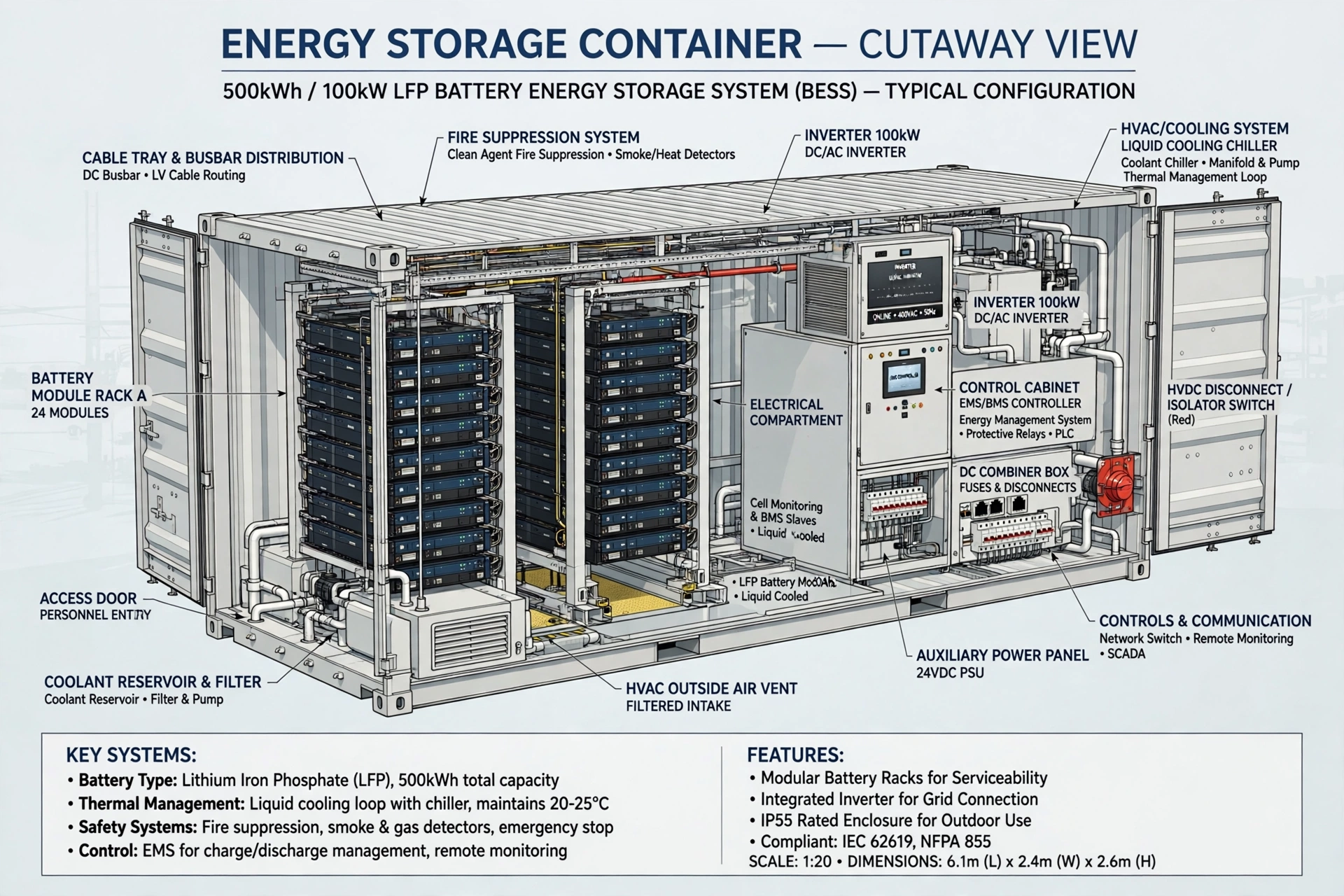
Open the doors and you’ll find racks of smaller modules wired together, plus the equipment that keeps them safe and efficient. Every containerized system shares the same core parts.
Battery Modules and Racks
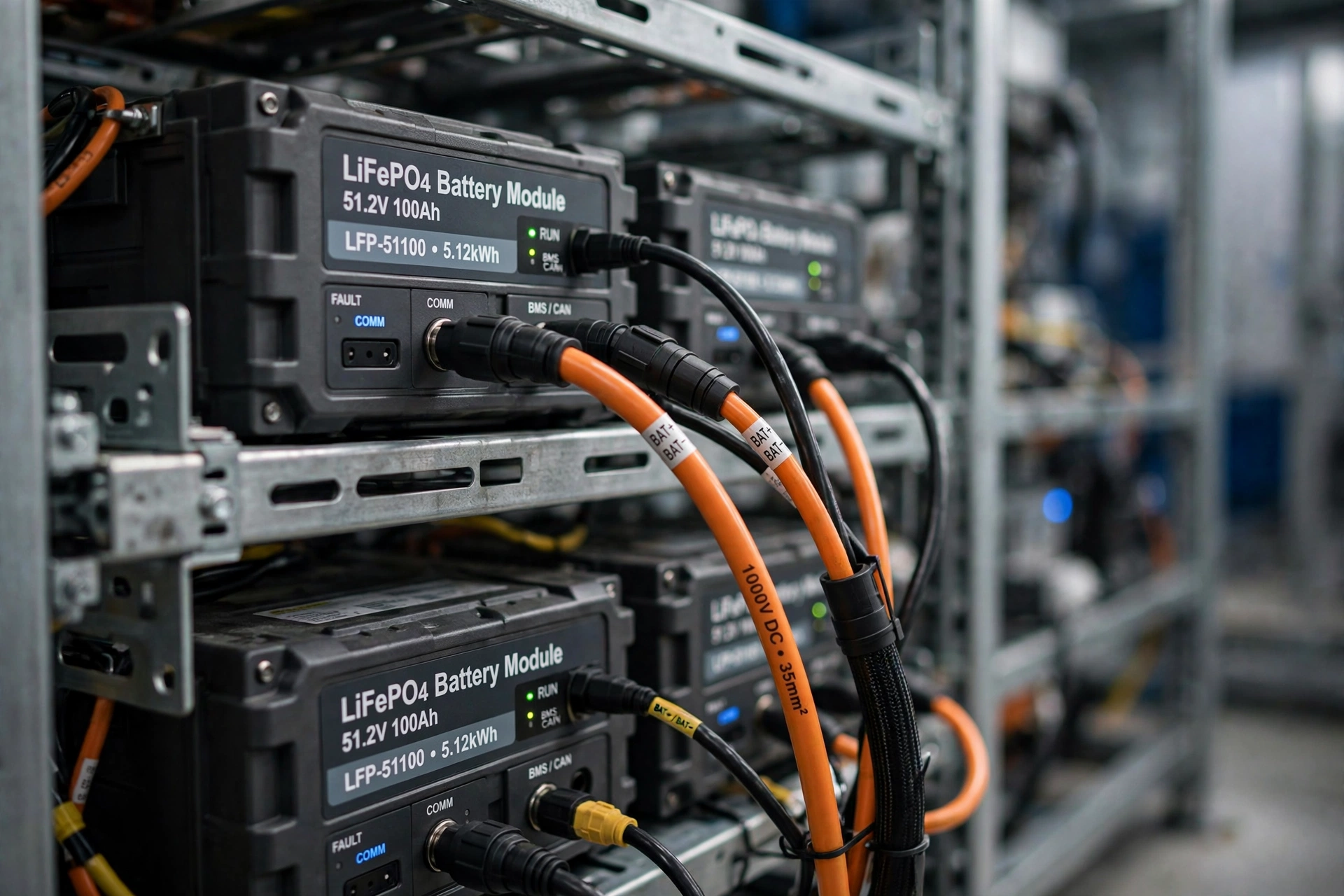
The heart of the system is the battery itself. Individual lithium cells group into modules, and modules stack into tall racks. Racks then connect in series to reach the right voltage and in parallel to reach the right current. A single container can hold hundreds of modules acting as one.
LFP cells dominate new installations, though older projects may use NMC chemistry. The trend favors LFP for its longer life and stronger safety record.
Battery Management System (BMS)
Because a container holds thousands of cells, the BMS acts as the battery’s brain and bodyguard, watching every cell’s voltage, temperature, and state of charge in real time. Because of that, if one cell gets too hot, the BMS isolates it before it can harm its neighbors.
Why does this matter? A container holds thousands of cells, and one failing cell can trigger a chain reaction called thermal runaway. The BMS is the first line of defense against that. In fact, good BMS design is often the difference between a boring, reliable asset and a fire headline.
Power Conversion System (PCS)
Batteries store direct current (DC), but the grid runs on alternating current (AC). The PCS, essentially a large inverter, converts between the two. It charges the battery by turning grid AC into DC, then discharges by converting battery DC back into grid-ready AC.
Modern PCS units react in milliseconds. That speed also lets the container perform jobs like frequency regulation, where the grid needs power injected or absorbed within seconds.
Energy Management System (EMS)
The EMS decides when to charge and discharge. It is software that reads electricity prices, weather forecasts, and grid signals, then picks the most profitable schedule. So you charge at night when power is cheap and discharge at 6 PM when prices spike. That is the EMS earning its keep.
For solar farms, the EMS also stores midday surplus instead of wasting it, then sells during the expensive evening peak. This single behavior can make or break a project’s economics.
Thermal Management and Fire Safety
Batteries hate temperature swings. Containers therefore carry their own HVAC systems that hold the interior steady year-round, much like a server room.
For fire safety, containers include smoke and gas detectors, suppression systems, and venting panels. Newer designs add cell-level monitoring that spots a failing cell hours before it becomes dangerous. Standards like UL 9540A also certify the whole package has been fire-tested as a system.
How Does the Charge Cycle Work?
The basic cycle is simple: electricity in, chemical energy stored, electricity out. Here is what happens in each phase.
Charging
During charging, the PCS pulls AC power from the grid or from solar panels. It then converts that power to DC. The BMS then guides that current into the battery racks, filling cells from empty to full. A full charge of a 2.5 MWh container at a steady 1 MW takes about two and a half hours, plus small efficiency losses.
Smart operators charge when electricity is cheapest, usually overnight or during sunny midday hours. Some containers charge only from their paired solar farm, while others buy from the grid like a trader buying low.
Storing
Once charged, the battery simply holds its energy as a chemical charge inside the cells. Self-discharge is tiny, often under 3 percent per month, yet the thermal system still keeps working to hold temperature steady.
This waiting ability is what makes storage valuable. Solar power without storage must be used the instant it is generated. With a container in the loop, noon sunshine can light up evening homes instead.
Discharging
When the EMS gives the signal, the process reverses. DC flows out of the racks, the PCS converts it to AC, and power feeds the grid or the facility. Round-trip efficiency for a modern LFP container runs about 85 to 90 percent. Roughly 10 to 15 percent of the energy is therefore lost as heat along the way.
Discharge can be fast or slow. A container can dump full power in an hour for peak shaving. It can also trickle power out over four to eight hours for longer backup. The operator then picks whichever strategy pays best.
Where Are These Containers Used?
These steel boxes show up in more places than most people realize, and each use case earns or saves money differently.
Solar and Wind Farm Support
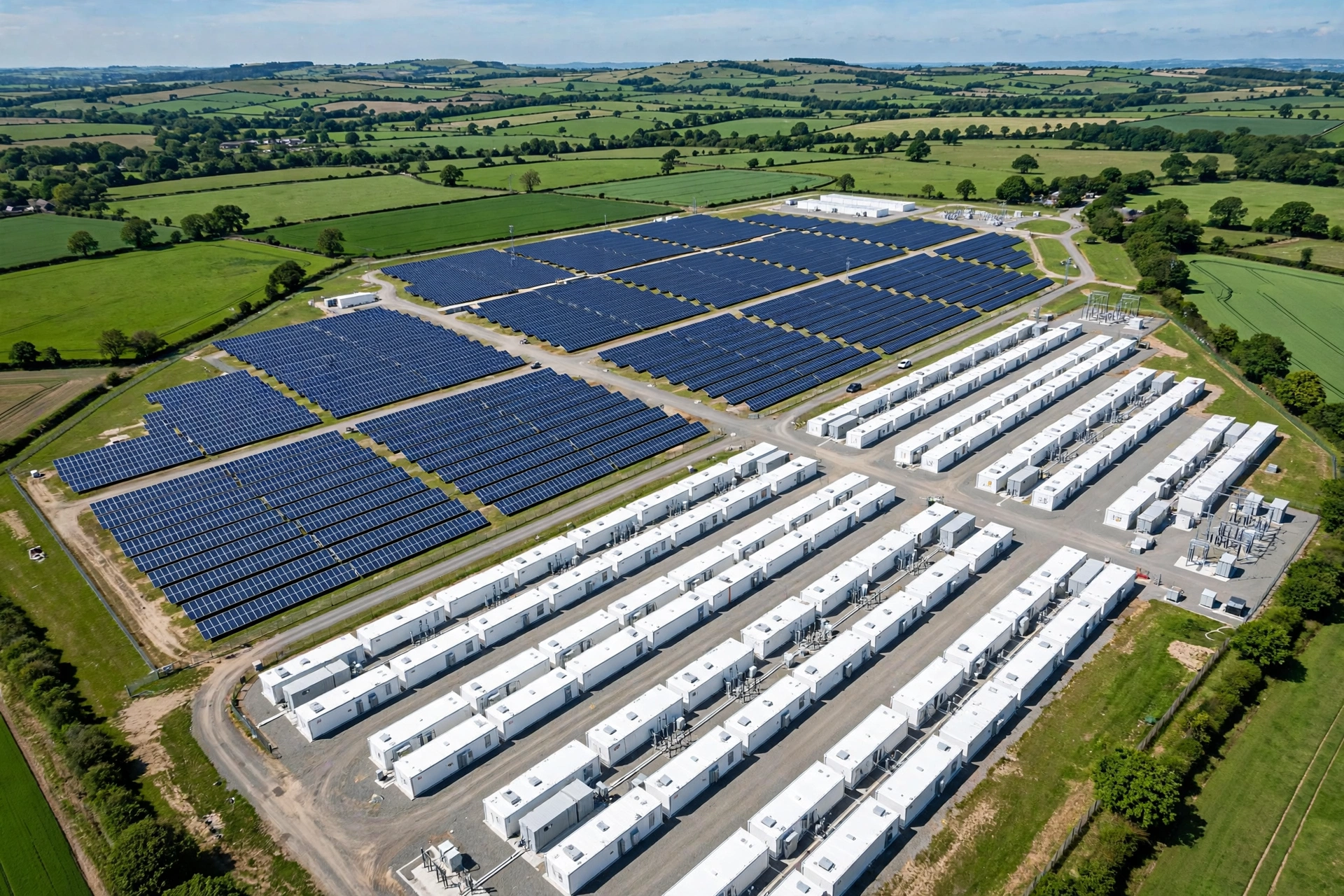
Renewables are intermittent. A container next to a solar farm therefore stores the midday surplus and releases it after sunset. This turns an unreliable generator into a dependable one. As a result, many new solar projects now include storage by default because buyers demand firm supply.
Peak Shaving for Businesses
Commercial electricity bills punish peak usage. Utilities charge demand fees based on your highest 15 minutes of consumption each month, so one bad afternoon can inflate the whole bill.
A container fixes this by discharging during spikes and keeping grid draw flat. For illustration: if demand charges run $15 per kW monthly and the battery shaves 200 kW off the peak, that saves $3,000 a month, or $36,000 a year. Because the math is that direct, peak shaving is often the first use case businesses evaluate.
Backup Power and Microgrids
Hospitals, data centers, and remote communities use containers as clean backup power. Unlike diesel generators, for instance, batteries start instantly, run silently, and need no fuel. Paired with solar, a container plus panels can form a microgrid that runs even when the main grid fails for days.
Grid Services and Frequency Regulation
Grid operators pay storage owners for fast-response services like frequency regulation and voltage support, which need power in seconds. Batteries deliver that faster than any spinning turbine, so containers earn steady revenue through aggregators just for staying available.
Energy Storage Container Sizes and Capacity
Containers come in standard shipping sizes, and capacity has grown fast as battery density improved. The table below shows what you typically get today.
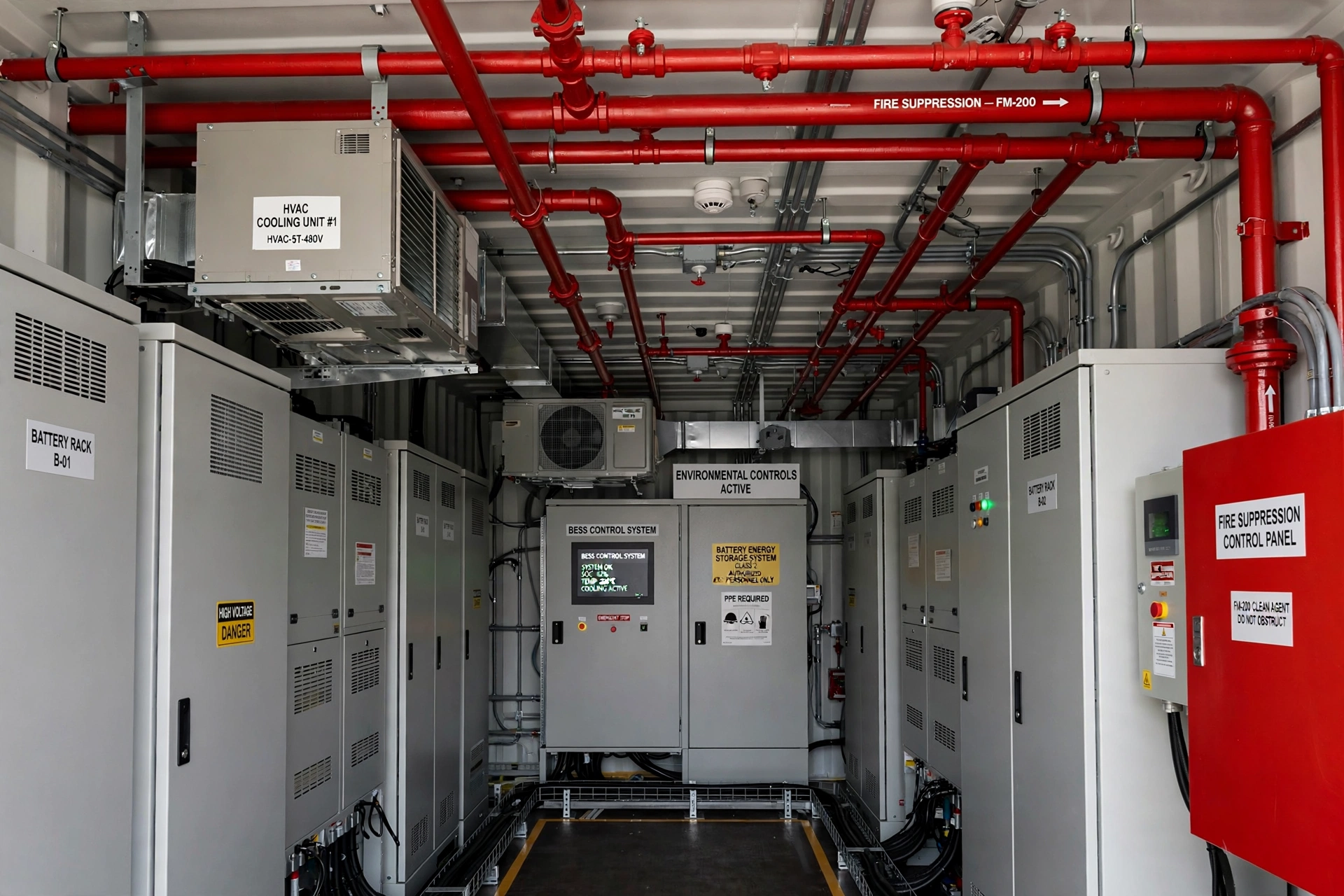
Table: Common container sizes and typical capacity
| Container Size | Typical Capacity | Typical Power | Best Suited For |
|---|---|---|---|
| 20-foot | 2 to 5 MWh | 1 to 2.5 MW | Commercial sites, small solar farms |
| 40-foot | 5 to 10 MWh | 2.5 to 5 MW | Utility projects, large solar farms |
| Modular cabinet | 200 to 400 kWh | 100 to 200 kW | Small businesses, EV charging hubs |
For reference, the well-known Tesla Megapack is a purpose-built enclosure holding about 3.9 MWh per unit. It follows the same idea at maximum scale: factory-built, crane-delivered, and grid-connected in weeks rather than years.
When comparing options, watch two numbers. Energy capacity (MWh) tells you how long it can run; power rating (MW) tells you how hard it can push. For example, a 2 MWh unit with 1 MW runs two hours at full output, while the same energy with 0.5 MW stretches to four hours. Modular cabinets are also popular for EV charging hubs avoiding demand charges.
How Much Does One Cost?
Prices have fallen hard over the past decade. A utility-scale containerized system today typically costs between $150 and $300 per kWh of capacity installed, though exact pricing moves with battery markets and project size. That still puts a 2.5 MWh container roughly between $375,000 and $750,000 before incentives.
Several factors swing the final price. Larger projects get better per-unit pricing, while sites needing grid upgrades pay more. In the United States, the federal investment tax credit can cut a large share for qualifying projects, so always get quotes showing pricing before and after incentives. Our breakdown of home EV charger installation costs shows how home batteries and EV charging are converging.
Still, don’t judge on purchase price alone. The real question is lifetime cost per cycle. An LFP system rated for 6,000 to 8,000 cycles spreads its cost over 15 to 20 years, while a cheaper system that dies in year eight is actually the expensive one.
How It Compares to Other Storage Types
Containers are the most popular large-scale option, but they aren’t the only game in town. Here is an honest comparison.
In contrast, pumped hydro storage moves water uphill and releases it downhill. It is cheap per unit of energy and lasts for decades, but it needs mountains, rivers, and years of construction. Only a few locations qualify, so it can’t scale everywhere.
Flywheels spin a heavy rotor at extreme speed and convert that motion back to electricity. They respond in milliseconds and last almost forever but store energy for minutes, not hours, so they suit frequency regulation rather than overnight backup.
Compressed air storage pumps air into underground caverns and releases it through turbines. It scales well but needs the right geology and loses efficiency to heat, so containerized batteries beat it on siting flexibility.
For most new projects, the container wins on speed, scalability, and location freedom. That is why battery containers now dominate new storage installations worldwide, and the gap keeps widening.
Is Container Storage Right for Homes?
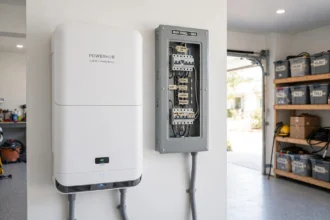
Mostly no. A 20-foot container is overkill for a house in both size and cost, since homes use wall-mounted batteries in the 10 to 20 kWh range.
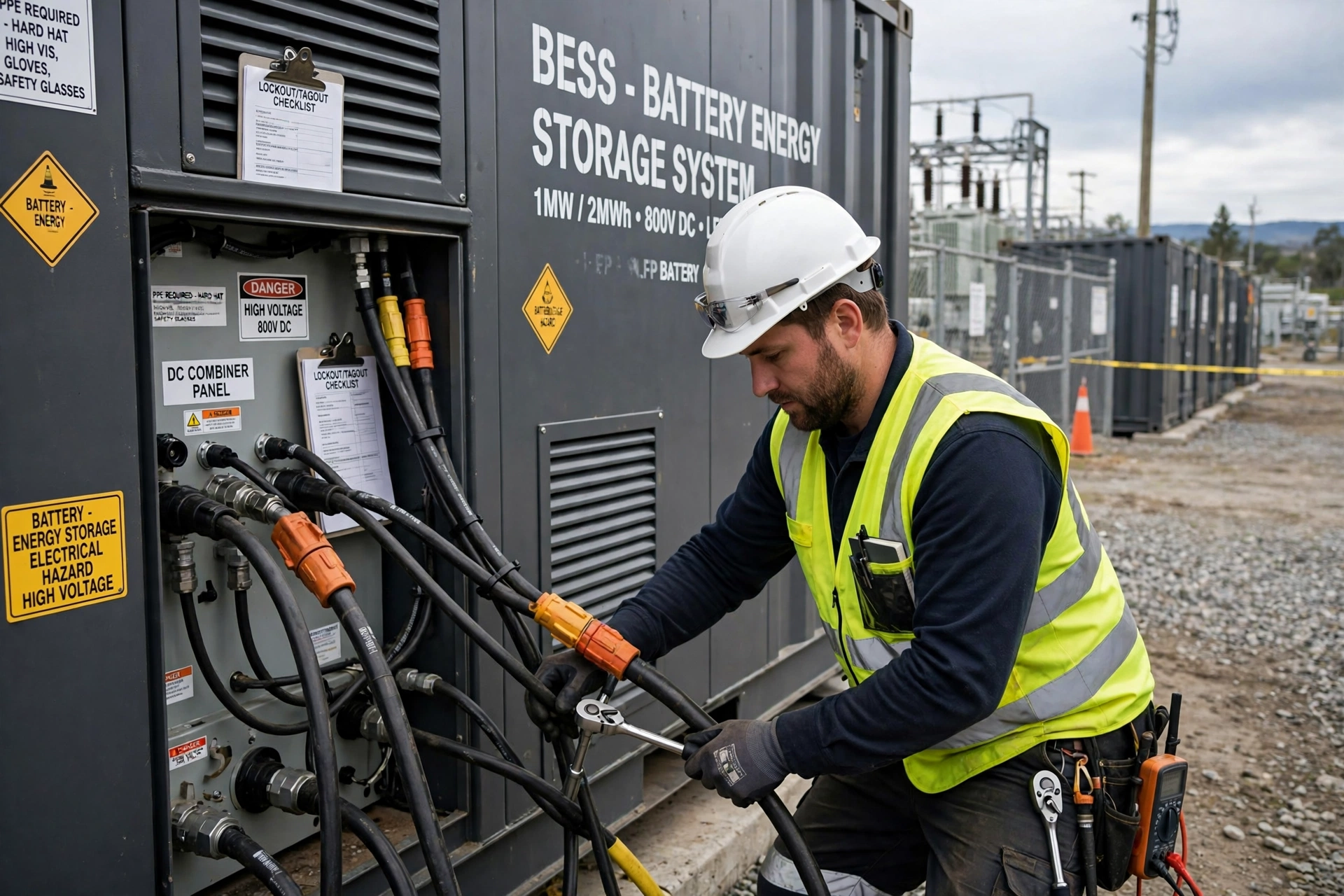
The connection still matters for homeowners, because the same LFP chemistry and BMS concepts inside a giant container also live in a home battery on your garage wall. If you are curious how the small version works alongside an EV, our guide to what an EV charger is explains the home-energy side.
Still, there’s one exception worth noting. Large rural properties, farms, or home-based businesses sometimes install cabinet-sized units in the 200 to 400 kWh range. These sit between home batteries and full containers, and they make sense where grid power is unreliable or very expensive. Properties considering mid-size storage often add EV charging at the same time, so it pays to plan both together.
Safety: What About Battery Fires?
Let us be honest, because buyers always ask: lithium battery fires do happen, and a container holds a lot of lithium.
But context matters. Modern LFP chemistry is far more stable than those early chemistries, and multi-layer protection, cell-level monitoring, and certified fire testing have cut the risk dramatically. Spacing rules, better venting, and stricter commissioning tests are now standard practice.
If you are evaluating a project, ask the vendor three questions: what cell chemistry is used, what fire testing has this exact configuration passed, and how fast does monitoring catch a failing cell? Clear answers signal a serious supplier, while vague ones are a red flag.
FAQs
What is it in simple terms?
It is a giant rechargeable battery built inside a shipping container. It stores electricity from solar, wind, or the grid and releases it later when demand or prices are high. Everything needed, including batteries, cooling, safety systems, and controls, comes pre-installed in one transportable box.
How long do these systems last?
Most LFP-based containers are designed for 15 to 20 years of service and roughly 6,000 to 8,000 full charge cycles. Real lifespan depends on how deeply the system is cycled each day and how well temperature is managed. Shallow daily cycling can stretch service life well beyond the rated cycle count.
How much energy can a 20-foot unit hold?
A modern 20-foot container typically holds 2 to 5 MWh, depending on battery density and configuration. That equals 2,000 to 5,000 kWh, enough to power 65 to 160 average homes for a day. Larger 40-foot units roughly double those figures for utility-scale projects.
Are these containers safe?
Modern containers are far safer than early designs, thanks to stable LFP chemistry, battery management systems, gas detection, fire suppression, and UL 9540A fire testing. Incidents still occur in the industry, so buyers should verify the exact configuration’s certifications and the vendor’s monitoring capabilities before committing.
What is the difference between a BESS and a containerized system?
A BESS (battery energy storage system) is the general term for any large battery installation. A containerized system is one specific form of BESS, where everything ships inside a standard container. All storage containers are BESS units, but not all BESS units are containers, since some are custom-built facilities.
Can one container power a house?
Technically yes, but it’s massive overkill. A small container holds thousands of kWh while a home needs 20 to 40 kWh per day. Homeowners should look at wall-mounted residential batteries instead, since containers are built for solar farms, factories, and utilities rather than single-family homes.
Do they work with solar panels?
Yes, and pairing with solar is their most common job. The container stores excess midday solar output and discharges it in the evening when the sun is down but demand peaks. Many new solar farms include containerized storage as standard equipment, and the combination qualifies for strong tax incentives in several countries.
Conclusion
An energy storage container is the workhorse of the clean energy transition: a factory-built, modular battery system that stores renewable power and releases it when needed.
If you are weighing storage for a business, pull 12 months of electricity bills and find your peak demand charges, since that single number tells you whether peak shaving alone can justify a system. For background on how storage pairs with electric vehicles, our guide to what an EV charger is is the natural companion to this one.