


Sliding Glass Door Window Covering: Manual and Smart Options
A sliding glass door window covering should give you privacy without making every trip outside awkward. Before choosing fabric or smart controls, work out where the covering will sit when the door is open.
That detail can decide the whole purchase. A curtain needs room to gather; a panel-track system needs somewhere to park its panels. A motor adds convenience, but it cannot correct a poor fit.
My recommendation is to settle the physical arrangement first, then choose the controls. Here is how to compare your options, measure properly, and avoid buying an automation system that creates extra work.
Quick answer: The right sliding glass door window covering balances privacy, light control, and easy access. Compare vertical blinds, curtains, panel-track shades, and cellular options by fit and opening direction. For motorized systems, check power, everyday controls, and compatibility with your smart-home platform before choosing a product.
Which Sliding Glass Door Window Covering Suits Your Space?
Start with how you use the doorway. A busy kitchen exit needs a different arrangement from a rarely opened bedroom balcony door.
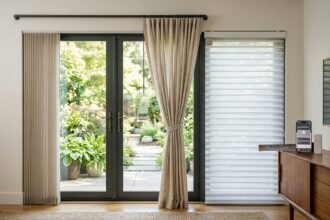
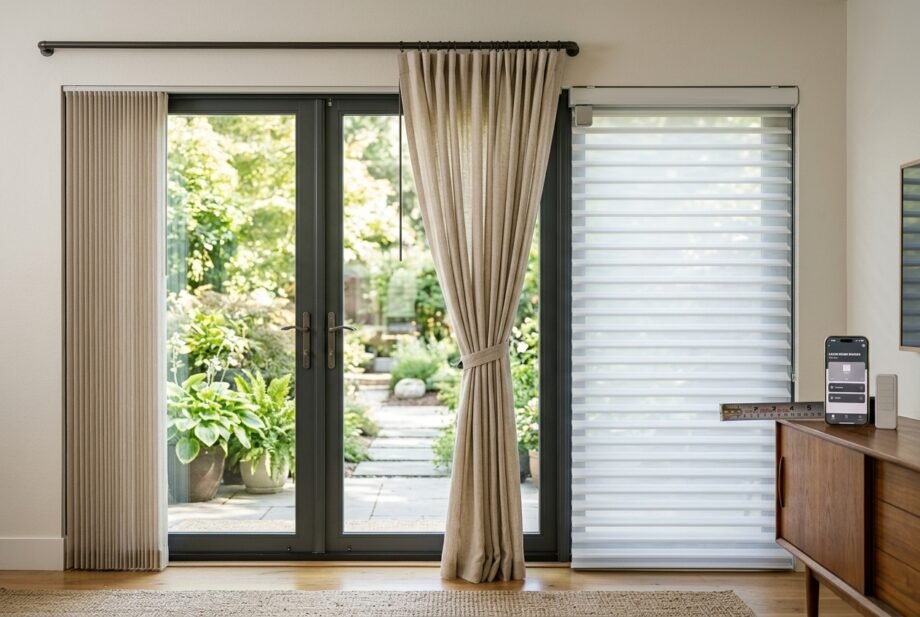
Sideways-opening treatments deserve particular attention because they can move in the same direction as the door. Hunter Douglas identifies horizontal movement as a practical advantage for these openings. However, the available stacking space still matters.
| Covering | Main appeal | Access consideration | What to check |
| Vertical blinds | Adjustable slats and familiar operation | Slats gather to one side or split | Draw direction and slat clearance |
| Curtains | Broad fabric and lining choices | Gathered fabric needs space | Track length and fabric fullness |
| Panel-track shades | Large fabric panels and a clean appearance | Panels overlap when open | Remaining clear opening |
| Vertical cellular shades | Pleated construction and insulation potential | Pleats compress sideways | Stack size and operating options |
| Roller shades | Simple appearance when raised | Must lift clear of the walking route | Maximum width and raised clearance |
| Bypass shutters | Rigid panels and adjustable louvers | Panels slide past one another | Track depth and usable doorway |
For frequent patio access, compare curtains, vertical blinds, and sideways-opening shades first. For a quieter doorway, roller shades may also deserve consideration, provided you accept raising them before passing through.
Choose your sliding glass door window covering around the usable opening, not just the glass dimensions.
Privacy, blackout and warmth are separate decisions
Ask for fabric samples and assess them against light. For nighttime privacy, examine the sample with the room illuminated and someone checking the view from outside where practical.
A blackout fabric does not guarantee a completely dark room: the finished installation also needs attention to edges, overlaps, and mounting. Specify the result you need, rather than relying on a fabric label alone.
If insulation motivates your sliding glass door window covering purchase, inspect the product’s energy-performance evidence. Cellular shades have documented energy-saving potential, but results depend on the covering, installation, climate, and operation. Avoid applying a general savings claim to an unverified vertical model.
How to Measure for a Sliding Glass Door Window Covering
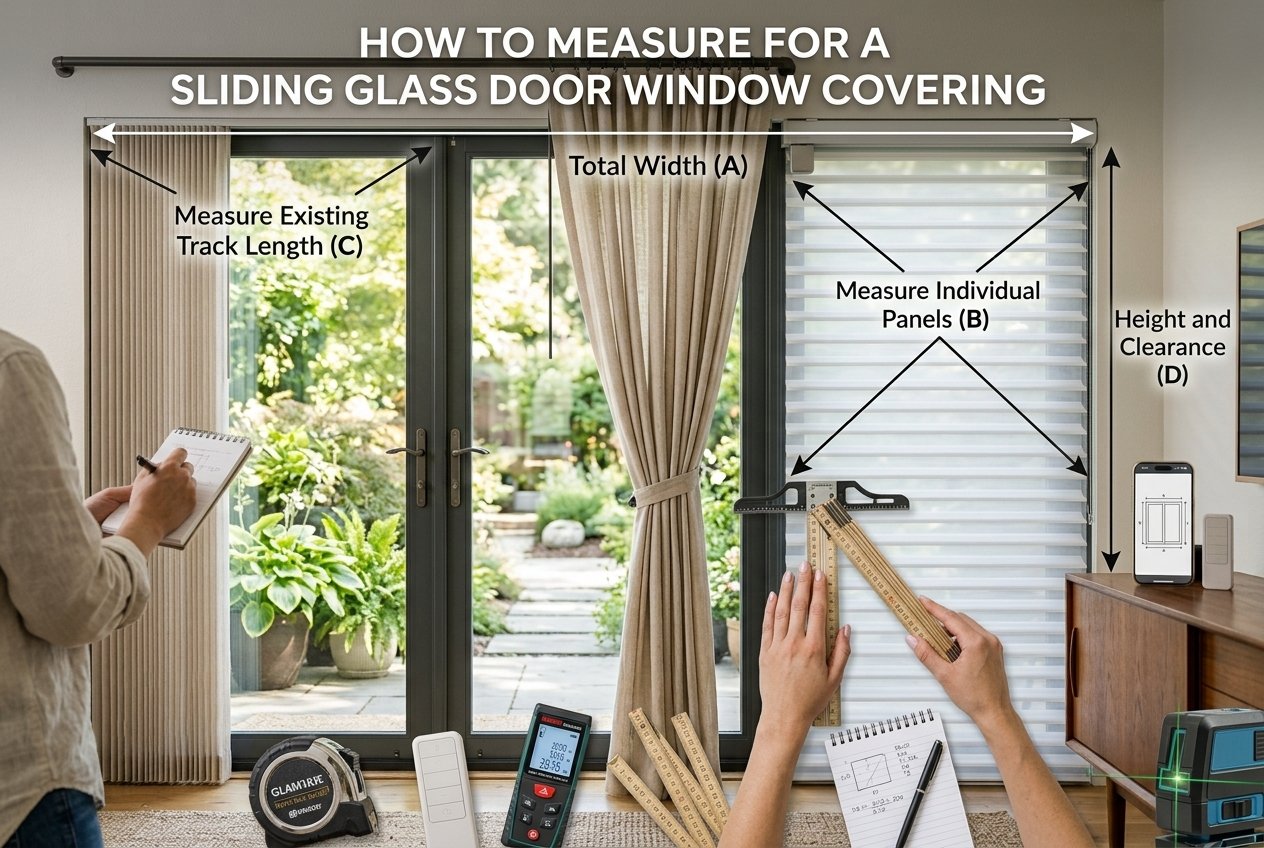
Measure before ordering, using the selected manufacturer’s instructions. Sellers may ask for opening dimensions or finished product dimensions; those are not necessarily interchangeable.
Record these details:
- Moving panel: Which side opens, and where do people walk?
- Mounting position: Wall, ceiling, or a suitable recess?
- Width and drop: Measure at the points required by the supplier.
- Handle projection: Include handles, locks, and nearby obstructions.
- Stack-back: Allow for fabric, slats, or panels when fully open.
- Mounting support: Confirm that the proposed fixing locations suit the system.
- Power access: Locate charging ports, sockets, or the approved supply route.
For any sliding glass door window covering, request the actual open-stack dimension when available. A photograph cannot reliably tell you how much doorway remains clear.
For example, imagine a hypothetical 72-inch opening with only a narrow strip of wall beside it. Extending a curtain track beyond the glass might help, but only if sufficient wall space and suitable mounting support exist. Otherwise, you may need a different draw arrangement or covering.
Do not automatically add a fixed number of inches to every order. Fabric fullness, panel overlap, brackets, and motor placement vary.
Also check furniture placement. A covering can fit the opening correctly yet collide with a nearby cabinet or become difficult to charge behind a sofa.
Is a Motorized Sliding Glass Door Window Covering Worth It?
Motorization is worth considering when reaching the covering is difficult, daily adjustment is inconvenient, or scheduled privacy would be useful. Manual operation remains a sensible choice when the mechanism is easy to reach and use.
There are three purchasing routes:
- Manual covering: Fewer components and no motor to charge.
- Retrofit motor: Retains a compatible existing covering or track.
- Complete motorized system: Supplies the covering and drive mechanism as a matched arrangement.
A retrofit is not automatically compatible with your sliding glass door window covering. Check the supported track or roller tube, dimensions, load, brackets, and travel direction.
Eve’s Motionblinds Upgrade Kit, for example, is designed for compatible roller blinds and uses a rechargeable USB-C battery. Its requirements should not be generalized to curtain tracks or vertical blinds.
Think of a motorized sliding glass door window covering as several connected parts: fabric, moving mechanism, motor, power supply, everyday controls, and optional smart-home equipment.
Compare the complete installed cost. Ask whether the quotation includes the motor, remote, gateway, fitting, charger, and future replacement parts.
Check the electrical label, not just the connector. A USB charging port and a motor’s separate DC power input serve different purposes. Use the specified voltage, polarity, connector, and supply rating; similar-looking plugs are not proof of compatibility.
Ask for a noise demonstration if the covering will operate in a bedroom. Also check charging access and the manufacturer’s supported fallback controls. A motorized mechanism should never be assumed safe to force by hand.
For more help comparing fabrics, privacy, and automation, explore our window covering ideas for privacy and smart control.
Smart-Home Compatibility: What to Check Before Buying
“Motorized” describes movement. It does not establish compatibility with your preferred app or voice assistant.
For a connected sliding glass door window covering, verify the exact motor and controller combination before ordering.
| Platform or technology | Confirm before purchase |
| Apple Home | Supported model, connection route, required home hardware |
| Google Home | Supported integration, available commands, dependencies |
| Amazon Alexa | Integration method, gateway requirements, supported functions |
| Home Assistant | Exact integration and exposed controls |
| Matter | Native or bridged support and compatible controller |
| Thread | Required border router and supported setup procedure |
| Zigbee | Compatible hub/coordinator and device support |
| Z-Wave | Controller support and correct regional model |
| Wi-Fi | Supported network settings and local/cloud requirements |
Matter and Thread are not interchangeable labels. Matter defines device interaction; Thread provides a network connection for products that use it. Home Assistant documents the need for a Thread border router when connecting Matter-over-Thread devices through its integration.
A gateway can also change the purchase. Hunter Douglas identifies its PowerView Gateway as the component enabling integration with other manufacturers’ smart-home systems and remote access.
Confirm whether your sliding glass door window covering exposes only opening and closing, or also position and any supported slat adjustment. Check this in the chosen integration’s documentation.
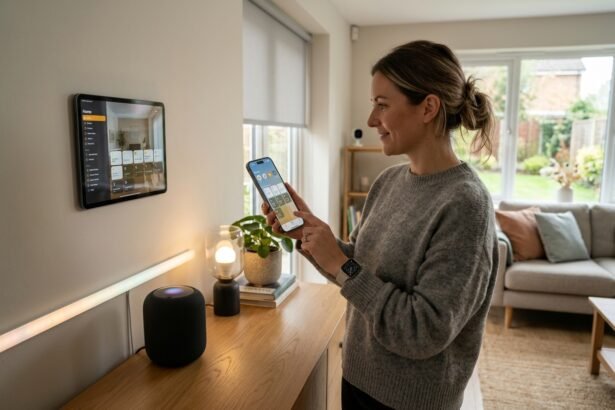
If you use an iPhone, our guide to how Apple Home works and which hardware you need explains the platform and home-hub requirements.
Installation and Setup, Step by Step
The following is a commissioning checklist to use alongside the product manual. Button sequences, mounting details, and travel-limit procedures vary.
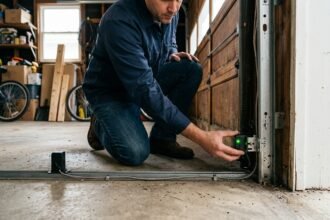
Electrical and installation safety: Use a qualified electrician for mains wiring and follow local requirements. Use manufacturer-approved supplies and suitable fixings. Keep cables and moving components clear of the doorway. Do not drill where concealed services may be present.
1. Verify the physical installation
Check the supplied dimensions, brackets, and parts before drilling. Confirm that the door opens fully without catching the proposed covering.
An incorrectly aligned sliding glass door window covering needs mechanical correction before automation setup. Do not try to compensate for rubbing fabric or a crooked track through app settings.
2. Establish reliable basic operation
Charge or connect the specified supply. Set opening and closing limits using the manual, then run several complete cycles with the supplied control.
Check for rubbing, uneven movement, and an obstructed walkway. Stop if the system binds; repeated attempts are not a repair.
3. Add the supported smart controls
Follow the manufacturer’s pairing procedure. Confirm required gateways or controllers are running, and preserve the setup code in a secure place.
For your sliding glass door window covering, verify that app commands correspond to the actual open and closed positions before building routines.
4. Start with one useful automation
Try a simple evening privacy schedule. Choose a time that suits household activity, and explain the physical control to everyone who uses the door.
Add more complex behavior only after the basic routine is dependable. If you later want routines based on whether the patio door is open, our door and window contact sensor guide explains sensing and hub requirements. Confirm that your covering and platform support the intended routine.
5. Check fallback behavior
Document how your sliding glass door window covering behaves when internet access is unavailable. Keep local equipment powered during this check; it is a different scenario from a household power failure.
Confirm any power-loss behavior from the manual. Do not unplug hardwired equipment or pull against a powered mechanism to experiment.
Troubleshooting: Obstructions, Offline Controls and Power Loss
When a sliding glass door window covering stops responding, identify which control still works. That quickly narrows the investigation.
| Symptom | First checks |
| Fabric catches or panels rub | Obstructions, alignment, stacking space |
| Motor stops early | Charge, load, obstruction, travel limits |
| Remote works; app fails | Gateway, integration, network connection |
| Pairing will not finish | Setup procedure, controller, discovery requirements |
| Nothing responds | Motor power, supplied controls, documented recovery |
Check mechanics and power before resetting everything. A factory reset can add unnecessary reconfiguration when the real problem is a depleted battery.
For Matter installations, Home Assistant highlights local IPv6 and mDNS discovery. Network isolation or multicast filtering can interfere with communication. Review Home Assistant’s Matter troubleshooting documentation before changing router settings.
During an outage, a battery-powered motor may retain power while its controller or gateway does not. That does not guarantee every command or schedule will work. Verify the supported physical control separately.
Maintenance and Long-Term Reliability
Maintain your sliding glass door window covering according to its fabric and mechanism instructions. Keep the travel path clear, check accessible fixings, and inspect charging cables for damage.
Record the model, power-supply specification, purchase details, and setup procedure. Check whether batteries and remotes are replaceable before support becomes an urgent issue.
Review permissions and account requirements for connected apps. Local device control does not establish that every associated service avoids cloud processing.
Install firmware only through supported procedures. Do not assume older firmware can be restored, and avoid unofficial flashing as a routine troubleshooting step. Interrupted or incompatible updates can leave equipment unusable.
Child safety: Accessible window-covering cords can present a strangulation hazard. CPSC’s window-covering safety guidance identifies cordless coverings as the safest choice where young children are present. Inspect the complete product rather than assuming motorization removes every accessible cord.
Frequently Asked Questions
What is the best window covering for a sliding glass door?
The best option meets your privacy needs while clearing the walking route. Compare side-drawing curtains, vertical blinds, panel tracks, and vertical cellular shades first for frequently used doors. Your available stacking space and preferred light control should guide the final choice.
What can I use instead of vertical blinds?
Alternatives include curtains, panel-track shades, vertical cellular shades, roller shades, and suitable shutters. Compare their fully open positions, not just their appearance when closed. Ask the supplier to show how much glass and walking space each proposed arrangement leaves available.
How do you measure a sliding glass door for blinds or curtains?
Identify the mounting position, then follow the supplier’s width and drop instructions. Check handles, nearby furniture, stack-back space, and mounting support. Confirm whether the seller wants opening measurements or finished product dimensions before ordering, especially for custom products with limited return options.
Are motorized blinds or curtains worth it?
A motorized sliding glass door window covering can be worthwhile for difficult access, frequent adjustment, or scheduled privacy. Compare the full system cost and ongoing charging needs. Ask for a demonstration of everyday operation, including the physical remote and any documented fallback behavior.
Do smart blinds work without Wi-Fi or during a power outage?
Some use other radio technologies or physical controls, but behavior depends on the complete system. Internet failure, Wi-Fi failure, and loss of electrical power are different events. Check motor power, controller availability, and the manufacturer’s supported controls; never assume that battery power preserves every smart feature.
Final Verdict
Choose your sliding glass door window covering in this order: usable access, mounting fit, privacy, light control, then automation. Request samples and open-stack measurements before committing to a custom order.
Motorization earns its place when it makes a daily task easier. Match the mechanism to the door, verify the exact ecosystem requirements, and make sure everyone can operate it comfortably. A well-chosen manual covering is useful every day; a well-chosen smart version should make that same reliable arrangement more convenient.
Disclaimer:
Specifications, compatibility, and installation requirements vary by model. Follow the manufacturer’s instructions; use qualified help for mains wiring or uncertain mounting conditions, and never assume manual release is supported.