

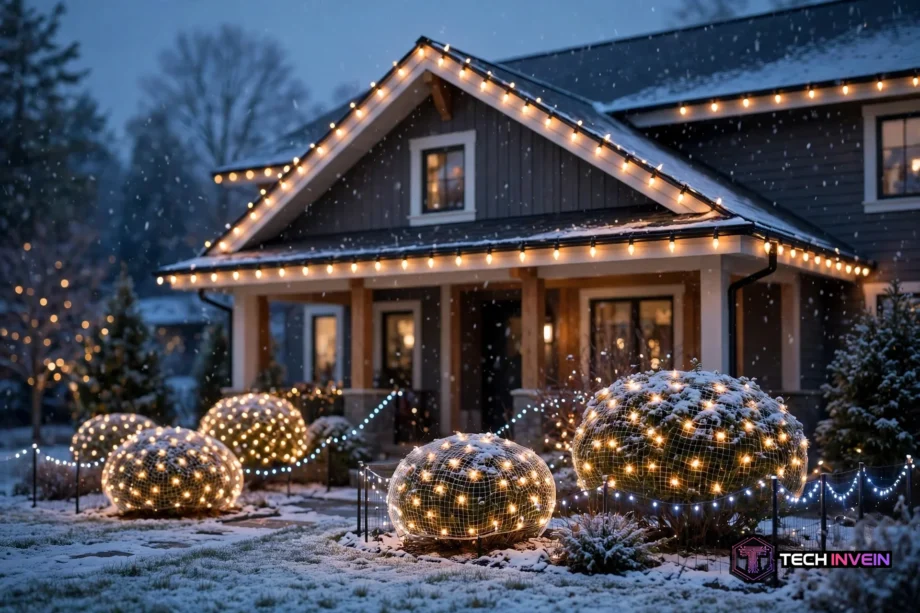
The best outdoor Christmas lights for most homes are LED strings with an IP65 rating, warm white or color modes, and a timer. Govee Christmas Lights 2 lead for smart control, while classic C9 LED bulbs lead for a bold roofline look. So start with your spot, then match the light type to it.
- Best Outdoor Christmas Lights by Type
- How to Pick the Right Set
- What IP Ratings Mean Outdoors
- Our Best Outdoor Christmas Lights Picks for 2026
- Best smart string: Govee Christmas Lights 2
- Best for mapped effects: Twinkly Strings 400
- Best classic roofline: C9 LED bulbs
- Best for shrubs: net lights
- Best with no outlet: solar Christmas lights
- Best permanent option: eave lights
- Timers, Schedules, and Smart Control
- The Mistake That Ruins Most Displays
- Power and Safety Basics
- FAQs
- How many outdoor Christmas lights do I need for a house?
- Are LED Christmas lights better than incandescent ones outdoors?
- What IP rating do outdoor Christmas lights need?
- Can I leave outdoor Christmas lights up all winter?
- Can you connect different brands of Christmas lights together?
- How do I hang Christmas lights without damaging my house?
- Conclusion
Best Outdoor Christmas Lights by Type
Not every set suits every spot. A roofline needs big bulbs that read from the street. A bush needs even cover in one throw. So pick by job first, then compare brands inside that type.
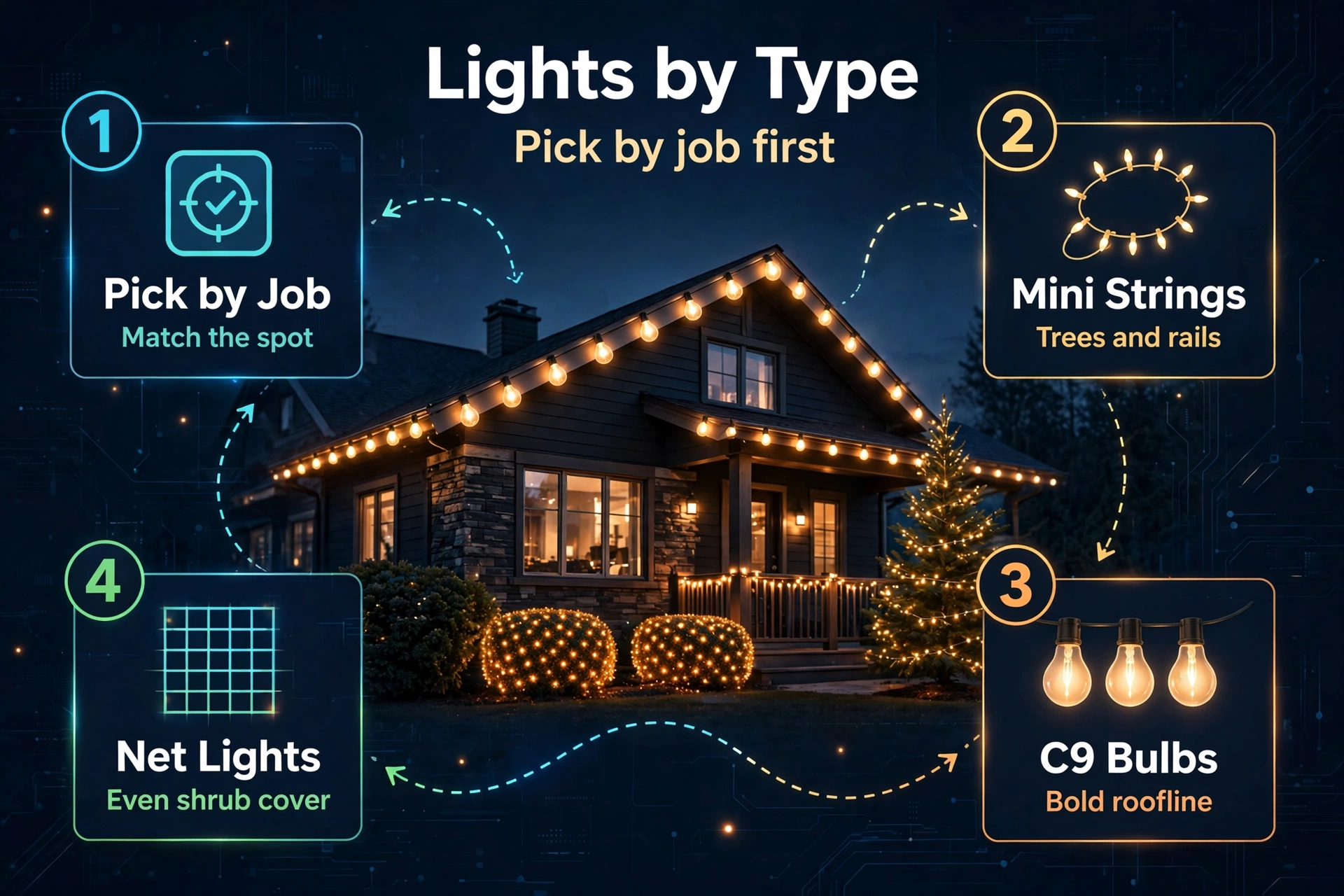
LED mini strings are the all-round choice. They wrap trees, rails, and garland with ease. They also use less power than old incandescent sets, and they stay cool to the touch.
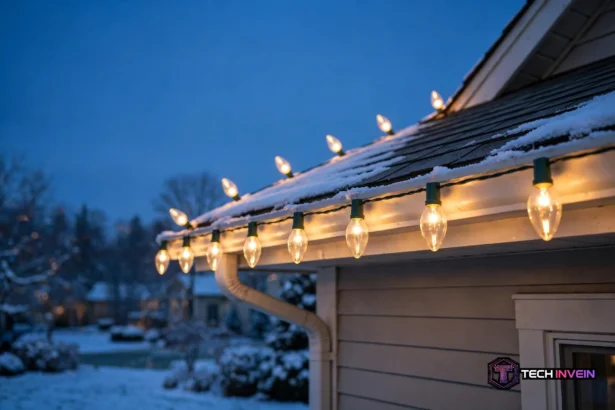
C9 bulbs give the classic look. They sit 12 to 24 inches apart on most strands, so each bulb stands out. C7 bulbs are smaller, and they suit a single-story home or a porch rail.
Table: Best outdoor Christmas lights at a glance, by type and best use.
| Type | Best spot | Weather rating to look for | Control |
|---|---|---|---|
| LED mini strings | Trees, rails, garland | IP44 or higher | Button, remote, or app |
| C9 LED bulbs | Rooflines and gutters | IP65 | Button or timer |
| Net lights | Shrubs and hedges | IP44 or higher | Button or timer |
| Icicle lights | Eaves and porches | IP44 or higher | Button or timer |
| Smart strings | Feature trees and rooflines | IP65 for exposed runs | App and voice |
| Solar strings | Fences and paths | IP44 or higher | Button and light sensor |
| Permanent eave lights | Eaves, all year | IP65 or IP67 | App and voice |
How to Pick the Right Set
Measure first, then shop. Walk the roofline or tree with a tape, and write down the length in feet. Then add about 10 percent for sag, corners, and the drop to the outlet. That small buffer stops a shortfall on install day.
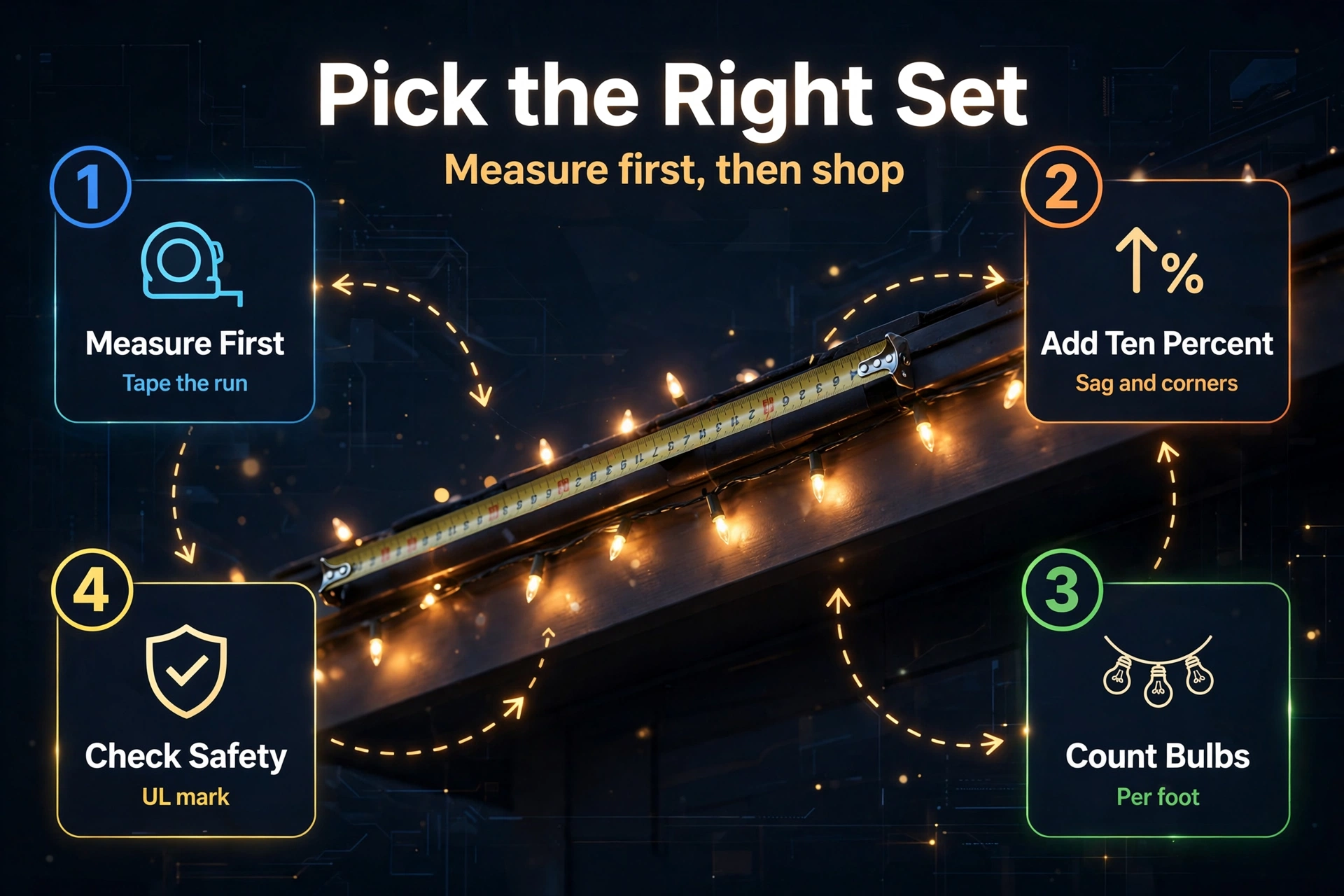
Count bulbs per foot as well. Mini strings often pack 3 to 4 bulbs per foot, which gives a dense glow. C9 strands space bulbs much wider, so they read as single dots from the street. Both can look great, but they give a very different feel.
Look for a UL mark or a similar safety listing on the box. Also check the max connectable sets in the manual before you link strands end to end. Too many linked sets can trip a breaker or dim the far end.
If you want a deeper smart comparison, our guide to the best smart Christmas lights covers app features and indoor picks as well.
What IP Ratings Mean Outdoors
IP ratings tell you how a set handles dust and water. The first digit covers solids, and the second covers water. So IP44 means splash-proof, while IP65 means it can take water jets from any side.
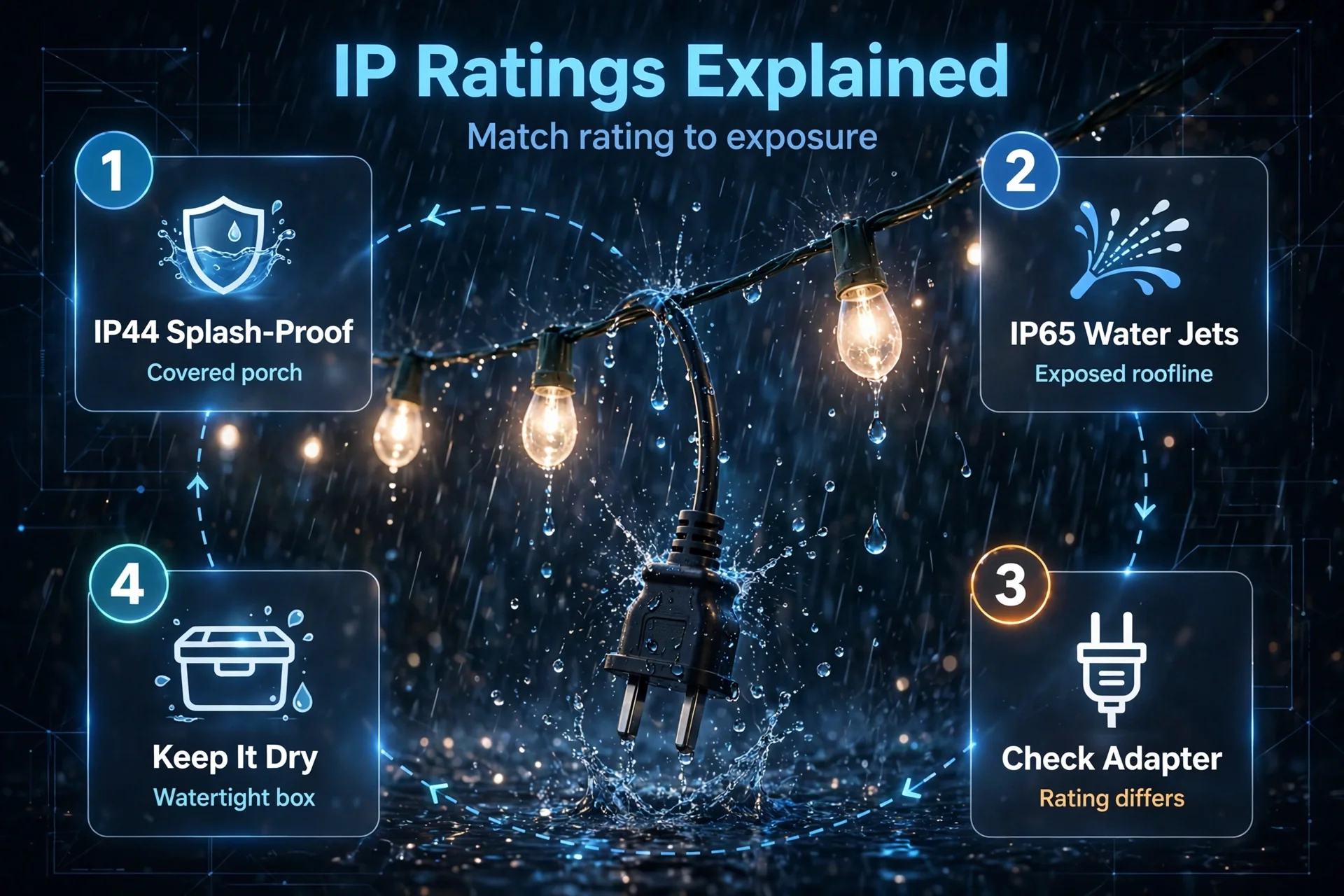
IP44 suits a covered porch or a sheltered rail. It does not suit a fully exposed roofline in heavy rain. IP65 is the safer pick for rooflines, yard trees, and fence tops that face the sky.
Watch the adapter rating as well, because it often differs from the string rating. Many smart strings rate the lights IP65 but rate the adapter IP44. Then the adapter must sit in a watertight box or under cover, even when the string can take rain.
Our Best Outdoor Christmas Lights Picks for 2026
These picks come from maker specs, not from a lab test in our hands. We compared length, bulb count, weather rating, and control options on the listing or manual for each set. Then we matched each one to the job it does best.
Best smart string: Govee Christmas Lights 2
Govee Christmas Lights 2 is the smart pick for most homes. The 66-foot kit carries 200 RGBWIC LEDs, and each bulb has its own chip plus a dedicated white diode. So warm white looks clean, not like a muddy mix of red, green, and blue.
The string rates IP65, and it works from minus 20 to 40 degrees C. It runs on Wi-Fi and Bluetooth, and it works with Alexa, Google Assistant, and Matter. It also offers more than 130 preset scenes, plus shape mapping in the Govee Home app.
One limit matters here. The set does not support series connection, so you cannot link two sets end to end. Also, the adapter on the 66 to 164-foot kits rates IP44, so keep it dry in a watertight box outdoors. The manual for the Govee Christmas Lights 2 user manual lists these ratings in full.
Best for mapped effects: Twinkly Strings 400
Twinkly Strings 400 suits a display built around effects. The set carries 400 addressable RGB LEDs over 105 feet, with lamps spaced about 3.1 inches apart. It also works with Alexa, Google Assistant, and Apple HomeKit.
The Twinkly app maps your lights with your phone camera. Then it knows where each bulb sits, so effects can chase across a tree or a wall in the right order. That mapping step is the main reason to pick Twinkly over a plain smart string.
The set runs on Wi-Fi and Bluetooth, and it can group with other Twinkly devices for one synced display. The Twinkly Strings 400 datasheet lists the 105-foot length, 400 LEDs, and IP44 rating.
Best classic roofline: C9 LED bulbs
C9 LED bulbs give the bold look most people picture on a house at Christmas. The large bulbs read clearly from the street, even on a wide two-story front. They also use far less power than old C9 incandescent bulbs.
Look for a set rated IP65, with bulbs spaced 12 to 24 inches apart. Some sets wire bulbs in parallel, so one bulb out leaves the rest lit. Others let you unscrew and replace a single bulb, which saves a whole strand.
Hang C9 strands with clips, not nails or staples. Clips grip the wire or the socket without piercing it, so the strand lasts more seasons. Then test the full run on the ground before you climb a ladder.
Best for shrubs: net lights
Net lights are the fastest way to dress a bush. One mesh sheet spreads bulbs evenly, so you skip the slow wrap and the bare patches. Most nets measure about 4 by 6 feet or 6 by 4 feet, so measure your shrub first.
Look for 150 to 360 LEDs per net, based on the size of the bush. A small shrub needs fewer bulbs, while a wide hedge may need two nets side by side. Then connect the nets with the lead cord, not by stretching one net too far.
Drape the net from the top down, then tuck the edges under the outer branches. That keeps the mesh in place in wind, and it hides the wire from the street. So step back and check the cover before you plug it in.
Best with no outlet: solar Christmas lights
Solar strings suit fences, far trees, and garden beds where no outlet sits close. A small panel charges by day, and a light sensor switches the bulbs on at dusk. So you skip extension cords across a lawn.
For a patio, Zigbee string lights join the same mesh as your other lights, so they respond fast. Our outdoor Zigbee string lights patio review tests one such set on a real patio.
Runtime depends on sun, not on the box claim alone. A panel in full sun may run 6 to 8 hours, while a shaded panel may run far less. Then a cloudy week can cut that time further, so place the panel where it sees the most sun.
If you want solar lights that also react to movement, our guide to solar smart lights with a motion sensor for garden paths shows how those sensors work outdoors. Pick solar when the spot is far from power, and accept shorter runtimes on dark days.
Best permanent option: eave lights
Permanent eave lights stay up all year in a channel under your roof edge. You install them once, then switch scenes for Christmas, Halloween, and everyday white light. So they suit a home where you hate ladders in December.
Look for IP65 or IP67 lights, with an app that offers warm white plus color scenes. Govee Permanent Outdoor Lights 2 lists IP67 lights over 100 feet, with 72 lights in that run. Eufy Permanent Outdoor Lights E22 lists a similar 100-foot run with 60 triple-LED nodes.
Pixel spacing decides how smooth effects look up close. One node per foot gives a clear dot pattern, while tighter spacing looks smoother on a wall wash. So check the node count per 100 feet before you buy, not just the total length.
Timers, Schedules, and Smart Control
A timer is the cheapest upgrade in Christmas lighting. It switches lights on at dusk and off at bedtime, so you save power and skip the daily trip to the plug. Most plug-in timers cost little, and they work with any set.
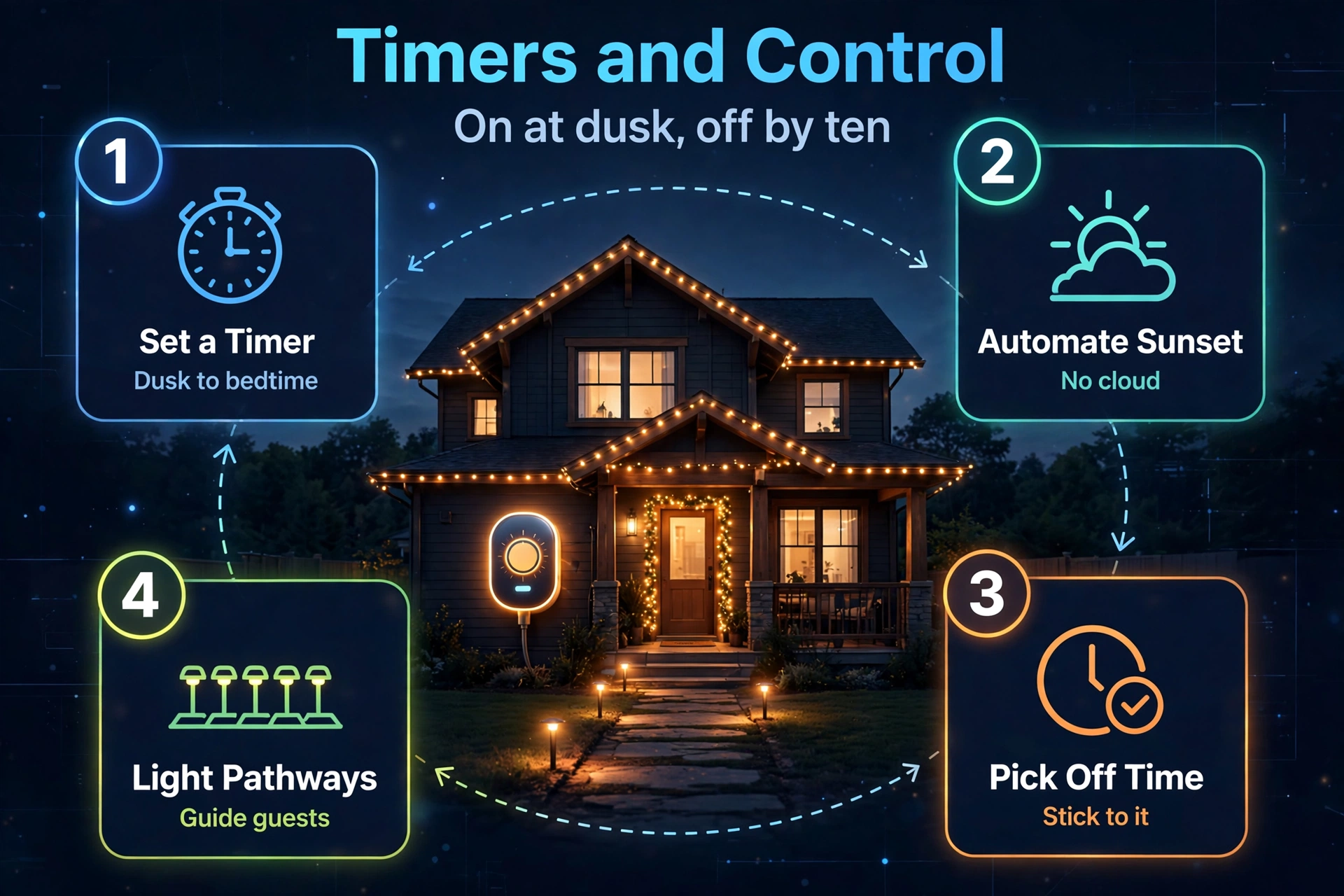
Home Assistant can tie outdoor lights to sunset with no cloud at all. Our guide to automating outdoor lights at sunset and sunrise in Home Assistant walks through that setup step by step. It suits a smart home that already runs Home Assistant.
Set one off time and stick to it. Lights that run all night waste power, and they can annoy neighbors. A 5 p.m. to 10 p.m. window covers the evening, and it still leaves the house dark for sleep.
Pathway lights guide guests to the door, and they also mark the edge of a walk in the dark. Our roundup of the best smart outdoor pathway lights with no wiring covers battery and solar options for that job.
The Mistake That Ruins Most Displays
The most common mistake is buying by total length alone. Two sets can both say 100 feet, yet one has 100 bulbs and the other has 300. Then the sparse set looks thin on a tree, while the dense set looks full.
Check bulbs per foot before you buy. Divide the bulb count by the length, and compare that number across sets. A mini string with 3 bulbs per foot suits a tree, while a C9 strand with 1 bulb per 2 feet suits a roofline.
Test the full display on the ground first. Plug in every strand, check every mode, and swap any dead bulb before you hang a thing. That one hour of testing saves a cold night on a ladder.
Power and Safety Basics
Use only outdoor-rated lights outdoors, and plug them into a GFCI outlet. A GFCI outlet cuts power fast if water gets into a cord, so it is the single most vital safety step. If your outdoor outlet has no GFCI, ask an electrician to fit one.
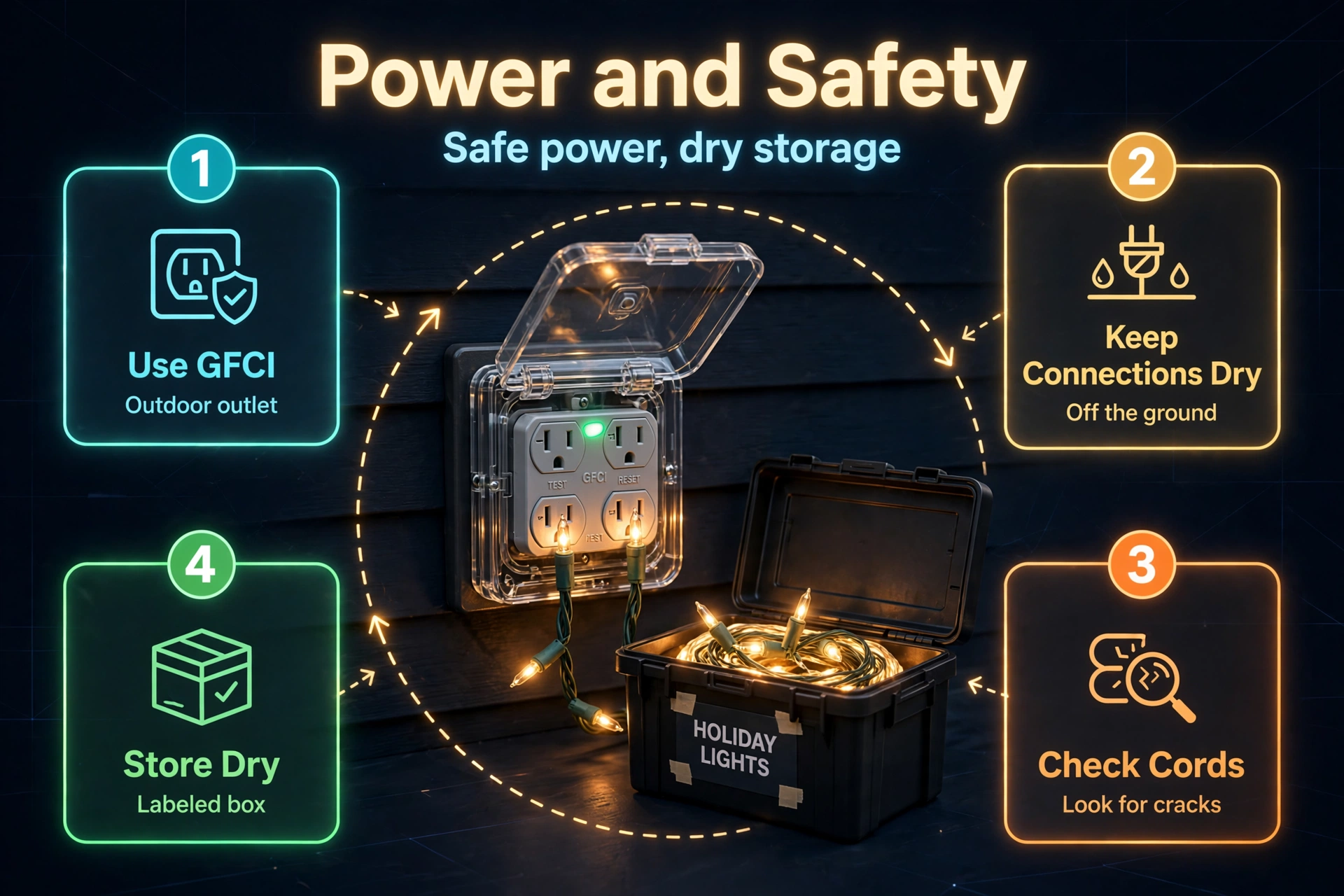
Keep connections off the ground and out of puddles. Use a weatherproof in-use cover on the outlet, and seal cord joints with a cord cover. Then check the cords each year for cracks, since sun and cold wear the insulation.
Take lights down on time, or store them dry if you leave permanent sets up. Coil each strand loosely around your arm, and store it in a labeled box with its clips. That keeps next December quick and tangle-free.
FAQs
How many outdoor Christmas lights do I need for a house?
Measure each run in feet, then add about 10 percent for sag and corners. A 30-foot roofline needs about 33 feet of lights, while a 6-foot tree needs about 66 feet of mini lights for a full wrap. Count peaks and gables as extra length, since slopes add more feet than a straight eave.
Are LED Christmas lights better than incandescent ones outdoors?
Yes, LED lights are better outdoors in most cases. They use less power, run cooler, and last far longer than incandescent bulbs. They also hold up better in cold weather, since they do not rely on a hot filament. Incandescent sets still give a warm classic glow, but they cost more to run and burn out faster.
What IP rating do outdoor Christmas lights need?
Look for IP44 on a covered porch or sheltered rail, and IP65 on a fully exposed roofline or yard tree. IP65 handles rain and water jets, while IP44 handles splashes only. Check the adapter rating too, since many adapters rate IP44 even when the string rates IP65. Then keep the adapter dry in a box.
Can I leave outdoor Christmas lights up all winter?
Yes, you can leave outdoor-rated LED lights up through winter if they stay dry at the plugs. Check cords and adapters after storms, and clear snow off the strands so weight does not pull them down. Take plug-in sets down in early spring, and store them dry in a labeled box.
Can you connect different brands of Christmas lights together?
No, you should not connect different brands end to end in most cases. Plugs, voltage, and max link counts differ by brand, so a mixed run can dim, flicker, or trip a breaker. Use one brand per run, and start a new run from a separate outlet for a second brand. Then check the manual for the max linked sets.
How do I hang Christmas lights without damaging my house?
Use plastic clips made for gutters, shingles, or brick, and never use nails or staples. Clips grip the wire without piercing it, so the strand and the house both stay safe. Test the full run on the ground first, then hang it with a stable ladder and a helper. Remove the clips in spring to avoid marks.
Conclusion
Start with your spot, then pick the type that fits it. Use C9 bulbs for the roofline, mini strings for trees, nets for shrubs, and a smart IP65 set for effects. Measure twice, add 10 percent, and test the run on the ground before you hang it.
Check the best outdoor Christmas lights picks above, then order the set that matches your longest run. Hang it with clips, keep the adapter dry, and set a timer for dusk to 10 p.m. Your house will look bright, and you will spend less time on a ladder next year.