


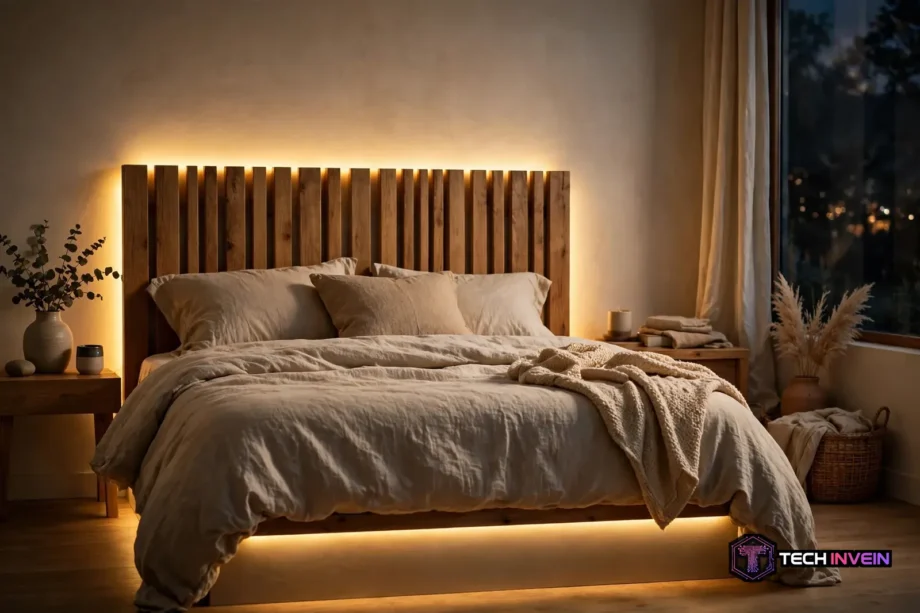
The best led lights for bedroom decor are flexible LED strips hidden behind furniture and along ceiling edges. They beat a single harsh ceiling bulb. They wash walls with soft, dimmable colour. So the room feels calm at night and still works for reading or getting dressed.
- Why Strips Beat a Single Ceiling Light
- Choosing LED Lights for Bedroom Decor
- Best Places to Put Strips in a Bedroom
- Behind the Headboard
- Along the Ceiling Edge
- Under the Bed Frame
- Wardrobes, Shelves, and Desks
- Mirrors and Vanity Corners
- Colour, Brightness, and Control
- Installing Strips Without Damage
- Scenes for Sleep, Reading, and Mornings
- A Small Test Worth Copying
- Mistakes That Ruin the Look
- FAQs
- Are strip lights safe to leave on overnight?
- What colour works best for sleep?
- Can strips replace a ceiling light completely?
- Why do my strips show dots instead of a smooth line?
- How long do bedroom strips last?
- Do I need a smart strip, or will a simple one do?
- Final Thoughts
Why Strips Beat a Single Ceiling Light
A ceiling light throws light straight down. As a result, it creates hard shadows and a flat, washed-out room. Strips do the opposite job. They bounce light off a wall or ceiling, so the glow feels soft and even.
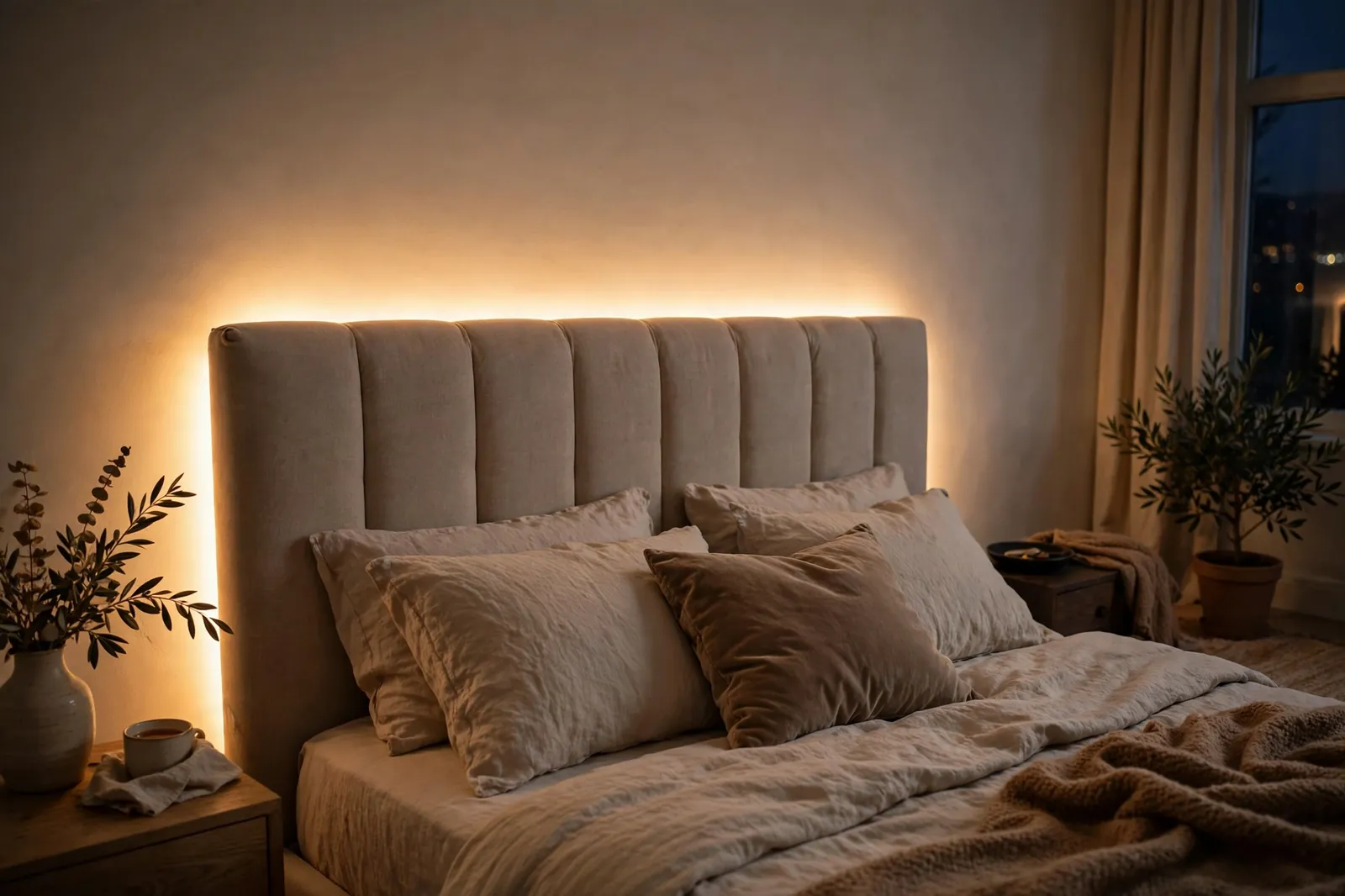
That difference matters most in a bedroom. You want low light when you wind down, and you want brighter light when you get ready. One fixed ceiling bulb cannot do both jobs well. Strips can, because you can dim them and change their colour.
Strips also let you light zones, not the whole room at once. For example, you can glow the headboard wall while the rest of the room stays dark. Your partner can sleep while you read. That kind of control is hard to get from one overhead fitting.
Choosing LED Lights for Bedroom Decor
Start with the job, not the product page. Do you want a soft halo behind the bed, a night light under the bed, or a bright strip for a desk corner? Each job needs a different strip, and buying one long roll for everything is a common first mistake.
For a calm bedroom, pick a warm white strip first. Warm white sits around 2700K to 3000K, and it looks like lamplight rather than office light. Cool white can look clean in a kitchen, but in a bedroom it often feels cold and hard to relax under.
Density matters more than most buyers expect. A strip with 30 LEDs per metre shows clear dots when you can see it. In contrast, a denser strip, or a strip hidden in a channel, gives a smooth line of light. If any part of your strip will be visible, go denser or hide it well.
Our comparison of COB versus RGB strips for ambient lighting explains the dot problem in more depth. It helps if you can’t decide between a smooth white glow and full colour.
Before you buy, measure every run with a tape, not by eye. Corners, headboard widths, and bed lengths all eat up strip. Also, add a little extra for the turn at each end. A run that ends 20 cm short looks unfinished, and joining a short offcut later rarely matches the first strip exactly.
Best Places to Put Strips in a Bedroom
Good placement hides the strip and shows only the glow. If you can see the strip itself, the effect drops fast. So aim each strip at a surface, and let that surface spread the light for you.
Behind the Headboard
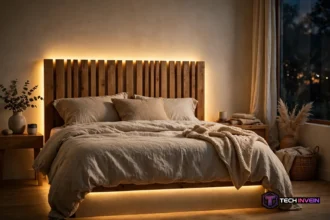
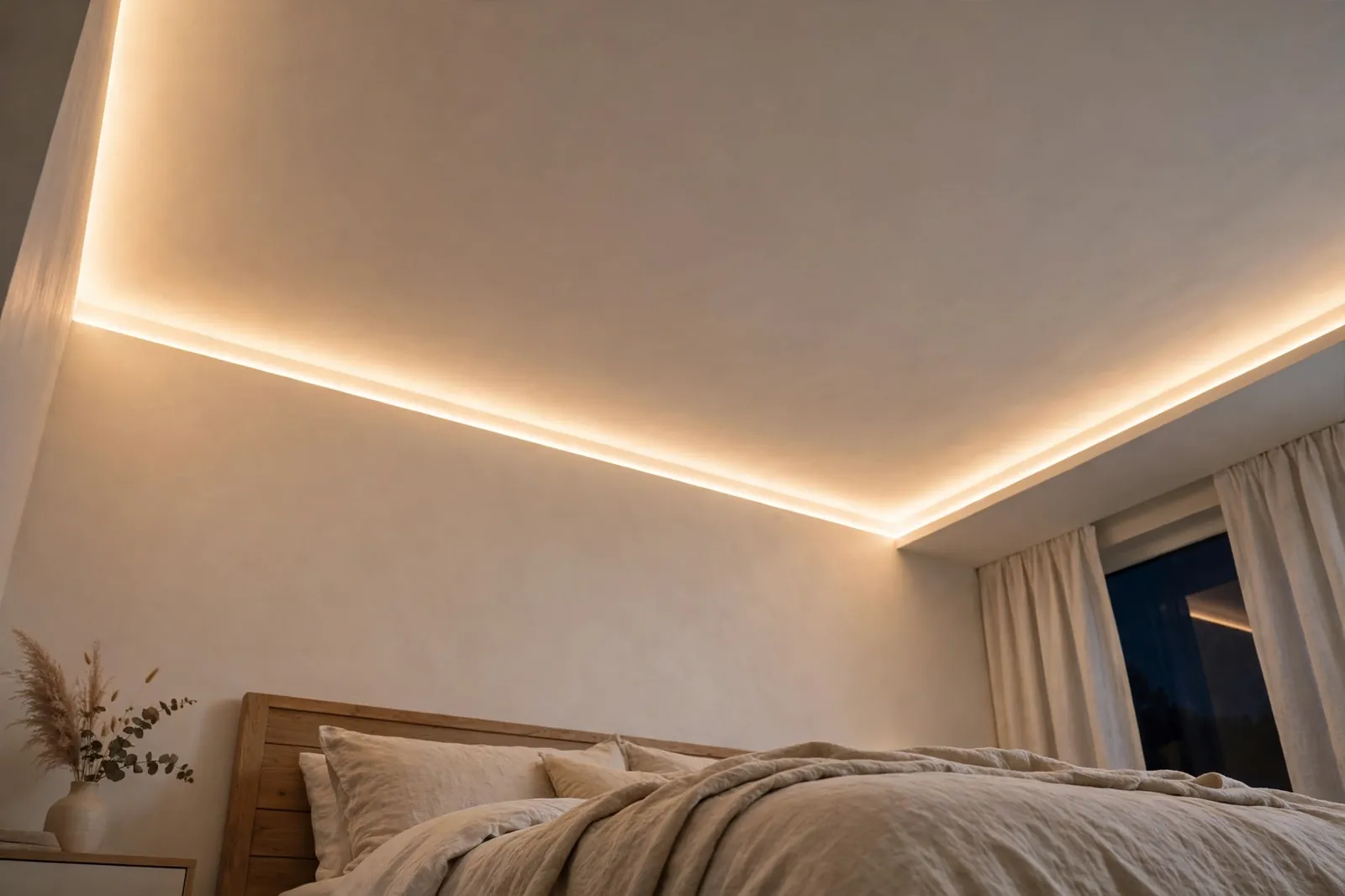
This is the easiest win in most bedrooms. Fix the strip to the back of the headboard, a few centimetres in from the edge, and point it at the wall. The wall then glows in a soft halo around the bed.
Keep the strip inset so it does not shine into your eyes when you sit up. A small gap between the headboard and the wall helps too. Even 3 to 5 cm of space gives the light room to spread instead of forming a hard line.
Along the Ceiling Edge
A ceiling cove or a simple ledge near the ceiling gives the most room-wide effect. The strip points up, light bounces off the ceiling, and the whole room feels taller and softer. This is the closest a strip comes to replacing a ceiling light.
Under the Bed Frame
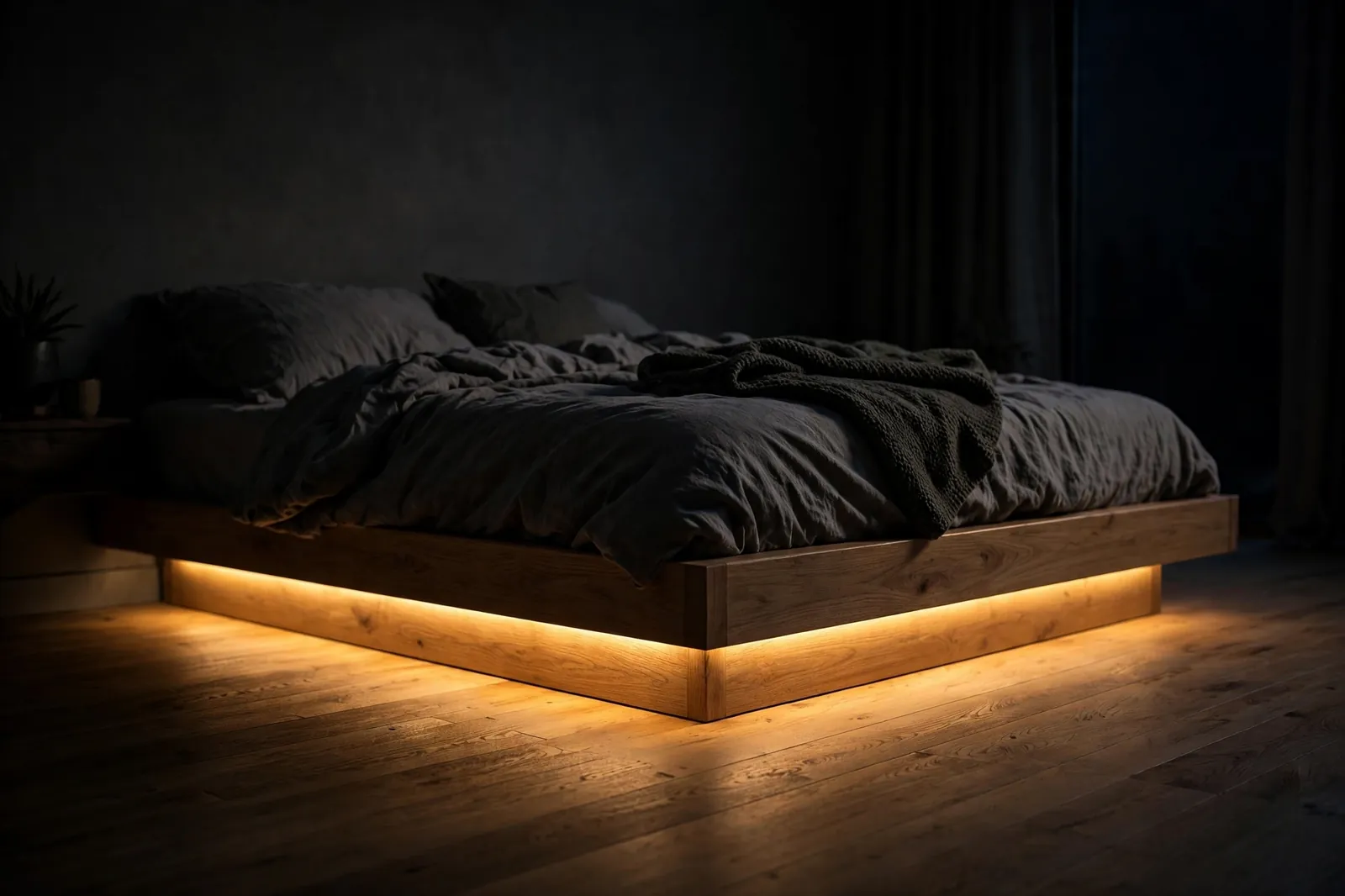
An under-bed strip is the best night light I have used. It lights the floor just enough to walk safely, and it does not wake a sleeping partner. Set it low, warm, and dim, and it stays out of your eyes because it points at the floor.
Fix the strip slightly inside the frame edge, not flush with it. That way the glow pools under the bed and the bed looks like it floats. If the strip sits right at the edge, you will see the bright line itself, and the trick falls apart.
Wardrobes, Shelves, and Desks
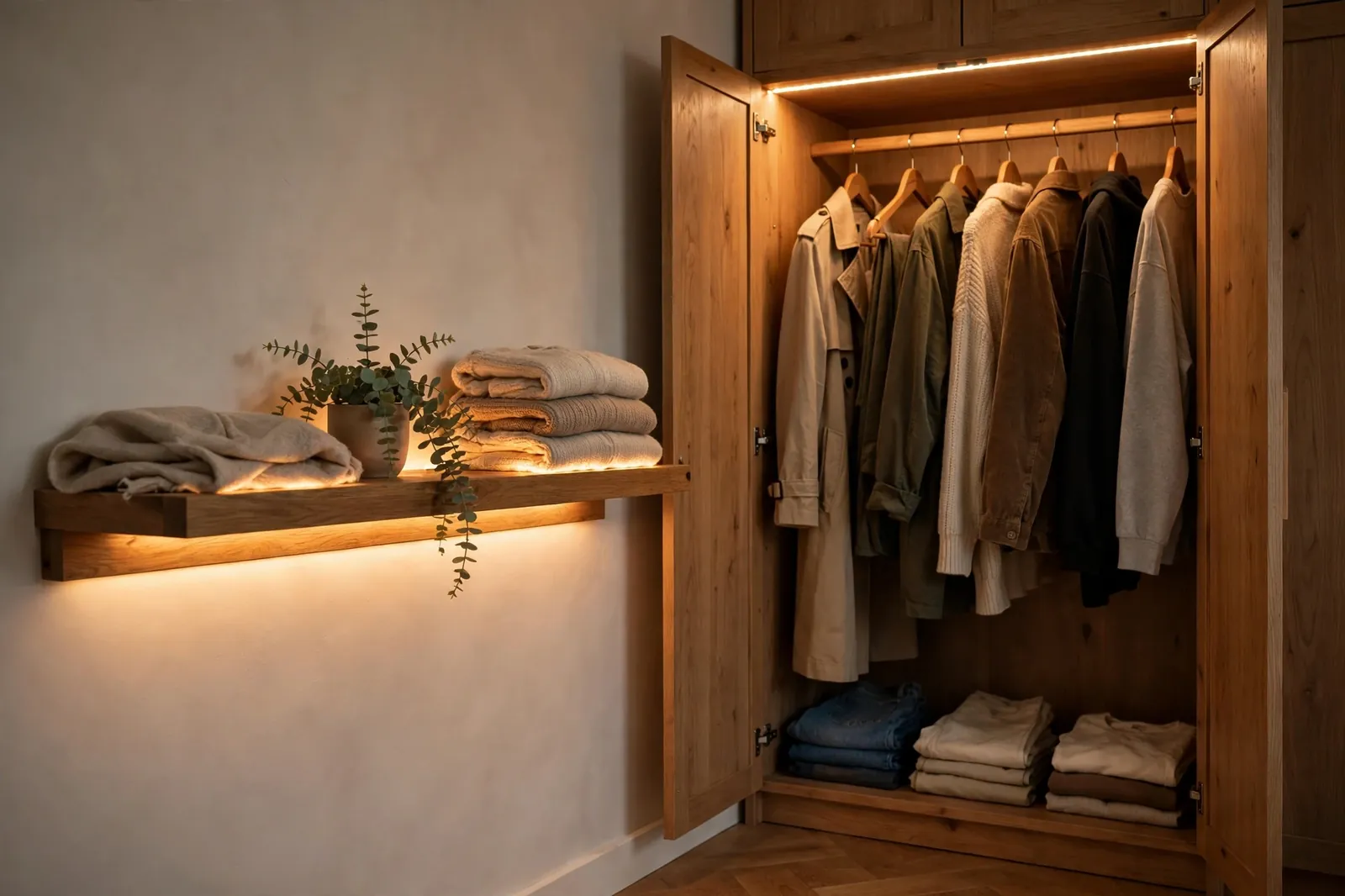
Wardrobe strips solve a real daily annoyance. Clothes look different under dim room light, and a strip inside the wardrobe or along its top edge shows true colours. Warm white works here, and a door sensor or simple switch keeps it from running all day.
Shelf strips work best when they sit under the shelf, not on top of it. Light from above a shelf lights the wall, but light from under a shelf lights the books and objects below it. The same rule holds for a desk: a strip under a shelf above the desk beats a strip stuck to the wall behind a monitor.
Mirrors and Vanity Corners
A strip around the back of a mirror gives a clean, even glow for getting ready. Face the strip toward the wall, not toward your face. Direct light in your eyes makes you squint, while bounced light flatters skin and shows colour more truly.
Colour, Brightness, and Control
Colour temperature sets the mood before brightness does. Warm white relaxes, neutral white feels alert, and strong colour feels playful. Most bedrooms need warm white most of the time, with colour saved for evenings when you want a change.
Brightness is where many setups fail. A strip at full power in a dark room feels harsh, even if the colour is warm. A good dimmer fixes that. Also, you want a strip that drops to a very low level for late night use. Half brightness is not low enough.
If your strips buzz or flicker when dimmed, the dimmer and the strip are often a poor match. Our guide to smart dimmer switches for LED lights without buzzing or flicker walks through that fix, and it is worth reading before you blame the strip itself.
Control should match how you live. A remote in a drawer gets lost, while a bedside switch or a simple routine gets used in the dark.
Table: Bedroom strip choices at a glance
| Placement | Best strip type | Colour to start with | Brightness tip |
|---|---|---|---|
| Behind headboard | Warm white, dense | 2700K to 3000K | Dim to 10 to 20 percent at night |
| Ceiling edge | Bright warm white or tunable white | 2700K to 3000K | Use a dimmer, since full power is strong |
| Under bed | Low output warm white | 2700K | Keep very low, as a night light |
| Desk or shelf | White or RGB, as needed | Warm white for work, colour for fun | Brighter than accent zones |
| Mirror back | Warm white, dense | 3000K | Pair with a front light for grooming |
Installing Strips Without Damage
Most bedroom strips stick on with adhesive backing. That sounds simple, and it is, until the strip peels off a painted wall six weeks later. Prep work decides whether the install lasts.
First, clean the surface with a dry cloth, then let it dry fully. Dust and grease kill adhesion fast. Next, test-fit the whole run without peeling the backing. Mark corners and cut points, and check that the power cable can reach a socket without crossing a walkway.
Only cut at the marked cut points, usually shown by a scissor symbol or a line between copper pads. Cutting anywhere else can kill that section. Philips Hue confirms this rule in its official strip light FAQ, which also covers joining strips with connectors instead of soldering.
For a lasting install, add clips or an aluminium channel on ceilings and long runs. Adhesive alone often fails on warm ceilings or textured paint. A channel also hides the strip, spreads heat, and turns a dotted strip into a smooth line.
- Measure each run, then test-fit it with the backing still on.
- Clean and dry the surface, then press the strip in short sections.
- Connect power, test the full run, and only then tuck cables away.
- Add clips or a channel on any run longer than a headboard.
- Set a low night scene first, so the first use feels calm, not blinding.
Check power too. A long run draws more current than a short one, so check the supply rating against your total strip length. When in doubt, ask the maker or an electrician rather than guessing.
Keep strips away from curtains and bedding, and never run one under a mattress or a pillow. If a strip feels hot, switch it off and check the supply before you use it again.
Scenes for Sleep, Reading, and Mornings
Scenes turn a strip from a novelty into a daily habit. A sleep scene means warm, very dim light across one zone only. A reading scene means a brighter, focused glow near the bed. A morning scene means a slow rise to a brighter white.
Start with just three scenes, and name them plainly. “Sleep”, “Read”, and “Morning” beat clever names you forget at midnight. You can add party colours later, but the three daily scenes are the ones you will use every week.
If you use Google Home, our guide to creating lighting scenes in the Google Home app shows the exact steps for grouping strips into a room scene, so one command can set the whole bedroom at once.
Also, a slow rise suits dark winter mornings well. You can set the ceiling strip to climb gently while your alarm sound stays soft. That pairing feels kinder than a sudden burst of light.
For that gradual wake-up, our sunrise alarm light setup guide explains how to build a slow brightening routine, and the same idea works well with a ceiling strip if you prefer strips to a dedicated wake-up lamp.
A Small Test Worth Copying
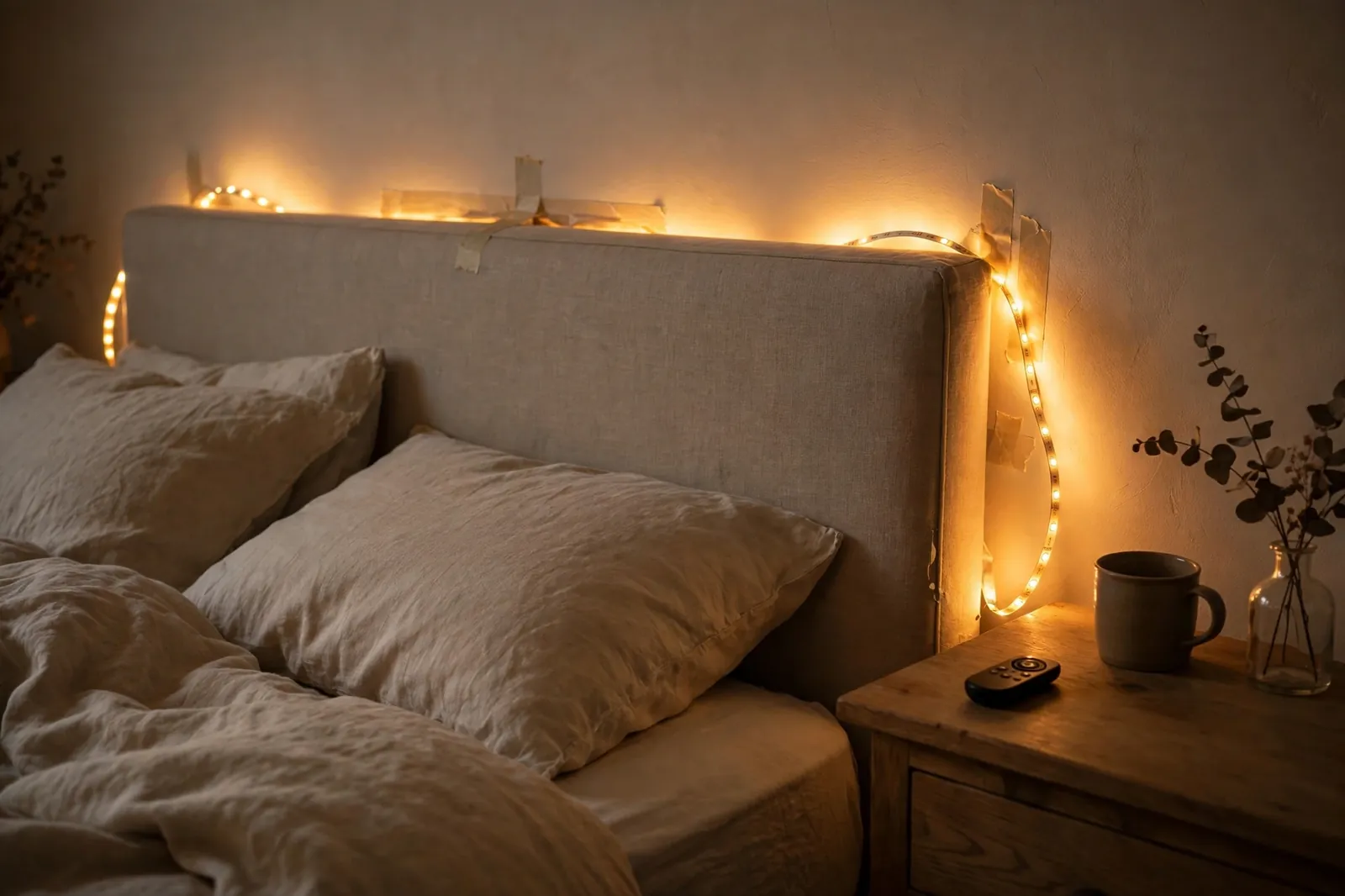
Before I fixed any strip in place, I taped a 2 metre warm white test strip behind my headboard and lived with it for three nights. On night one, I ran it at full power, and it was far too bright for a bedroom. It lit the wall well, but it also spilled into my eyes when I sat up.
On night two, I dimmed it to 10 percent and moved it 5 cm further in from the headboard edge. That single change fixed both problems. The wall glowed softly, the strip itself stayed hidden, and I could still read a book title on the bedside table without a second lamp.
On night three, I added a low under-bed strip at the same warm colour. The pair worked better than either strip alone. The headboard glow set the mood, and the floor glow handled late-night trips without waking anyone. That test is why this guide pushes dimming and hidden placement so hard.
Test one zone loose for a few nights before you stick anything down for good. You will learn your true brightness fast, and spot glare while it is still easy to fix.
Mistakes That Ruin the Look
The most common mistake is facing the strip toward the room. The strip then looks like a bright line, and you see every dot. Turn it toward a wall, a ceiling, or the floor, and the room gets glow instead of glare.
The second mistake is mixing colour temperatures in one view. A warm headboard glow next to a cool white wardrobe strip looks mismatched, even if each strip alone looks fine. Pick one white for the whole room, and keep colour strips to a separate zone you can switch off.
The third mistake is skipping a dimmer to save money. A strip without dimming has only two modes, on and off, and both feel wrong in a bedroom. Dimming is not a luxury here. It is the feature that makes strips work for sleep.
If you want bulbs that shift colour through the day for sleep, that is a different job from decor strips, and our guide to circadian rhythm smart bulbs for the bedroom covers bulbs in depth. Strips handle the look of the room, while bulbs handle the main light source, and the two can work side by side.
FAQs
Are strip lights safe to leave on overnight?
Low-voltage strips from a known maker are generally safe for overnight use at low brightness, if they are mounted clear of fabric and fed by a matched power supply. Keep them off curtains and bedding, check that the supply is not hot, and use a timer or night scene so they run dim, not at full power, while you sleep.
What colour works best for sleep?
Warm white around 2700K is the safest starting point for sleep, because it feels like lamplight and stays easy on the eyes at low brightness. Strong blue or bright white light feels alerting late at night, so save vivid colours for early evening fun and switch to warm, dim light for the last hour before bed.
Can strips replace a ceiling light completely?
Yes, in many bedrooms, if the ceiling run is bright enough and the ceiling is light in colour so it bounces light well. A ceiling strip plus a bedside or wardrobe light usually covers both ambient and task needs. Dark ceilings bounce less light, so test a ceiling run first before you remove your old ceiling fitting.
Why do my strips show dots instead of a smooth line?
Dots appear when the strip is visible or its density is low. They also appear when it sits too close to the surface it lights. Hide the strip in a channel, move it further from the wall, or choose a denser or COB strip. Combining two of those changes usually gives a clean, even line.
How long do bedroom strips last?
Most quality strips last for many years in a bedroom, since they run for short periods and often at dim levels that reduce heat. Cheap strips with weak adhesive or an undersized supply fail sooner, usually by peeling, flickering, or losing sections. Good mounting, a matched supply, and dimmed use all help a strip reach its full life.
Do I need a smart strip, or will a simple one do?
A simple dimmable strip is enough if you only want one warm glow and a remote or switch for control. Choose a smart strip if you want scenes, schedules, voice control, or a gradual morning rise. Smart strips cost more and need setup, so match the choice to habits you already have, not features you might use one day.
Final Thoughts
Start small, and start hidden. One warm strip behind the headboard, dimmed low, will change your bedroom more than a room full of bright colour strips. Test it loose for a few nights, fix the glare and brightness, then add a second zone only if you still want more.