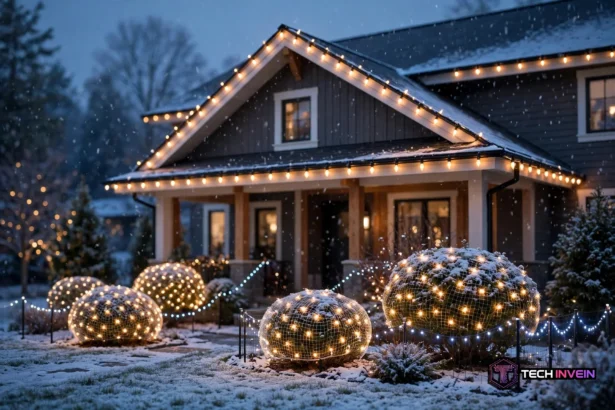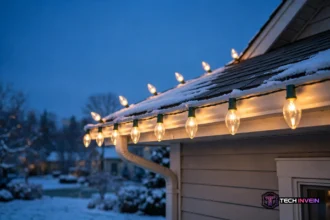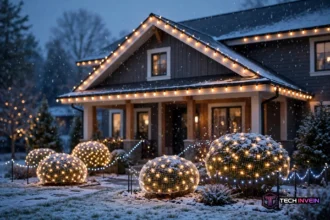



Solar Christmas lights use a small panel to charge a battery during the day, then glow on their own after dark. You get a bright display with no outlet, no extension cord, and no extra power bill. This guide explains how they work, how long they last in winter, and the best ways to set them up around your home.
- How They Work
- Solar vs Plug-In: Which Should You Pick?
- Do Solar Christmas Lights Work in Winter?
- How to Choose the Right Set
- How to Set Up Solar Christmas Lights for the Best Charge
- Best Places to Hang Them
- Common Problems and Quick Fixes
- How to Store Them After Christmas
- FAQs
- How long do the lights stay on at night?
- Do the lights need direct sunlight to charge?
- Can the lights stay outside in rain and snow?
- Why are my lights not turning on?
- How many hours of sun do the lights need?
- Can you leave the lights outside all year?
- The Bottom Line
How They Work
Every set has three parts. A small solar panel sits in the sun, a rechargeable battery stores the energy, and a string of LED bulbs does the glowing. A light sensor watches the sky and flips the set on at dusk, then off again at dawn. You do not need to touch a switch each night.
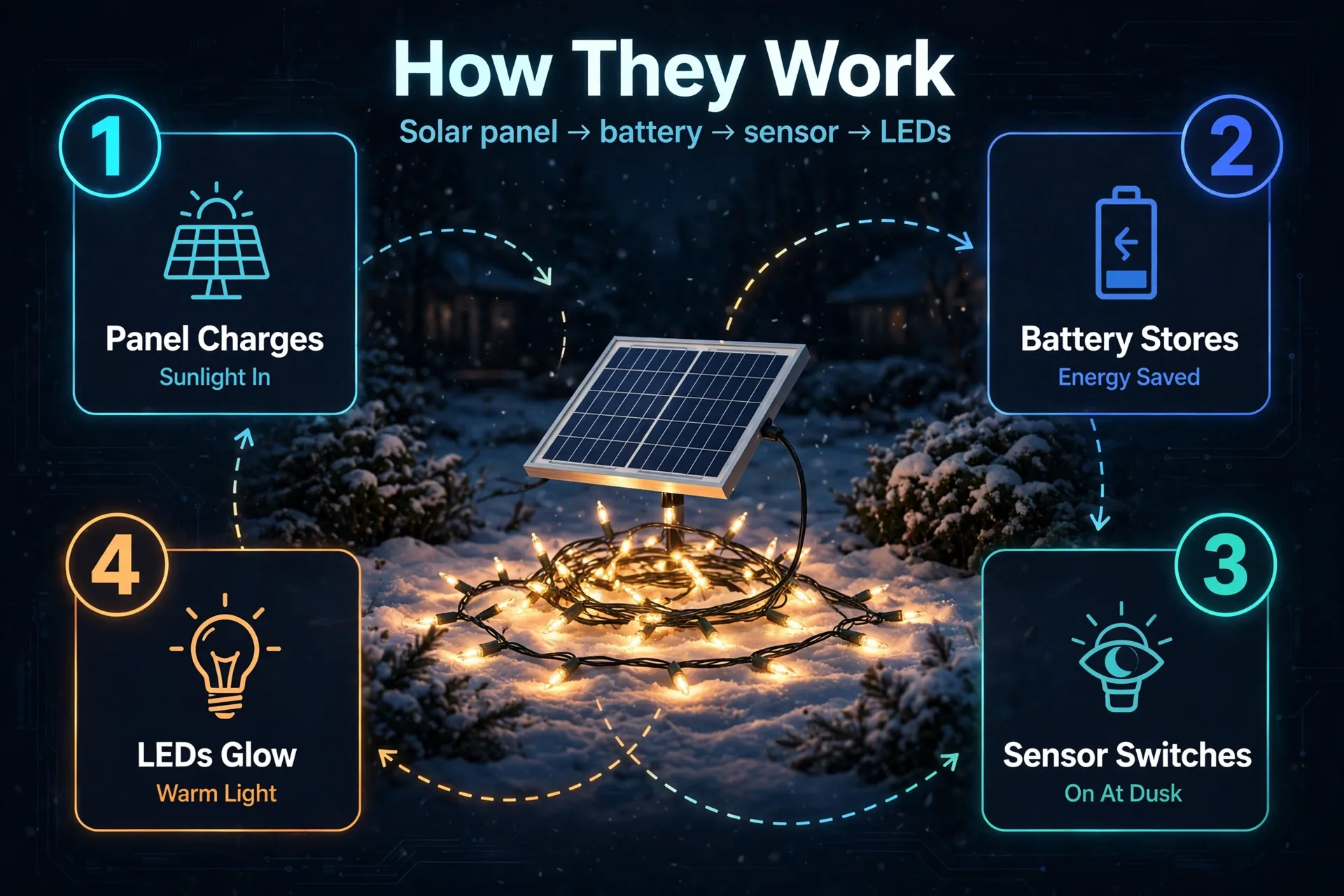
The panel turns sunlight into power, and the battery holds it until dark. Most sets use LEDs because they sip power and stay cool to the touch. The manual for a 100-LED solar set lists a NiMH battery, a timer, and six modes, from steady glow to twinkle. So check the instructions for your own set before you change any setting.
So what happens on a grey day? The panel still charges, just at a slower pace. Solar cells respond to daylight, not only direct sun. A cloudy sky can cut output by more than half, so the battery may not fill up. That is why the same set can shine all night after a sunny day and fade early after a dull one.
The Parts That Matter Most
Start with the battery. Its size is listed in milliamp-hours, or mAh, and a bigger number means more stored light. Many budget sets use a 600 mAh cell, while stronger sets use 1200 mAh or more. Next, look at the panel. Monocrystalline panels do better in weak light than older polycrystalline ones. Then check the wire. A long lead wire lets you put the lights where they look best and the panel where the sun actually falls.
Solar vs Plug-In: Which Should You Pick?
Plug-in sets are brighter and run all night, every night. They do not care about clouds or short days. Solar sets win on ease. You hang them anywhere, with no cord to run and no outlet to find. The trade is brightness and run time, so pick based on the spot, not the habit.

If you want colour changes, music sync, or app control, a plug-in smart set is the better buy. Our guide to the best smart Christmas lights compares the top options for indoor and outdoor use. You can still mix the two types across one display, since solar suits the far corners and smart sets suit the main view.
Table: Solar vs plug-in Christmas lights at a glance
| Feature | Solar lights | Plug-in lights |
|---|---|---|
| Power source | Sunlight and battery | House outlet |
| Brightness | Softer glow | Bright and steady |
| Run time | 3 to 10 hours | All night |
| Install | No cord needed | Needs an outlet |
| Running cost | Free after purchase | Adds to power bill |
Solar suits fences, trees, and garden beds far from the house. Plug-in suits rooflines and big displays where steady brightness matters most. Many homes use both, and that mix works well. Put solar where cords cannot reach, and save plug-in sets for the spots people see first.
Do Solar Christmas Lights Work in Winter?
Yes, they work in winter, but expect shorter run times. December days are short, the sun sits low, and clouds steal much of the light. A set that runs ten hours after a summer charge may run four or five hours after a dull December day. Cold itself is not the main enemy. Snow on the panel is.
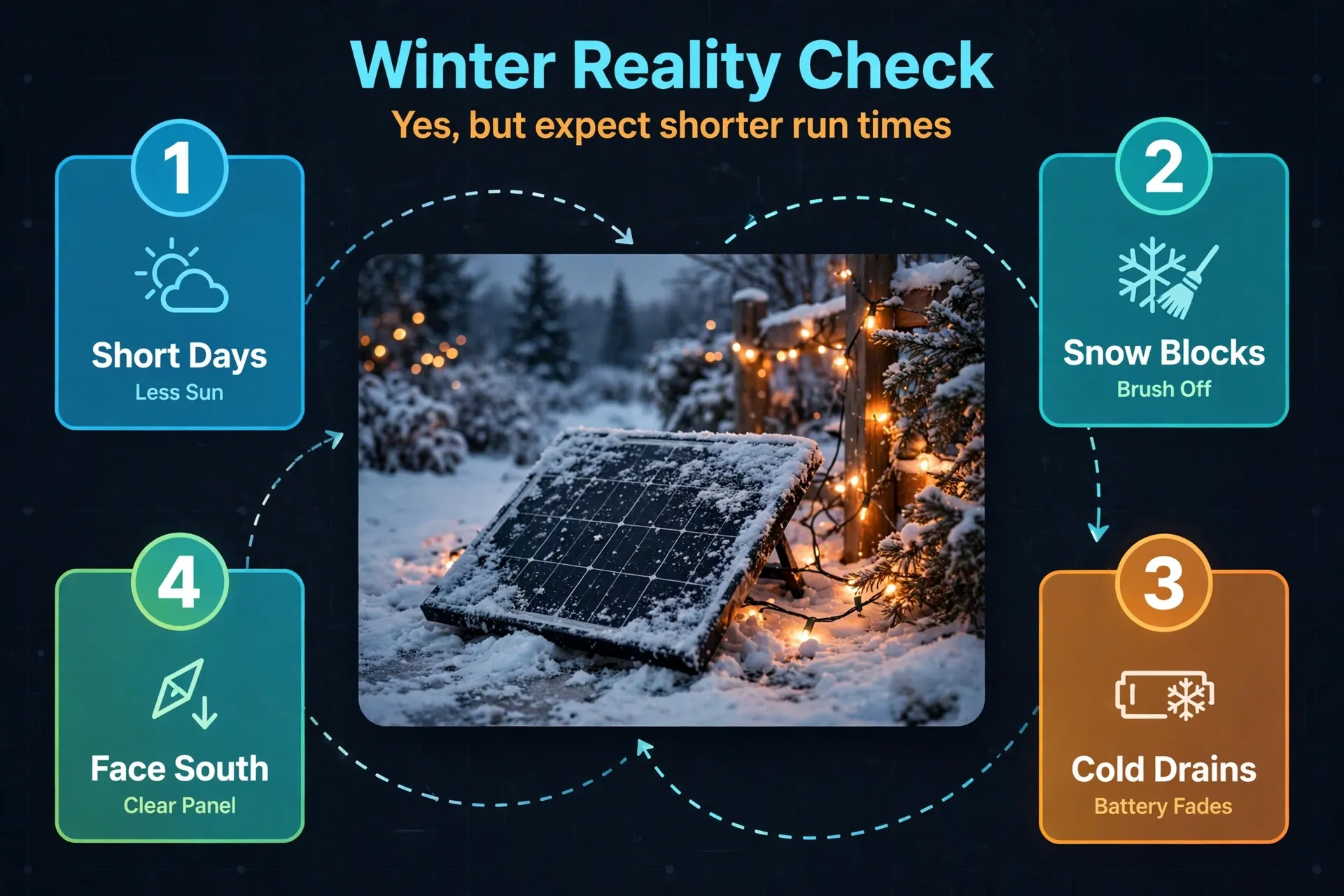
Your area shapes the result more than the brand does. A sunny southern yard can run solar sets all season with little fuss. A shaded northern yard with weeks of cloud needs a bigger battery and a well-placed panel. So set your hopes by your sky, not by the hours printed on the box.
What Cold Does to the Battery
Cold trims how much charge a battery can hold. Lithium-ion cells can lose a fifth or more of their usable capacity below freezing, while NiMH cells also fade in the cold. The panel itself likes cold, clear air, since solar cells make voltage more easily when they are cool. So a bright, frosty day can still charge well. The real problem starts when the battery stays cold all night and the charge runs low before midnight.
Snow, Cloud, and Short Days
A thin layer of snow can block almost all light from reaching the panel. Brush it off after each snowfall, and tilt the panel so snow slides away on its own. Clouds cut output too, yet panels still gather some power from diffuse daylight. The fix is simple. Face the panel south, keep it clear, and choose a flashing mode on dull days so the battery lasts longer.
Short days shrink the charging window as well. In December, the useful sun may last only from late morning to mid-afternoon. That leaves little room for shade. Walk the yard at noon and check for shadows from the house, the fence, and tall trees. Then move the panel to the brightest patch you can find.
How to Choose the Right Set
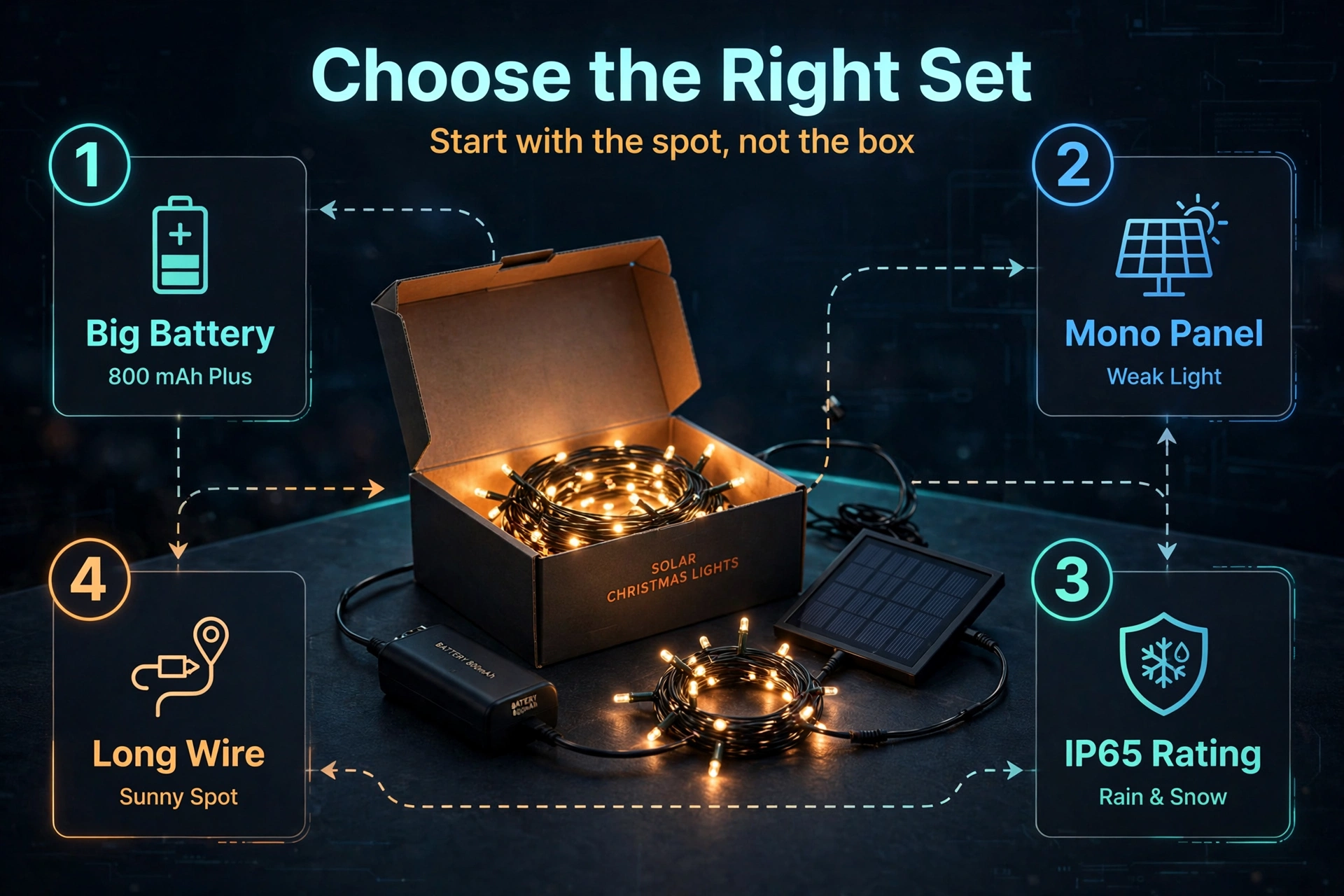
Start with the spot, not the box. A fence in full sun can run a big string, while a shaded porch needs a smaller set or a separate panel on a long wire. Read the battery size, the panel type, and the water rating before you buy. Those three numbers tell you more than the photo on the box.
Battery Capacity
Look for at least 800 mAh if you want six or more hours of light each night. Sets with 1200 mAh or more hold up better after cloudy days. The same battery tech powers garden lights, and our guide to solar garden lights with motion sensors explains how panel and battery size shape run time. A bigger battery is the single best upgrade for winter use.
Small 300 to 500 mAh batteries fade fast. They may look fine on the first night, then die by 9 p.m. after a grey day. If the listing hides the battery size, treat that as a warning sign and pick another set. Honest sellers print the number, since it is the spec buyers ask about most.
Panel Type and Size
Monocrystalline panels are the better pick for winter. They squeeze more power from weak, low light than polycrystalline panels do. A bigger panel also helps, since more surface area catches more light. If the panel is built into the string, you cannot move it, so check where the sun falls first. A separate panel on a lead wire gives you far more freedom.
Water Rating and Wire Length
Outdoor sets should carry at least an IP44 rating, and IP65 is better for rain and snow. Read the rating on the listing, not just the word waterproof. Then measure the lead wire between the panel and the first bulb. A short lead forces the panel into shade, while a long lead lets you stake it in the sunniest patch of the yard.
How to Set Up Solar Christmas Lights for the Best Charge
Good setup beats a bigger battery. Most weak displays come from a panel in the wrong place, not a faulty set. Walk your yard at midday and note where the sun falls between 10 a.m. and 3 p.m. That window gives you the strongest charge in winter.
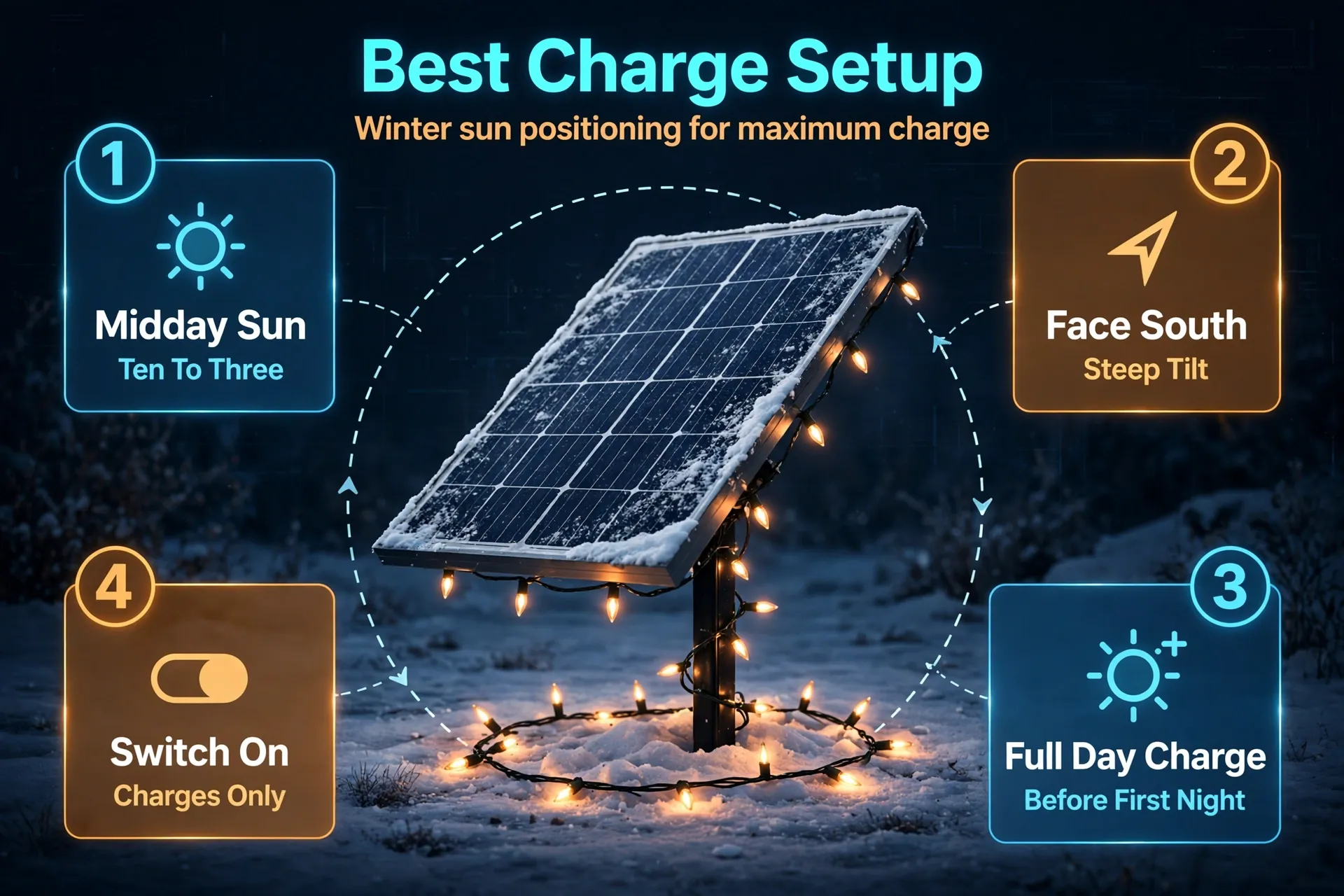
Plan the layout before you climb a ladder. Decide where the string will run, then find the nearest sunny spot for the panel. The lead wire sets the limit, so measure it first. If the sunny spot sits too far away, pick a set with a longer lead or a separate panel.
Panel Placement
Face the panel south if you live in the northern hemisphere. Tilt it up steeply, since the winter sun rides low in the sky. A steep tilt also sheds snow and rain. Keep the panel clear of eaves, fences, and evergreen branches. For more ideas on lighting spots with no outlet nearby, see our guide to the best smart outdoor pathway lights with no wiring.
Test the spot before you hang a single bulb. Stake the panel down, switch it on, and let it charge for a full day. Then check the lights after dark. If they fade early, move the panel first. Nine times out of ten, the panel is the problem, not the bulbs.
The First-Charge Mistake to Avoid
Here is the mistake most people make. They hang the lights, flip the switch on at dusk, and judge the set after one night. The battery was never full. Give the set a full day of sun before the first night, or two days if the sky is grey. Also check the switch. Many sets only charge when the switch is set to ON, so a set left on OFF will sit dead no matter how sunny the day is.
You can test the sensor in daylight too. Cover the panel with a dark cloth, and the lights should turn on within a minute. If they stay dark after a full day of charging, the battery or the sensor has likely failed. That quick test tells you in seconds what a week of guessing cannot.
Once the set runs well, you can shape when it shines. Some sets have a built-in timer for six, eight, or ten hours. If your display shares a smart setup, you can also automate outdoor lights to follow sunset and sunrise through Home Assistant. A timer saves charge on dull days, since the lights rest after bedtime instead of burning down to dawn.
Best Places to Hang Them
Trees and shrubs are the classic spot. Wrap the string loosely so branches can move in the wind without pulling the wire. Fences work well too, since the panel can sit on a sunny post while the lights run along the rail.
Patios and pergolas suit solar strings as well. You get warm light with no cord across the walkway. Our review of outdoor Zigbee string lights for the patio shows how string lights can shape an evening space. The same layout ideas work for a solar set, from the seating area to the rail above it.
Try garden beds and pathway edges for a low, soft glow. Stake the panel where it catches the midday sun, then run the string along the bed. Avoid spots under a porch roof or a thick tree, since the panel will starve there even on a bright day.
Common Problems and Quick Fixes
Most solar light faults have a simple cause. Work through the list below before you return a set or buy a new one. Start with the panel, since it causes most failures.
Table: Quick fixes for common solar light problems
| Problem | Likely cause | Fix |
|---|---|---|
| Lights never turn on | Switch off or panel shaded | Flip switch ON, move panel to sun |
| Lights fade early | Weak charge or small battery | Tilt panel, use flashing mode |
| Lights on in daylight | Sensor covered or faulty | Uncover sensor, move porch light |
| One section stays dark | Loose wire or dead LED | Check connectors, swap section |
If nothing works after a full sunny day, test the sensor. Cover the panel with a dark cloth in daylight. The lights should turn on within a minute. If they stay dark, the battery or the sensor has likely failed, and a replacement set is the faster fix.
How to Store Them After Christmas
Take the sets down before the worst of the winter weather sets in. Wipe each panel with a soft, damp cloth so dirt does not bake on over the year. Coil the wire loosely, since tight coils crack the insulation over time.
Switch the set off and store it in a cool, dry place. Then bring the panel out every three or four months for a day in the sun. That short charge keeps the battery healthy, so the set still works next December.
FAQs
How long do the lights stay on at night?
Most sets run for 6 to 10 hours after a full day of sun. The exact time depends on the battery size, the lighting mode, and how much sun the panel received. Steady glow drains the battery fastest, while twinkle or flash modes stretch it further. After a cloudy December day, expect 3 to 5 hours instead.
Do the lights need direct sunlight to charge?
They charge best in direct sun, but they do not need it to work. Panels also gather power from diffuse daylight on cloudy days, just at a slower rate. Aim for 6 to 8 hours of sun for a full charge. Shade from a house or tree hurts far more than cloud, so place the panel in open sky.
Can the lights stay outside in rain and snow?
Yes, if the set is rated for outdoor use. Look for an IP44 rating at minimum, and IP65 for heavy rain or snow. The panel and wire joints should be sealed, with no open battery door. Bring the set inside during a hard freeze or storm if you want it to last more seasons.
Why are my lights not turning on?
Check the switch first, since many sets only charge and run when it is set to ON. Then check the panel for shade, dirt, or snow, and make sure no porch light shines on the sensor. Give the set a full sunny day to charge. If it still stays dark, test it by covering the panel with a cloth.
How many hours of sun do the lights need?
Most sets need 6 to 8 hours of direct sun for a full charge. Smaller sets may fill up in 4 to 6 hours, while big strings with large batteries may need a full day. In December, the charging window is short, so face the panel south and keep it clear of shade to catch every hour.
Can you leave the lights outside all year?
You can, but the set will wear out faster. Sun, rain, and frost age the wire, the seals, and the battery over time. Most people take them down after the holidays and store them in a cool, dry place. A short charge every few months keeps the battery healthy until next December.
The Bottom Line
Solar Christmas lights are a simple way to light spots no cord can reach. They will not match a plug-in set for brightness, yet a good panel, a strong battery, and a sunny spot will carry most displays through the evening. Pick your set this week, charge it for a full day, and hang it where the sun can find it.