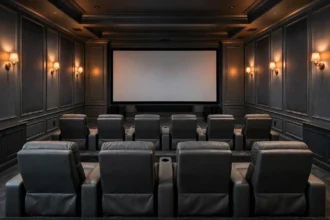


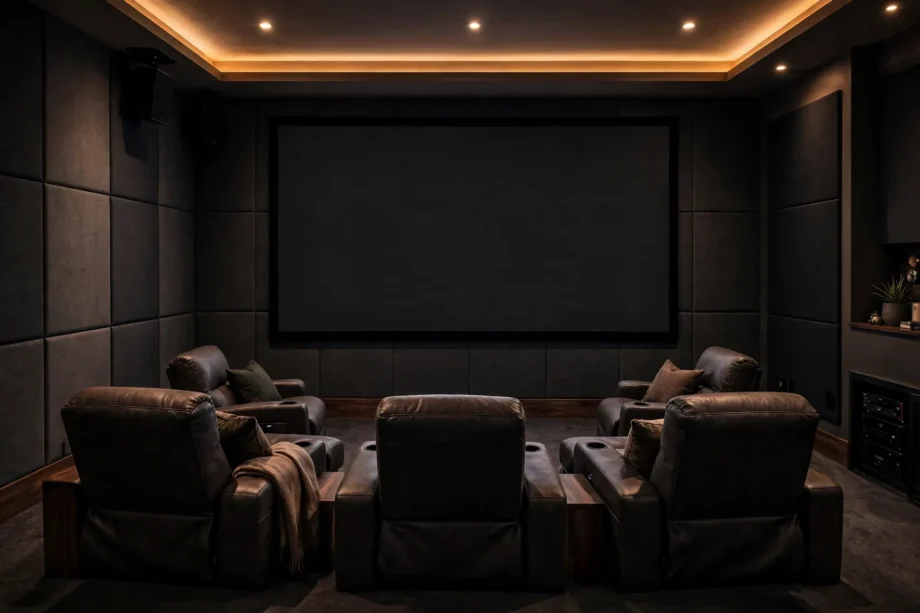
Home cinema acoustic panels are wall and ceiling treatments that soak up or scatter sound, so dialogue stays clear and surround effects stay sharp. A good speaker set in a bare room can still sound harsh, echoey, and muddy, because hard walls bounce sound back at you a fraction of a second after the direct sound.
- What acoustic panels do, in plain terms
- Types of home theater acoustic panels
- How to read NRC and thickness
- Where to place panels first
- A simple room by room plan
- DIY panels vs bought panels
- Mistakes that waste money
- Style, safety, and upkeep
- How much should you budget?
- Frequently asked questions
- Do home cinema acoustic panels block sound to other rooms?
- How many acoustic panels do I need for a home theater?
- Where should I put acoustic panels first?
- Are foam panels enough for a home cinema?
- What thickness of acoustic panel is best?
- Can acoustic panels make a room sound too dead?
- Final thoughts
Have you ever noticed how a film sounds better in a carpeted room than in a tiled one? That is room acoustics at work. The speakers may be the same, yet the room changes what reaches your ears. Panels give you a way to fix the room without rebuilding it, and you can start small and add more as your budget allows.
What acoustic panels do, in plain terms
Sound leaves a speaker, travels to your ears, and also travels to walls, the ceiling, and the floor. The direct sound is what you want to hear first. The reflected sound arrives a little later, and it can blur dialogue, smear stereo imaging, and make bass sound boomy. Panels reduce that problem in two ways. Absorption panels soak up sound energy. Diffusion panels scatter it in many directions, so it does not bounce straight back at you as a sharp echo.
That is different from soundproofing, and the mix up causes a lot of wasted money. Soundproofing stops sound leaving or entering a room, and it usually needs mass, sealed gaps, and construction work. Acoustic treatment improves sound inside the room. Panels will not stop your neighbour hearing a loud film, and they are not sold as a soundproofing fix. Buy them for clarity inside the room, not for silence outside it.
Think of a panel as a sponge for certain frequencies. Thin panels handle high frequencies well, such as sibilance and flutter echo. Thicker panels reach lower into the midrange and upper bass. Very thick corner traps handle deep bass that builds up in corners. No single panel fixes every frequency, which is why a mix of types works better than a wall covered in one thin foam.
Types of home theater acoustic panels
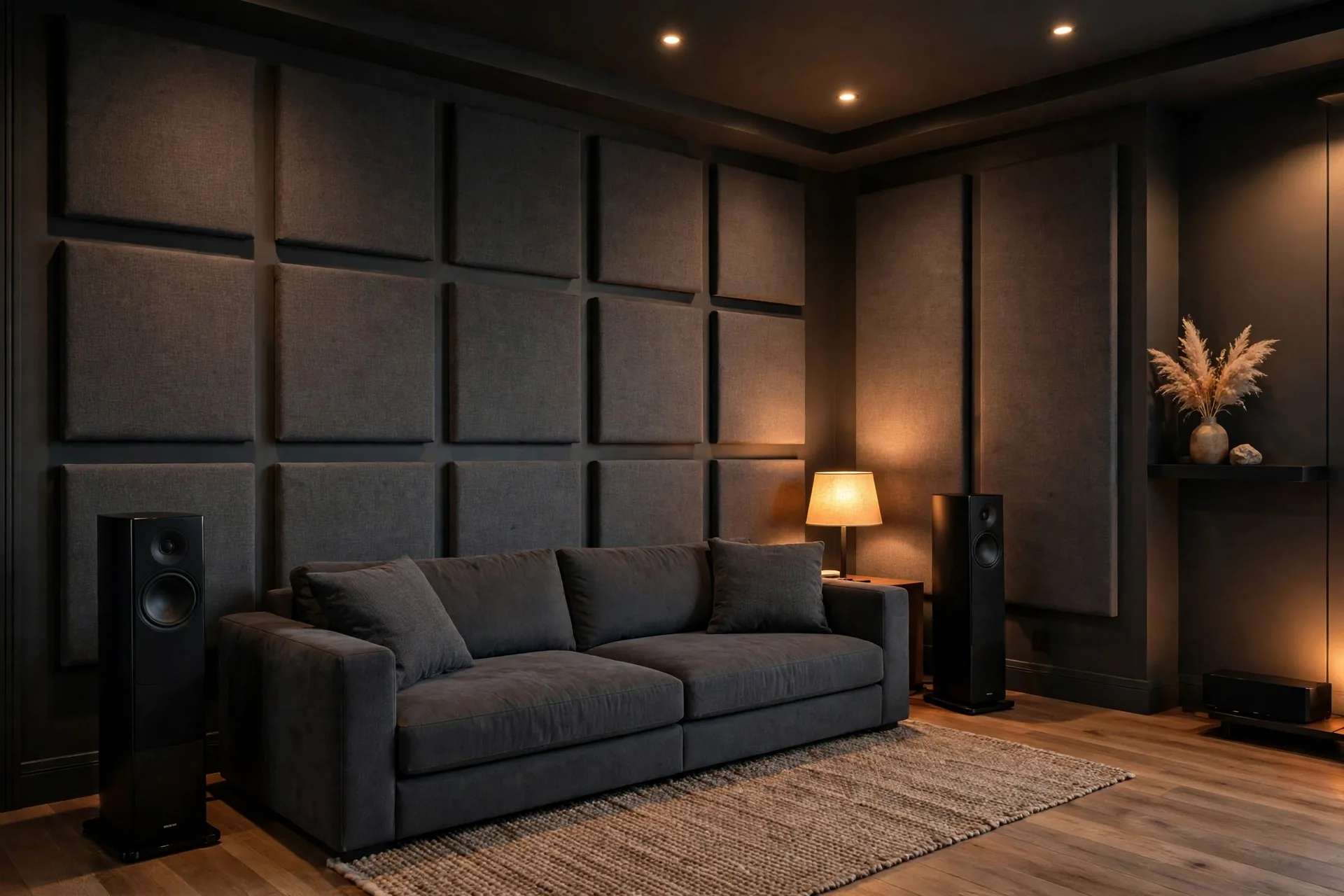
Fabric wrapped fiberglass or mineral wool panels are the workhorse of home cinema treatment. A dense core, often rigid fiberglass or mineral wool, sits inside a frame and is wrapped in acoustically transparent fabric. These panels absorb a broad range of mid and high frequencies, they look neat on a wall, and they come in many colours. For most dedicated rooms, start here.
Foam panels are cheaper and lighter, and they suit high frequency problems such as flutter echo in a small room. They are less effective for midrange and bass than a dense fiberglass panel of the same size, so do not expect foam alone to fix a boomy room. Foam can be a good first step or a top up, but it is not a full treatment plan for a serious cinema room.
PET felt panels, made from recycled polyester fiber, offer a modern look with slats, shapes, and colours that suit a living room cinema. Some PET panels reach a Noise Reduction Coefficient near 0.95 at useful thicknesses, which shows strong absorption for their size. Check the spec for the exact thickness you plan to buy, because a thin felt tile and a thick felt panel behave very differently.
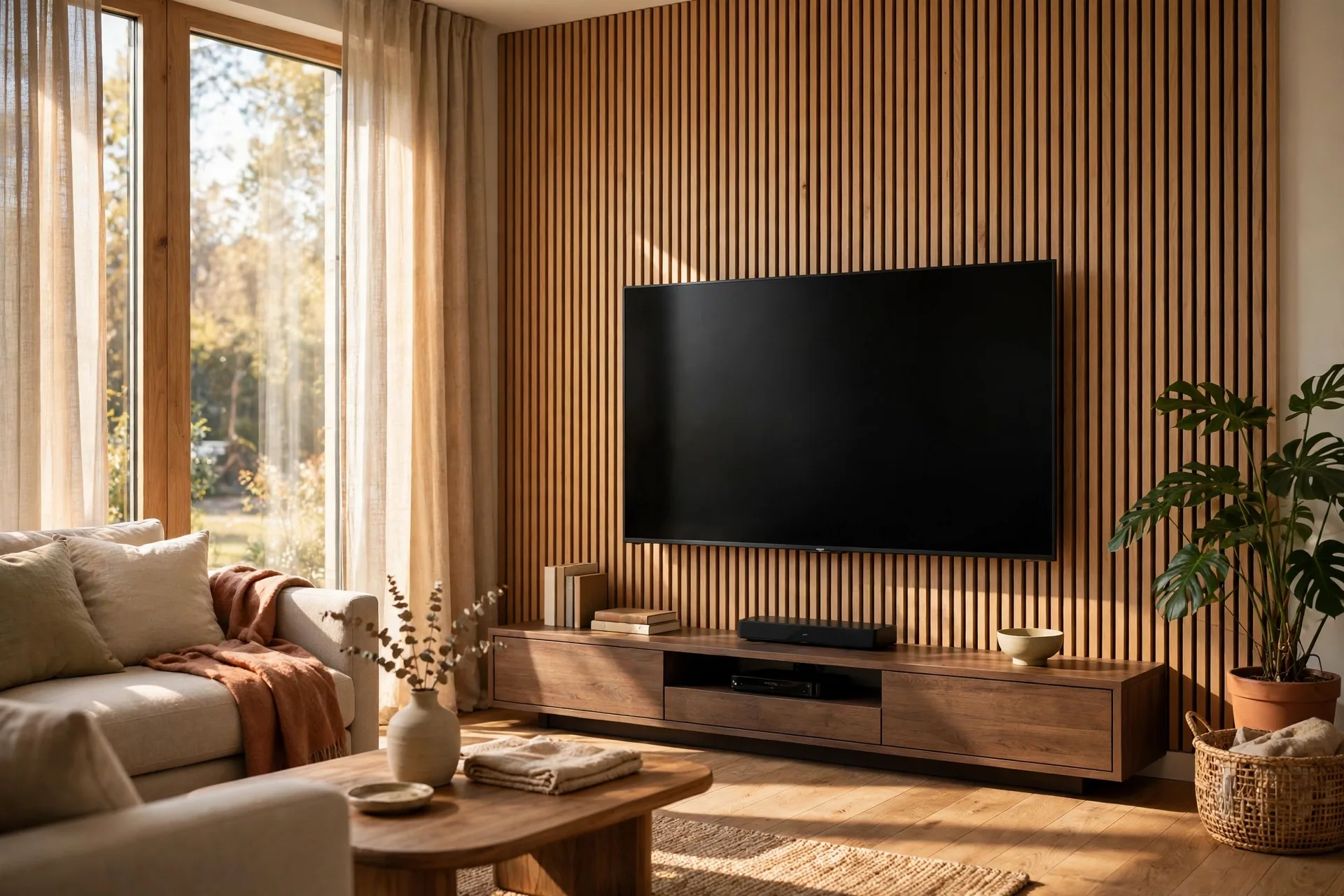
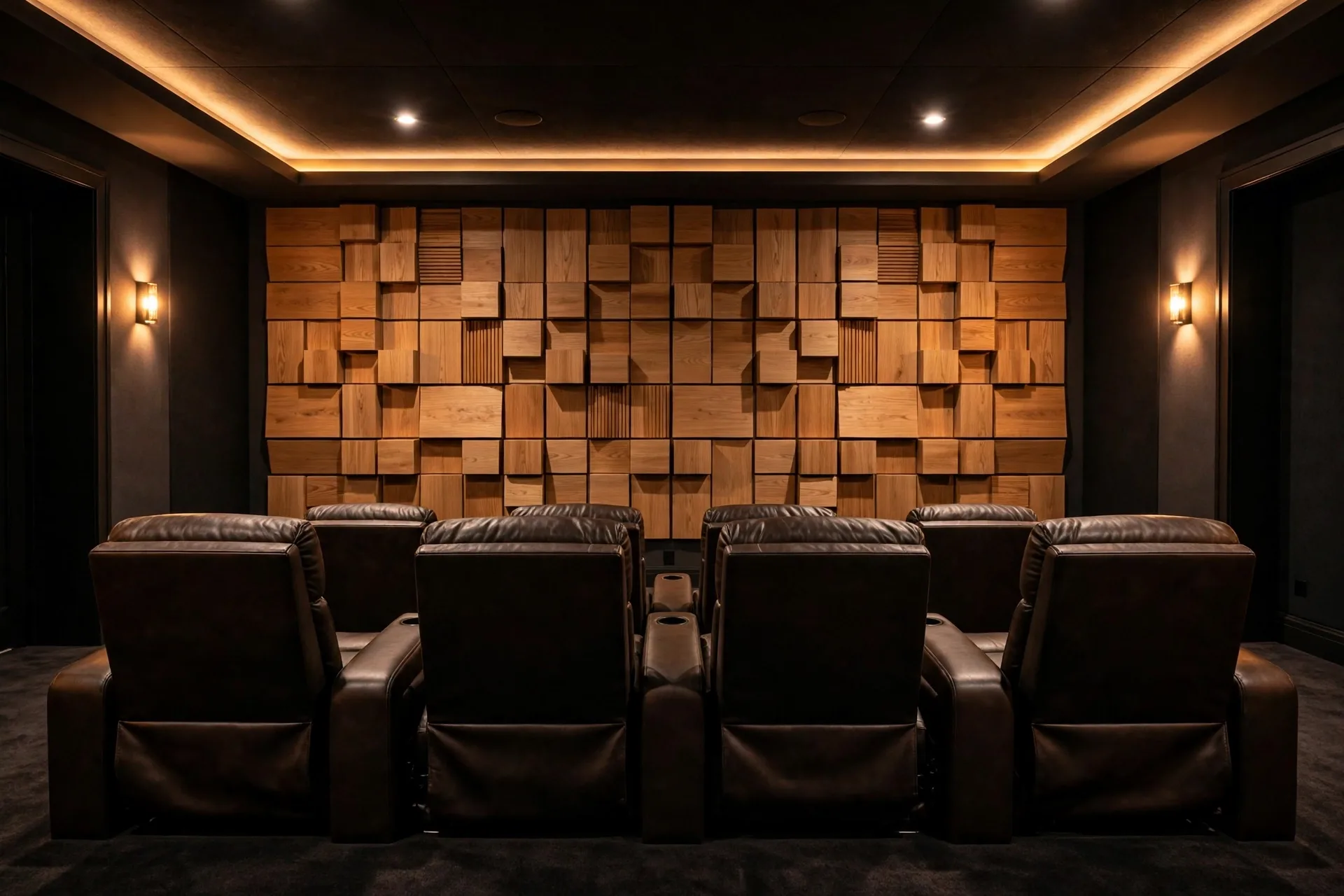
Wood slat panels pair a wooden slat face with an acoustic felt or mineral wool backing. They absorb some sound and scatter the rest, which keeps a room from sounding too dead. They also look like a design feature rather than a studio fix, so they suit a shared living room where the cinema must also look good when the film is off.
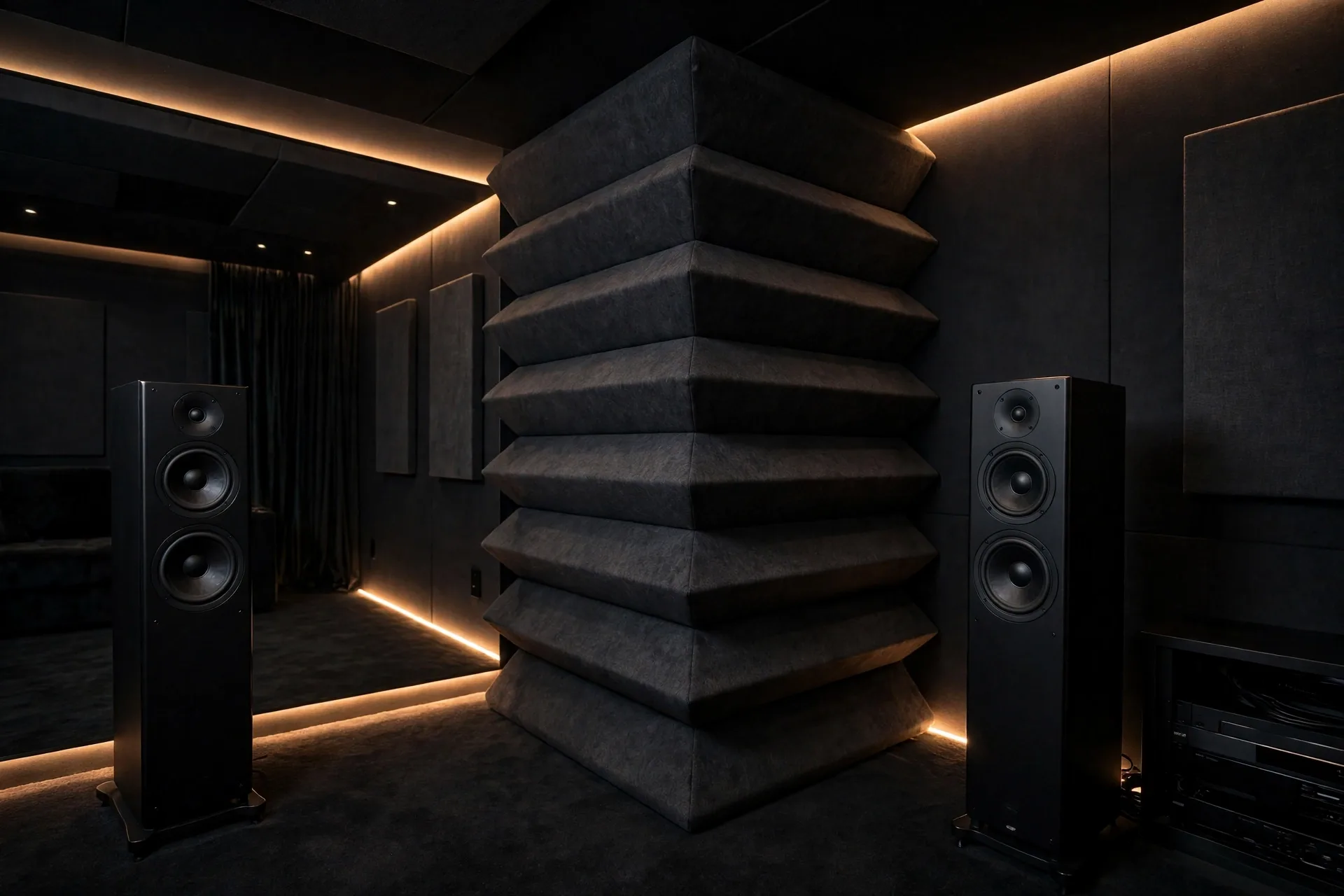
Bass traps are thick absorption units made for corners, where low frequency energy builds up. A regular wall panel is often too thin to control deep bass, so corner traps use extra depth and density. If bass sounds boomy in one seat and thin in another, corner traps are usually part of the fix, along with careful subwoofer placement.
Diffusers are the final type. They use shaped surfaces, such as wells, curves, or slats at varied depths, to scatter sound evenly. Diffusers suit the rear wall behind the seats in many rooms, because they keep the room sounding alive without a sharp slap echo. A room with only absorption can sound dull, so a few diffusers help balance the space.
How to read NRC and thickness
Noise Reduction Coefficient, or NRC, is a lab average of absorption at 250, 500, 1000, and 2000 Hz. A higher number means more absorption across those frequencies, with 1.00 marking very strong absorption. For home theater panels, look for NRC values around 0.80 or higher for main wall panels, as explained in guides to acoustic panels in home theaters, and read the full frequency data when the maker provides it. NRC says nothing about deep bass or the very top octave, so do not judge a bass trap by NRC alone.
Thickness is a practical guide to frequency reach. A 1 inch panel mainly tames high frequencies and flutter echo. A 2 inch panel is a solid all round choice for side walls and front walls in a home cinema. A 4 inch panel, or a panel mounted with an air gap behind it, reaches lower and helps more with midrange and upper bass. For corners, go thicker still with a dedicated trap.
Where to place panels first
Start with first reflection points. These are the spots on the side walls where sound from the front speakers bounces once and then reaches your ears. You can find them with a mirror. Sit in your main seat, have a helper slide a mirror along the side wall, and mark each spot where you can see a front speaker in the mirror. Put an absorption panel there. Repeat for the other side, and check the ceiling if you can reach it safely.
Next, treat the front wall around the screen. Panels bracketing the screen absorb sound that would bounce off the front wall and muddy dialogue. If you have an acoustically transparent screen, panels can also sit behind it.
Then look at the rear wall behind your seats. If the rear wall is close behind you, absorption there can cut a sharp echo that hits the back of your head. If the rear wall is further away, diffusion there can keep the surround field spacious without a slap echo. In a small room, start with absorption at the rear and add diffusion later if the room starts to sound too flat.
Corners come next, with bass traps straddling wall to wall and wall to ceiling corners. You do not need to fill every corner on day one. Start with the front corners, listen for a week, and then add rear corner traps if bass still sounds uneven across seats. That staged approach saves money and lets your ears learn what each change does.
How much wall should you cover? A common guide, shared in acoustic placement guides, is 20 to 30 percent of wall surface for a home cinema, with some guides stretching to 40 percent in a dedicated room. For a room around 20 to 25 square metres, that often means about 10 to 12 panels at 600 by 1200 mm, plus corner traps. Treat that as a starting range, not a rule. A carpeted room with soft sofas needs less treatment than a bare room with hard floors and glass.
A simple room by room plan
Caption: Panel types and best use at a glance
| Panel type | Best for | Typical thickness | Watch out for |
|---|---|---|---|
| Fabric wrapped fiberglass | Main wall treatment | 2 inches or more | Check fabric is acoustically transparent |
| Foam | Flutter echo, high frequencies | 1 to 2 inches | Weak for midrange and bass |
| PET felt | Modern look, good absorption | 9 to 24 mm, thicker is better | Compare NRC at your exact thickness |
| Wood slat | Living rooms, mixed absorb and scatter | Slat plus backing | Check backing, not just the wood face |
| Bass trap | Corners, uneven bass | 4 inches or more | Thin panels will not fix deep bass |
| Diffuser | Rear wall, spacious sound | Varied depths | Needs distance from seats to work well |
DIY panels vs bought panels
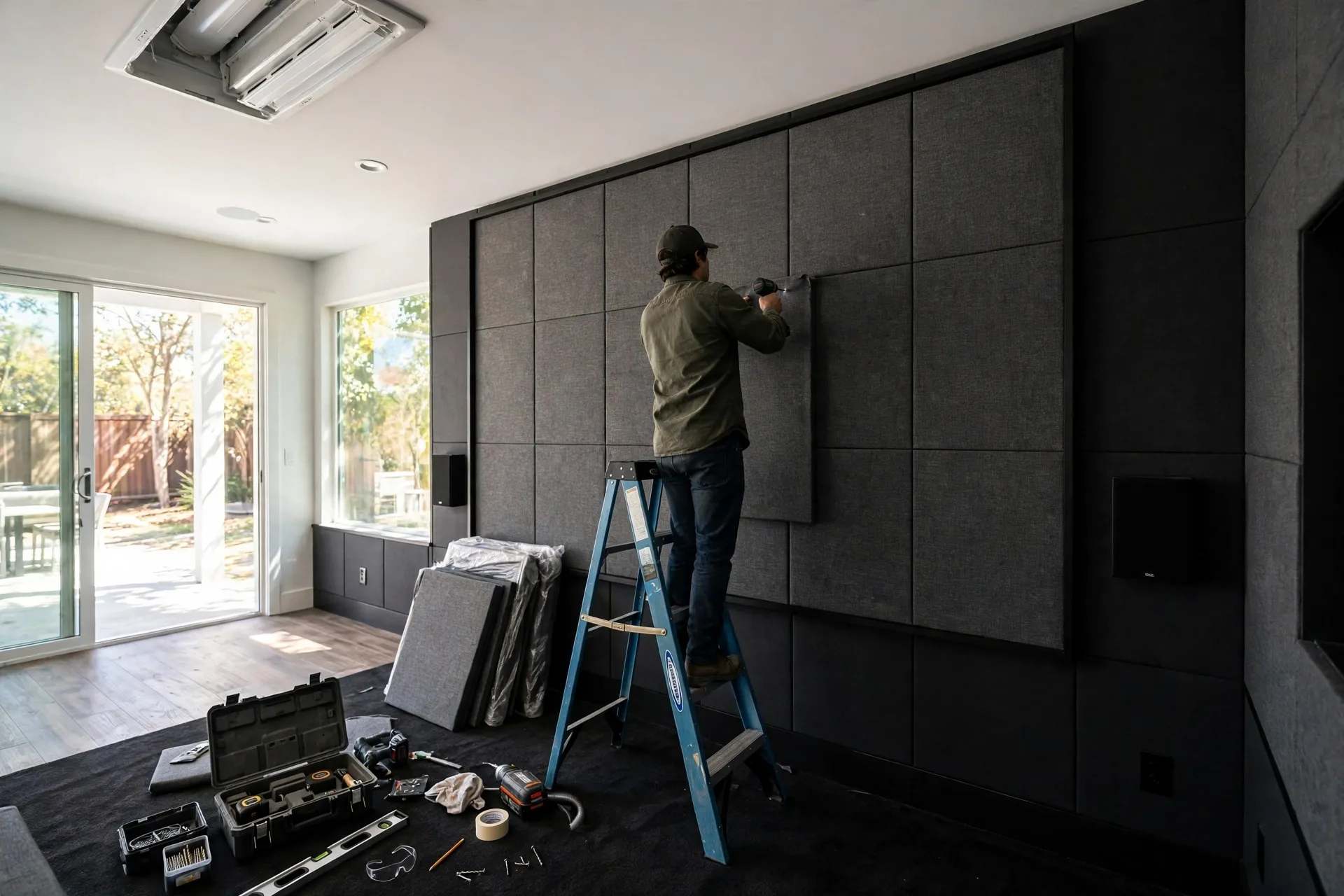
DIY panels can save money and let you match fabric to your room. A common build uses a wooden frame, rigid mineral wool or fiberglass, and acoustically transparent fabric stretched over the front. Wear gloves, a mask, and eye protection when you cut insulation, and seal the back so fibers do not shed into the room. A DIY panel built well can perform close to a bought panel of the same depth and core.
Bought panels save time and give you tested specs, fire ratings, and a clean finish. That matters if you want a known NRC, a Class A fire rating, or a colour that matches a full cinema design. Bought panels also mount with proper hardware, which helps on a ceiling cloud where a falling panel would be a real hazard. Price varies a lot, so compare cost per panel at the same thickness, not just the cheapest listing.
Mistakes that waste money
The biggest mistake is covering one wall solid with thin foam and expecting cinema sound. Thin foam helps high frequencies, yet it leaves midrange reflections and bass untouched. The room may sound a little less echoey, but dialogue can still blur and bass can still boom. A few thick panels in the right spots beat a full wall of thin foam in almost every room.
Another mistake is treating only the wall you see. Sound reflects off the ceiling too, especially with height speakers, and off the floor if it is hard. A rug helps the floor, and a ceiling cloud above the seats helps the ceiling. Skip the ceiling and you leave a clear reflection path that no side wall panel can fix.
Over treatment is the third trap. A room packed with absorption can sound dead, flat, and tiring to listen to for a full film. If voices sound muffled and surround effects lose their space, you may have gone too far. Remove a panel or two, add a diffuser at the rear, and listen again. Balance beats coverage every time.
Here is a measured check you can run at home with a free phone app for room echo, or simply with a clap test. Stand in your main seat, clap once, and listen for a fluttering repeat after the clap. Before treatment, many bare rooms show a clear flutter that lasts a second or more. After first reflection treatment, that flutter should shorten sharply and sound like a single soft decay. If it does not change, your panels may sit in the wrong spots, not the wrong quantity.
Style, safety, and upkeep
Panels are now a design choice, not just a studio tool. Fabric panels come in muted cinema colours, bold accent colours, and printed art faces. Wood slats suit a warm modern room. PET felt suits a clean minimal look. Pick a palette that works with the screen wall, the seating, and the lighting, because you will look at these panels every time you watch a film.
Safety checks matter, especially for ceiling panels and panels near heaters. Check the fire rating on the product spec, keep panels clear of heat sources, and use fixings rated for the panel weight. A ceiling cloud needs proper mounts, not just adhesive, because a panel over a seat must never fall. If you rent, use removable strips or French cleats rated for the weight, and check the wall type first.
Upkeep is simple. Vacuum fabric panels gently with a brush head, wipe slat panels with a dry cloth, and check fixings once a year. Keep panels dry, because damp insulation loses performance and can smell. If a panel gets stained, check the maker guide before you wash it, because some fabrics need a gentle spot clean only.
How much should you budget?
Spend in stages if the full plan feels too much at once. Start with side wall reflection panels, live with them for a few films, and then add front wall and corner treatment. Staged spending also teaches your ears what each step changes, so later buys are based on what you hear, not what a sales page promises.
Frequently asked questions
Do home cinema acoustic panels block sound to other rooms?
No, panels improve sound inside the room by absorbing or scattering reflections. Think of treatment as tuning, not sealing. They do not soundproof a room. Stopping sound from leaving needs mass, sealed gaps, and construction work, which is a different job from acoustic treatment.
How many acoustic panels do I need for a home theater?
A common starting range is 20 to 30 percent of wall surface, which often means 8 to 12 panels at 600 by 1200 mm for a 15 to 25 square metre room, plus corner bass traps. Start with first reflection points, then add more only if echo or boomy bass remains.
Where should I put acoustic panels first?
Put absorption panels at the first reflection points on the side walls, then on the front wall around the screen, then on the rear wall. Add corner bass traps for uneven bass, and consider a ceiling cloud if you have height speakers or a hard ceiling.
Are foam panels enough for a home cinema?
Foam helps with high frequencies and flutter echo, but it is weak for midrange and bass. For a serious cinema room, pair foam with thicker fabric wrapped fiberglass panels and corner bass traps, or use thicker panels as the main treatment instead.
What thickness of acoustic panel is best?
A 2 inch panel is a solid all round choice for side and front walls. Use 1 inch panels for light high frequency control, and 4 inch panels or dedicated corner traps for lower frequencies and bass. Mounting a panel with an air gap behind it also helps it reach lower.
Can acoustic panels make a room sound too dead?
Yes, too much absorption can make a room sound dull and flat. Balance absorption with diffusion, leave gaps between panels, and remove a panel or two if voices sound muffled. A lively room with controlled reflections sounds better than a fully dead one.
Final thoughts
Home cinema acoustic panels work when you place the right type in the right spot. Start with first reflection points, use thick panels for the main walls, add corner traps for bass, and keep some diffusion at the rear. Test with a clap and a familiar film after each stage, and stop when dialogue is clear and the room still feels alive. That is the point where treatment stops being a project and starts being part of the cinema.